Abstract
Employee onboarding is a foundational HR process that shapes organizational readiness and employee experience. Many enterprises continue to rely on manual coordination to create tasks, manage communication, and track cross‑department activities. This article introduces a vendor‑neutral framework for AI‑Augmented Employee Onboarding Orchestration that simulates AI‑driven decisioning using workflow automation. The model improves consistency, accelerates task execution, and provides a scalable pathway for organizations preparing for full AI adoption.
1. Introduction
Employee onboarding requires collaboration between HR, IT, Facilities, Security, and departmental managers. Manual processes often lead to delays, overlooked tasks, and inconsistent employee experiences. Automated onboarding orchestration ensures that required activities occur in the right sequence, with clear accountability and transparent progress tracking.
AI‑simulated orchestration offers a structured approach to determine onboarding tasks, assign work intelligently, and standardize the experience across different roles and departments without requiring predictive intelligence infrastructure.
2. The Need for Automated Onboarding
Modern enterprises face growing operational complexity. New hires expect seamless access to tools, communication, and resources from their first day. Manual onboarding workflows create bottlenecks and reduce productivity. Automation ensures repeatability, accuracy, and compliance across all onboarding steps.
3. Overview of the Onboarding Orchestration Framework
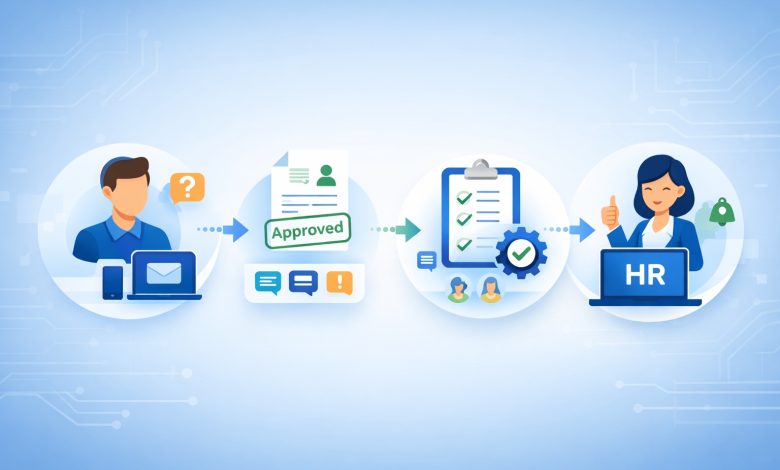
The framework consists of five building blocks: New Hire Signal Intake, Profile Construction, Simulated AI Task Determination, Cross‑Department Orchestration, and Progress Monitoring. Together, they promote scalable onboarding processes and provide clarity for all stakeholders.
4. New Hire Signal Intake
The onboarding lifecycle begins with an intake signal triggered by hiring events. Key data—such as job role, department, employment type, start date, and location—forms the basis for downstream automation. Proper intake normalization improves decision accuracy and reduces follow‑up requests.
5. Profile Construction
Constructing a standardized employee profile enables onboarding logic to adapt automatically to the individual’s role and needs. Profile fields map to provisioning rules, training requirements, workspace allocation, and compliance tasks.
6. Simulated AI Task Determination
Simulated AI logic evaluates the employee profile and determines which tasks must be created. Although not powered by machine learning, this logic reflects the decision pathways that AI systems would eventually perform. Task generation rules may incorporate job role, system access needs, equipment requirements, and mandatory training obligations.
7. Cross‑Department Orchestration
After determining required tasks, workflow automation creates and assigns them to responsible teams. Steps may include hardware provisioning, account creation, workspace preparation, orientation scheduling, and policy acknowledgments. Automated dependencies ensure that tasks follow the correct order and escalate when delays occur.
8. Progress Tracking and Monitoring
HR teams and managers benefit from dashboards, notifications, and workflow updates that track onboarding readiness. Automation prevents tasks from being missed and improves visibility into work distribution, bottlenecks, and completion trends.
9. Benefits of AI‑Augmented Onboarding Orchestration
- Standardized and predictable onboarding experiences
• Reduced administrative effort for HR and operational teams
• Faster day‑one readiness through efficient provisioning
• Improved compliance through automated enforcement of required steps
• Greater transparency and accountability across departments
10. Responsible Automation
Organizations must apply responsible automation principles to maintain fairness and transparency. Rules should be reviewed routinely, bias must be minimized, and sensitive decisions require human oversight. Responsible automation ensures onboarding remains equitable for all employee groups.
11. Conclusion
AI‑Augmented Employee Onboarding Orchestration delivers a scalable, structured, and consistent method for modernizing HR processes. By simulating AI‑driven decisioning through automation, organizations reduce delays, eliminate coordination gaps, and create a positive onboarding experience aligned with workforce expectations.