The software industry is captivated by AI code generation. Developers can now produce functions, unit tests, SQL queries, and scaffolding in seconds. Yet in enterprise environments, writing code accounts for less than a third of the developer lifecycle. The true sink of engineering productivity—and the primary catalyst for outages—is the cognitive overhead of discovering, understanding, and safely integrating distributed services before writing a single line of code.
Modern enterprises operate thousands of application programming interfaces (APIs) across fragmented business domains, legacy systems, cloud microservices, and asynchronous event streams. In these architectures, developers face a compounding context deficit: keyword-based search fails to capture business intent, API documentation diverges silently from runtime behavior, and generated integration code frequently breaks distributed systems invariants like idempotency and distributed tracing.
AI-assisted developer platforms offer a compelling solution to compress this discovery and integration tax. However, the winning model is not unconstrained code generation. It is an assisted context architecture—using AI to build a living, self-healing semantic reasoning layer across formal machine-readable contracts and telemetry, while keeping architectural decisions firmly in human hands.
The Developer Productivity Gap: APIs Multiply Faster Than Context
APIs have become the connective tissue of modern software. According to Postman’s State of the API Report, surveying over 5,600 developers and leaders, 74% of organizations identify as API-first. Furthermore, developers consistently rank clear, accurate documentation higher than raw performance when evaluating APIs.
Yet developer velocity continues to stall. Empirical studies from Microsoft Research, GitHub, and academic software engineering bodies reveal that developers spend upwards of 65% of their working hours searching for information, comprehending unfamiliar systems, and tracing dependencies, compared to just 25% to 30% actively authoring code.
This structural friction concentrates in three areas:
- The Discovery Maze: Developers know the business capability they need—such as “process a multi-currency refund with automatic tax recalculation”—but cannot identify which service owns it. Traditional portals index static names and arbitrary tags. Keyword searches return dozens of similar endpoints without clarifying domain ownership, operational maturity, or active consumer traffic.
- The Documentation Drift: Code changes constantly, but documentation remains a manual, point-in-time artifact. As teams patch endpoints, add optional fields, or update security scopes, documentation drifts from reality. Stale documentation misleads engineers into integrating against phantom contracts, creating regressions that only surface in production.
- The Integration Tax: Discovering an endpoint is only the first step. Building a production-grade integration requires deciphering schema nuances, error hierarchies, rate-limiting policies, token lifecycles, and downstream failure modes. Plausible code samples that ignore these constraints accelerate flawed implementations.
The enterprise does not have an API shortage; it has an architectural context shortage.
The 5-Pillar Context Architecture
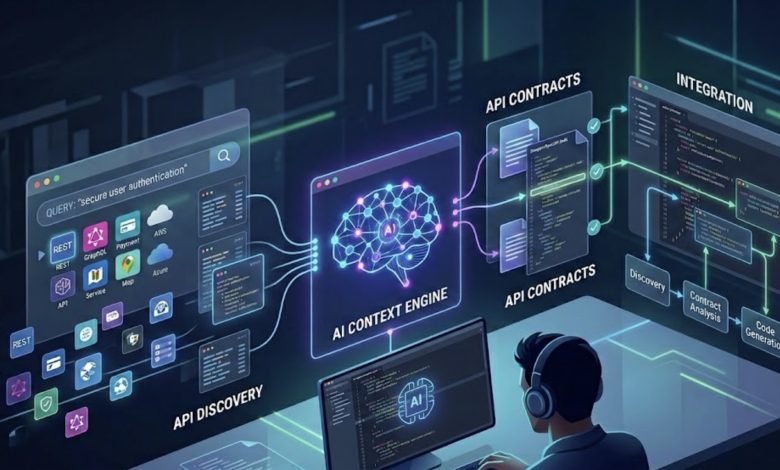
To solve the context crisis, developer platforms must evolve beyond static catalogs and generic chat interfaces. They require an active context architecture structured around five core capabilities:
+————————————————————————-+
| ENTERPRISE CONTEXT ENGINE ARCHITECTURE |
+————————————————————————-+
| [ Developer Query: Natural Language Intent / Integration Task ] |
+————————————————————————-+
|
v
+————————————————————————-+
| 1. THE SEMANTIC CARTOGRAPHER (Intent Discovery via Graph-RAG) |
| – Domain Boundaries (DDD) – Dependency Meshes – Service SLOs |
+————————————————————————-+
|
v
+————————————————————————-+
| 2. THE SCHEMA INTERPRETER (AST Contract Parsing & Semantic Diffing) |
| – OpenAPI 3.1 / Protobuf – GraphQL SDL – Breaking Change Diffs|
+————————————————————————-+
|
v
+————————————————————————-+
| 3. THE DRIFT SENTINEL (Continuous Telemetry Reconciliation) |
| – CI/CD Specifications – Gateway Access Logs – OpenTelemetry Traces|
+————————————————————————-+
|
v
+————————————————————————-+
| 4. RESILIENT INTEGRATION ENGINE (Distributed Systems Grounding) |
| – Idempotency Protocols – Jittered Retries – W3C Trace Context |
+————————————————————————-+
|
v
+————————————————————————-+
| 5. THE ARCHITECTURE GUARDIAN (NIST AI RMF / Human Governance Boundary) |
| – Scope Enforcement – Provenance Tracing – Human Decision Gates |
+————————————————————————-+
1. The Semantic Cartographer: Intent-Based Discovery via Graph-RAG
Traditional portals rely on exact lexical matching on endpoint paths. The Semantic Cartographer combines dense vector representations of API specifications with an Enterprise Service Knowledge Graph (Graph-RAG).
Instead of matching strings, the platform maps developer intent against relational system topology: domain boundaries (Domain-Driven Design bounded contexts), service tiers, upstream and downstream dependencies, and real-time consumer traffic volume.
When an engineer searches for “verify customer credit eligibility,” the system evaluates semantic intent, deprecation status, operational health (p99 latency and availability SLOs), and consumer adoption patterns. Crucially, the platform returns a ranked set of options with visible provenance: owning team, schema version, authorization model, and verified production consumers.
2. The Contract Interpreter: AST Parsing and Semantic Diffing
Machine-readable contracts—such as OpenAPI 3.1, Protocol Buffers (Proto3), GraphQL SDL, and AsyncAPI—provide syntactic precision. However, operational subtleties are often obscured within deeply nested schemas and polymorphic union types.
The Schema Interpreter analyzes the Abstract Syntax Tree (AST) of the specification to translate dense contracts into plain-language explanations. It clarifies field optionality, conditional validation rules, and error payload structures.
Furthermore, it performs automated semantic diffing across versions to distinguish safe additions from subtle breaking changes:
- Compatible changes: Newly added optional parameters or expanded nullable properties.
- Breaking changes: Narrowed enum definitions, modified default values, changed error structures, or tightened rate-limit windows.
By intersecting schema changes with the service dependency graph, the platform alerts downstream consumers before breaking changes reach production.
3. The Drift Sentinel: Telemetry-Grounded Documentation
Documentation must be generated from the system itself, not reconstructed from human memory. Robust developer platforms derive reference material directly from code-adjacent artifacts: executable contract tests (e.g., Pact), typed schemas, and deployment configurations.
The Drift Sentinel operates a continuous dual-loop verification process:
- Static Verification: Continuously scans repositories to flag documentation that references deleted fields, deprecated methods, or stale parameters.
- Runtime Reconciliation: Compares published specifications against live API gateway access logs and OpenTelemetry distributed traces.
When runtime telemetry reveals undeclared HTTP 429 status codes, undocumented response headers, or unexpected payload structures in production transit, the Sentinel flags the discrepancy, drafts an updated schema patch, and routes it to the service owner for validation.
4. Resilient Integration Scaffolding: Distributed Systems Primitives
Generative AI models often produce “happy path” integration code that overlooks distributed systems realities. In production, naive client calls can trigger cascading service failures or duplicate transactions.
An AI-assisted platform grounds code scaffolding in hardened architectural patterns:
- Idempotency Guarantees: Injects deterministic idempotency keys (Idempotency-Key headers) for all mutating operations, preventing duplicate charges or state updates during network retries.
- Fault-Tolerant Retries: Configures exponential backoff with decorrelated jitter to mitigate thundering herd problems against recovering dependencies.
- Distributed Observability: Automatically injects W3C Trace Context (traceparent, tracestate) and OpenTelemetry headers to maintain distributed tracing across service boundaries.
- Authentication Lifecycle: Implements standardized token interceptors for token caching, pre-expiry renewal, and secure credential handling.
5. The Architecture Guardian: Bounded Autonomy and Governance
AI can accelerate discovery, explain contracts, and scaffold integrations, but it cannot determine whether an organization should introduce a new dependency.
Architectural decisions require human evaluation of domain boundaries, data residency, operational cost, and long-term maintainability. In alignment with the NIST AI Risk Management Framework (AI RMF 1.0) and the EU AI Act, developer platforms must enforce clear governance boundaries:
- Zero Ungoverned Autonomy: AI systems must not autonomously alter routing rules, grant security scopes, bypass compliance controls (PCI-DSS, HIPAA, SOC2), or deprecate services.
- Explainable Provenance: Every recommendation, summary, or code snippet must link directly to an immutable source of truth (a version-controlled Git commit or verified schema registry entry).
- Decision Support: AI can draft Architecture Decision Records (ADRs) comparing options, but senior engineering leadership remains accountable for final approval.
Enterprise Case Studies
FinTech: Rationalizing 1,400+ Payment Microservices
A global payments organization operating across 18 regional jurisdictions had accumulated over 1,400 internal microservices. Engineers spent an average of 3.5 weeks identifying correct payment-processing endpoints, frequently building duplicate services.
By deploying an internal Graph-RAG discovery engine across OpenAPI specifications and gateway telemetry, the organization reduced initial endpoint discovery and sandbox integration time from 18 business days to under 4 hours, while eliminating an estimated 85% of redundant service proposals.
Healthcare: Navigating Complex FHIR Migrations
A healthcare platform migrating 80+ clinical services from legacy formats to HL7 FHIR (Fast Healthcare Interoperability Resources) utilized automated AST schema interpretation and runtime drift monitoring.
The system identified 42 critical schema discrepancies—including unvalidated null values emitted for mandatory FHIR fields—prior to production release, cutting developer onboarding time onto the complex clinical specification by 60%.
The 90-Day Execution Playbook
For engineering leadership, rolling out an AI-assisted context engine should follow a disciplined quarterly roadmap:
- Days 0–30: Establish the Source of Truth: Inventory active APIs, enforce machine-readable specifications (OpenAPI, Protobuf), define domain ownership, and integrate automated schema linting into CI/CD pipelines. Never place AI over ungoverned metadata.
- Days 31–60: Deploy Assisted Discovery & Scaffolding: Index verified schemas into a Graph-RAG engine. Introduce natural-language intent search and schema explanation in developer portals and IDEs with mandatory source citation. Deploy grounded integration scaffolding with idempotency and distributed tracing templates.
- Days 61–90: Activate Telemetry Reconciliation & Measure Impact: Connect gateway telemetry to the Drift Sentinel to catch runtime contract deviations. Track core Developer Experience (DevEx) metrics, including Time-to-First-Hello-World (TTFHW) and API reuse rates, while establishing human review gates with the Architectural Review Board.
Conclusion: From Static Catalogs to Living Knowledge Systems
Enterprise developer platforms are evolving from static directories into active knowledge engines. They will interpret intent, connect business capabilities to services, explain complex contracts, synthesize resilient integrations, and detect documentation drift before it causes production incidents.
Yet the architectural boundary remains clear: AI provides the context; human engineers provide the architecture.
By automating the cognitive toil of system discovery and contract forensics, organizations free their engineers to focus on high-leverage architectural design, domain modeling, and building resilient software.