The billable hour has survived decades of criticism. Generative AI may be the force that finally breaks it – but the disruption will come from inside clients, not outside counsel.
History is replete with moments when technological innovation transforms society and work. Artificial intelligence is one such moment. It is not just making the delivery of legal services more efficient; it is fundamentally reshaping what legal work is, how it is delivered, and who is best placed to deliver it.1
I have spent 30 years as a corporate lawyer, working across major law firms and multinational corporations, including as General Counsel of two large public companies. In that time, I have watched the legal profession evolve – from the adoption of email and document management systems to the rise of sophisticated legal operations teams and the growth of Alternative Legal Service Providers (ALSPs).2 Yet nothing in those decades compares with the scale, speed, and impact of the transformation now underway.
The central argument is this: AI is reshaping competitive dynamics in the legal industry, and clients will be the primary force driving that change. AI is what economists call a “general purpose technology” – a breakthrough with broad applications that sparks complementary innovations across every sector of the economy.3 As this transformation unfolds inside companies, legal departments will evolve in parallel. Transformed clients will expect law firms to adapt in turn, delivering greater efficiency, innovation, and value, while integrating more closely with the client’s own operations.4
Negative inflection points are difficult for dominant industry players to spot.5 Many law firms are currently enjoying record profits, underpinned by long-standing competitive advantages and high barriers to entry. But those very same advantages can mask early signs of disruption and make it difficult to adapt or innovate.
The Model That Would Not Die
For well over a century, the billable hour has been the backbone of law firm pricing. Clients pay for time. Lawyers track their hours in time-based increments, with partners profiting from the spread between what associates cost and what they bill. In 2024, profits per equity partner reached $9.25 million at Kirkland & Ellis and revenue across the top 100 US law firms grew at an average of 13.3%.6 By any conventional measure, the model is thriving.
And yet the warning signs are everywhere. A staggering 100% of General Counsel report regretting engaging law firms for cost, quality, or other reasons. Eighty-nine percent say that law firms no longer offer a completely effective solution for their needs. Ninety-six percent reported legal budget cuts averaging 11%.7 These are not the data points of a healthy client relationship. They are the early tremors of structural disruption – the kind that arrives, as Hemingway wrote of bankruptcy, “gradually and then suddenly.”
Why AI Is Different This Time
Law firms have heard the predictions before. As of 2025, at least 80% of legal matters still use hourly billing.8 One survey found that 80% of what were described as alternative fee arrangements were, in actuality, simply hourly rate discounts.9 But AI represents something structurally different. Digital processes allow businesses to scale in ways that favour first-movers and create winner-takes-most dynamics. In a real sense, every business is now a technology business.10 The rise of “agentic AI” (autonomous, goal-driven systems that extend the capabilities of generative AI) and the continued exponential gains driven by Moore’s Law11 will accelerate these dynamics still further.
Previous tools made lawyers faster at tasks they were already doing. AI systems are beginning to do the tasks themselves. In 2025, Goldman Sachs CEO David Solomon noted that AI can now draft 95% of an IPO prospectus within minutes – a task that previously occupied teams of bankers, lawyers, and accountants for many weeks. “The last 5% now matters,” he observed, “because the rest is now a commodity.”12 This is a category shift that is arriving at precisely the moment that clients themselves are being remade.
The Structural Trap
Understanding why the billable hour persists requires understanding the logic that sustains it. The traditional model rests on a leverage-dependent pyramid: large numbers of salaried professionals generating billable hours to sustain a smaller group of owners who collect the profits. Efficiency is not rewarded. Time saved is revenue foregone. A firm that deploys AI to dramatically reduce the time required to complete a matter has, under the hourly billing model’s logic, simultaneously reduced its revenue from that matter.
The partnership model compounds this problem: short-term horizons and distributions today take precedence over investment in tomorrow’s transformation. Amazon became profitable only in its tenth year, having accumulated $3 billion in cumulative losses along the way – a trajectory that would be structurally impossible under a traditional law firm partnership model, where partners expect annual distributions rather than deferred payoffs.22
The result is chronic underinvestment in the very technologies that could position firms to compete in an AI-driven market.
The Innovator’s Dilemma, Revisited
Clayton Christensen’s framework of disruptive innovation has rarely been more applicable. Incumbents tend to invest in sustaining innovations that incrementally improve their existing offerings, while dismissing disruptive entrants who initially serve lower-margin segments.13 Over time, those entrants improve, move upmarket, and reset client expectations.
Nokia’s trajectory is instructive. In 2007, it held 48.7% of the global smartphone market and a market capitalisation of around $120 billion.14 Forbes featured it on its cover: “Nokia: One Billion Customers – Can Anyone Catch the Cell Phone King?”15 By 2012, its market capitalisation had collapsed to $8 billion.16 Nokia did not fail because it made poor handsets. It failed because it was so good at making handsets that it could not see, let alone embrace, the radically different value proposition that the iPhone represented.
The danger for law firms is not that AI will make them irrelevant overnight. It is that they will integrate AI into their existing model, making it incrementally more efficient, while failing to recognise that the model itself is becoming obsolete. This is the corporate “immune system”: the organisational reflex that deflects disruptive innovation, blending it into the legacy model and neutralising its transformational potential. Kodak built the first digital camera and invested billions in digital technologies, yet repurposed those investments to reinforce photo printing rather than reimagine its business.17 By 2012, it filed for bankruptcy.18
What Clients Actually Want
The ‘Jobs to be Done’ framework, also developed by Christensen, offers a useful corrective.19 Corporate clients do not hire lawyers to provide hours of work. They hire them to achieve outcomes: a contract negotiated, a risk managed, a transaction completed. As AI enables faster, cheaper, and more integrated delivery of those outcomes, the question every law firm must honestly answer is: which jobs are we most vulnerable to being fired from?
Highly complex, high-stakes matters will continue to command premium pricing. But these represent the tip of a much larger iceberg. The bulk of the work, including anything that can be routinised or standardised, is where AI’s impact will be fastest and most complete. Firms that understand this distinction can redesign their delivery models around outcomes, not inputs. Those that conflate the two risk offering an outmoded solution to a problem that has already been solved differently.
The Moment That Changes Everything
Leading indicators are already flashing. In a recent survey, 45% of in-house lawyers rated leading professional services firms as offering “poor” or “terrible” value for money. Only 2% rated value as “excellent.”20 These are the early warning signs of an inflection point.
Columbia Business School professor Rita McGrath describes inflection points as the moments when a mismatch crystallises between what once made an organisation successful and the demands of the present. Customers, as she observes, “will only remain hostages for so long. Eventually the model that imprisons them is bound to collapse.”21
The billable hour has imprisoned clients for a long time. It has produced misaligned incentives, rewarding time spent over value delivered, seniority over competence, and volume over insight. Its persistence has been a function of its structural embeddedness in technology systems, reward structures, cultural norms, and partnership economics.
AI is dissolving that embeddedness, one use case at a time. As agentic AI becomes more prevalent across legal departments, these dynamics will shift at an accelerating rate. The result will be the emergence of strong demands for a genuinely new pricing paradigm built around outcomes, integration, and value, rather than time. The question for every law firm leader is whether their firm will lead through this transition or be led by it.
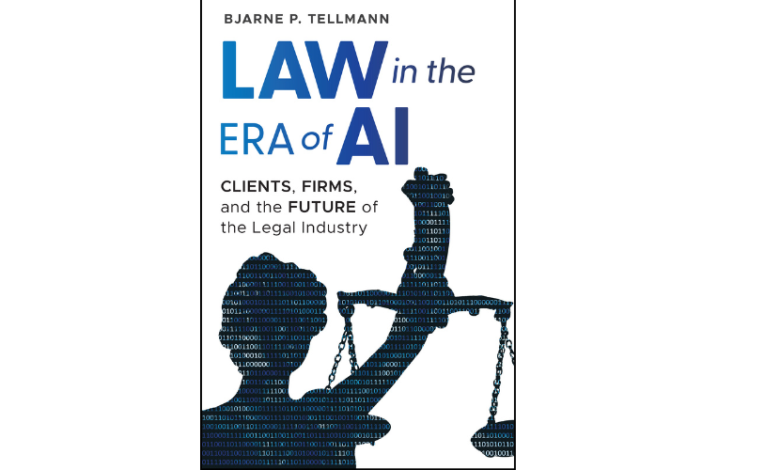
This article draws on Bjarne P. Tellmann, Law in the Era of AI: Clients, Firms, and the Future of the Legal Industry (Wiley, 2026), which examines how artificial intelligence is transforming corporate legal departments and the broader legal services ecosystem.

Bjarne P. Tellmann is CEO of FjordStream Advisors GmbH and a Senior Visiting Fellow at the London School of Economics. He previously served as Founding General Counsel and Executive Committee member at Haleon plc (FTSE 20), and as Chief Legal Officer and General Counsel at Pearson plc (FTSE 100). He is the author of Building an Outstanding Legal Team (Globe Law and Business, 2017) and he speaks and teaches regularly at numerous academic institutions, including Harvard and the London School of Economics, as well as at leading global conferences and executive leadership forums. His honours include General Counsel of the Year at the British Legal Awards, the Burton Award for Legends in the Law, and inclusion in the Chambers GC Influencers Global 100.
Notes
1 For a definition of AI and a discussion of it and related concepts, see Chapter 5 of Bjarne P. Tellmann, Law in the Era of AI: Clients, Firms, and the Future of the Legal Industry (Wiley, 2026).
2 Alternative Legal Service Providers are organisations that provide legal and legal-adjacent services outside the traditional law firm model by leveraging models, processes, or tools that represent a significantly different approach to creating or providing legal services than what the legal profession traditionally has employed. See Jordan Furlong, “An Incomplete Inventory of NewLaw,” Law21 (blog), May 13, 2014, https://www.law21.ca/2014/05/incomplete-inventory-newlaw/. ALSPs often provide these services more effectively and at lower cost than law firms or in-house teams can. Services offered by ALSPs typically include flexible staffing, contract management, document review, e-discovery, regulatory compliance, and legal operations support, as well as a growing range of consultancy and advisory, software, and even legal advisory services.
3 General-purpose technologies can be defined as ‘a single generic technology, recognizable as such over its whole lifetime, that initially has much scope for improvement and eventually comes to be widely used, to have many uses, and to have many spillover effects’. Richard G. Lipsey, Clifford T. Bekar, and Kenneth I. Carlaw, “The Consequences of Changes in GPTs,” in General Purpose Technologies and Economic Growth, ed. Elhanan Helpman (Cambridge, MA: MIT Press, 1998), 193–218, cited in Nicholas Crafts, “Artificial Intelligence as a General-Purpose Technology: An Historical Perspective,” Oxford Review of Economic Policy 37, no. 3 (2021): 521. For a discussion of how AI is transforming how companies are structured, how they operate, and how they create value, see Marco Iansiti and Karim R. Lakhani, Competing in the Age of AI: Strategy and Leadership When Algorithms and Networks Run the World (Boston: Harvard Business Review Press, 2020). See also McKinsey & Company, “The State of AI: How Organizations Are Rewiring to Capture Value,” March 12, 2025, https://www.mckinsey.com/capabilities/quantumblack/our-insights/the-state-of-ai; and Sumeet Gupta and Carl Jones, “Rethinking Business Models With AI,” FTI Consulting, January 8, 2025, https://www.fticonsulting.com/insights/articles/rethinking-business-models-with-ai.
4 See LexisNexis, “Majority of Corporate Legal Departments Anticipate Gen AI to Slash Expenses,” LexisNexis Insights, March 11, 2024, https://www.lexisnexis.com/community/insights/legal/b/thought-leadership/posts/majority-of-corporate-legal-departments-anticipate-gen-ai-to-slash-expenses-76-in-house-counsel-agree. See also Thomson Reuters, “Pricing AI-Driven Legal Services: Lead or Follow?” Thomson Reuters, January 30, 2024, https://www.thomsonreuters.com/en-us/posts/legal/pricing-ai-driven-legal-services-lead-or-follow/.
5 For a discussion of this, see Rita Gunther McGrath, Seeing Around Corners: How to Spot Inflection Points in Business Before They Happen (Boston: Houghton Mifflin Harcourt, 2019).
6 Debra Cassens Weiss, “This Law Firm Is Ranked No. 1 After Posting $8.8 B in Gross Revenue,” ABA Journal, April 16, 2025, https://www.abajournal.com/news/article/this-law-firm-is-ranked-no-1-after-posting-88b-in-gross-revenue-which-other-firms-are-category-leaders; Marcus Belanger, “Law Firm Rates in 2024: The Bull, Bear & Base Case for Rates and What It Means for Realization,” Thomson Reuters, October 17, 2024, https://www.thomsonreuters.com/en-us/posts/legal/law-firm-rates-bull-bear-base-case.
7 Axiom Law, GCs’ 2024 Outlook on Legal Budgets, Talent, and Innovation (Axiom Law, 2024), https://www.axiomlaw.com/resources/articles/gc-survey-report.
8 Robert J. Couture, “The Impact of Artificial Intelligence on Law Firms’ Business Models,” Harvard Law School Center on the Legal Profession, February 24, 2025, https://clp.law.harvard.edu/knowledge-hub/insights/the-impact-of-artificial-intelligence-on-law-law-firms-business-models/.
9 Steven J. Harper, The Lawyer Bubble: A Profession in Crisis (New York: Basic Books, 2013), 171.
10 Marco Iansiti and Karim R. Lakhani, Competing in the Age of AI: Strategy and Leadership When Algorithms and Networks Run the World (Boston: Harvard Business Review Press, 2020), 17.
11 Gordon E. Moore, “Cramming More Components onto Integrated Circuits,” Electronics, April 19, 1965, 114–17.
12 “Goldman Sachs Chief David Solomon Questions Start-Ups’ AI Valuations,” Financial Times, January 16, 2025, https://www.ft.com/content/4f20fbb9-a10f-4a08-9a13-efa1b55dd38a.
13 Clayton M. Christensen, The Innovator’s Dilemma: When New Technologies Cause Great Firms to Fail (Boston, MA: Harvard Business School Press, 1997).
14 Nick Bilton, “The End of an Era in Mobile,” Bits (New York Times blog), September 3, 2013, https://archive.nytimes.com/bits.blogs.nytimes.com/2013/09/03/the-end-of-an-era-in-mobile.
15 Barry Ritholtz, “Can Anyone Catch Nokia?,” The Big Picture (blog), October 26, 2022, https://ritholtz.com/2022/10/can-anyone-catch-nokia/.
16 Bilton, “The End of an Era in Mobile.”
17 Scott D. Anthony, “Kodak’s Downfall Wasn’t About Technology,” Harvard Business Review, July 15, 2016, https://hbr.org/2016/07/kodaks-downfall-wasnt-about-technology.
18 David Gann, “Kodak Invented the Digital Camera — Then Killed It. Why Innovation Often Fails,” World Economic Forum, June 23, 2016, https://www.weforum.org/stories/2016/06/leading-innovation-through-the-chicanes/.
19 Clayton Christensen Institute, “Jobs to Be Done Theory,” accessed April 30, 2026, https://www.christenseninstitute.org/theory/jobs-to-be-done/.
20 Katherine Bryant, “State of In-House 2025: Are Law Firms Delivering?,” Juro Blog, March 31, 2025, https://www.juro.com/general-counsel/state-of-in-house-2025.
21 Rita Gunther McGrath, Seeing Around Corners: How to Spot Inflection Points in Business Before They Happen (Boston: Houghton Mifflin Harcourt, 2019), 134.
22 “Opinion: Amazon Didn’t Make Money for a Decade, But Those Losses Weren’t Even Close to What Startup Companies and Their Investors Face Now”, MarketWatch, https://www.marketwatch.com/story/inside-svbs-bankruptcy-startup-company-losses-have-threatened-the-financial-system-for-years-773240f6, accessed April 30, 2026.