

How AI-Powered Simulations Are Changing the Way Future Technologies Are Tested
A self-driving car cannot encounter every dangerous road situation during testing. A spacecraft cannot be launched repeatedly to examine every possible failure. Yet engineers must prepare these technologies for conditions they may never have experienced.
AI-powered simulations are changing this process. By combining virtual environments, computational models, and machine learning, engineers can evaluate designs, reproduce failures, and test complex operating conditions before physical deployment.
A Shift Toward Virtual Testing
Traditional technology testing relies on physical prototypes, laboratory experiments, and controlled environments. Although these methods provide reliable evidence, testing every possible operating condition can be costly or impractical.
For instance, autonomous vehicle developers cannot safely recreate thousands of dangerous traffic situations on public roads. Similarly, aircraft manufacturers cannot physically test every combination of mechanical failure and environmental stress.
AI-assisted simulations allow engineers to generate additional scenarios, modify operating conditions, and examine system responses without repeatedly building physical prototypes.
| Testing method | Main advantage | Limitation |
| Physical testing | Measures actual hardware performance | High costs and limited repeatability |
| Conventional simulation | Tests predefined virtual conditions | Depends on manually configured models |
| AI-assisted simulation | Expands scenario coverage and analysis | Requires accurate data and validation |
The biggest change is how testing resources are allocated. Simulations help identify critical conditions, while physical experiments verify whether predicted behavior matches reality.
Technologies Behind Modern Simulations
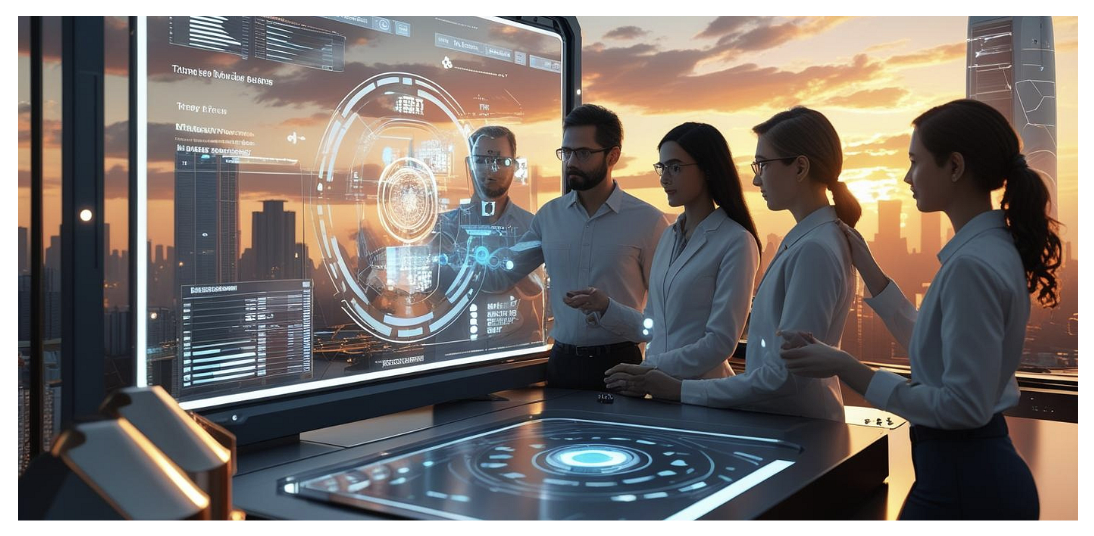
AI-powered simulations combine several technologies, each responsible for a different part of the testing process.
- Digital twins: Virtual representations of equipment, factories, or infrastructure. Some incorporate live sensor readings to monitor changing operating conditions and compare predicted performance with actual behavior.
- Physics-based engines: Mathematical systems that calculate motion, pressure, temperature, collisions, and material behavior according to defined physical principles.
- Machine learning models: Algorithms that identify patterns, approximate complex calculations, and detect unusual results across large simulation datasets.
- Generative AI: Systems capable of creating additional virtual environments, objects, and operating scenarios that may not appear in recorded data.
Consider an industrial robot. A physics engine calculates its movements, simulated cameras generate visual observations, and an AI control system determines how it responds to surrounding objects.
However, realistic-looking simulations are not necessarily physically accurate. Engineers must verify that virtual interactions reflect the forces, materials, and sensor characteristics of actual equipment.
Faster Prototyping and Product Development
Physical product development often involves manufacturing a prototype, testing its performance, identifying problems, and producing another version. AI-assisted simulations allow engineers to evaluate multiple design variations before manufacturing begins.
Electronics manufacturers can examine heat distribution, airflow, and component placement. Automotive engineers can assess structural stress, while battery developers can investigate cooling efficiency and enclosure design.
For example, changing the arrangement of battery cells may improve heat distribution but increase weight or manufacturing complexity. Simulations can compare these trade-offs before engineers select designs for physical testing.
BMW provides a practical industrial example. Its digital factory initiative, developed using NVIDIA Omniverse, includes virtual production environments covering more than 1 million square meters.
These environments support factory layout planning, production coordination, and robotics evaluation.
The advantage extends beyond prototype costs. Virtual models allow engineering teams to identify design conflicts before purchasing equipment, changing production lines, or modifying physical facilities.
Autonomous Systems and Transportation
Autonomous vehicles rely on cameras, lidar, navigation systems, and decision-making software operating together. Testing these systems requires more than checking whether a vehicle follows a route. Engineers must examine how it responds when environmental conditions change or surrounding objects behave unexpectedly.
AI-powered simulations help recreate situations including:
- Pedestrians appearing from behind parked vehicles, testing how perception systems respond to partially obstructed objects.
- Heavy rain, glare, and damaged road markings that affect camera visibility and vehicle positioning.
- Emergency vehicles approaching intersections, requiring changes in navigation and traffic decisions.
- Conflicting sensor readings that challenge the reliability of automated driving decisions.
In February 2026, Waymo introduced its World Model, designed to generate realistic driving environments using camera and lidar representations. The company also reported nearly 200 million fully autonomous miles of real-world driving, alongside extensive virtual testing.
These simulations help developers investigate rare events without deliberately recreating dangerous conditions on public roads.
Similar methods support warehouse robots, delivery machines, and autonomous drones. However, simulation performance must still be compared with real deployment data because artificial environments cannot perfectly represent every physical interaction.
Aerospace and Extreme Environment Testing
Aerospace systems operate under conditions that are expensive or impossible to reproduce completely during ground testing.
Spacecraft must withstand extreme temperatures, radiation, vibration, communication delays, and unexpected equipment behavior. A failure involving navigation software or onboard sensors can affect an entire mission.
NASA uses simulation environments to evaluate spacecraft software and operational responses before deployment. Its JSTAR digital-twin work supports software testing through simulated hardware, sensors, and mission conditions.
Engineers can use these environments to examine:
- Software faults: Introducing controlled errors to evaluate recovery procedures and system responses.
- Sensor failures: Testing navigation behavior when measurements become inaccurate or unavailable.
- Mission variations: Repeating operating sequences under different technical and environmental conditions.
Simulation also allows software integration tests to begin before all physical spacecraft components become available.
Physical testing remains necessary to verify material strength, thermal behavior, and hardware reliability. Virtual testing provides additional opportunities to identify weaknesses before costly missions begin.
Safety Testing and Real-World Accountability
Simulations can reveal potential failures involving mechanical components, software decisions, sensors, and environmental conditions before equipment reaches consumers.
However, these tests operate within defined assumptions. Real incidents may involve manufacturing defects, unexpected user behavior, maintenance problems, or combinations of conditions that were not represented in the simulation.
Technical Evidence After System Failures
When advanced equipment or automated systems malfunction, investigators often compare expected behavior with actual operating records. Simulation results, software logs, sensor measurements, and physical evidence can help establish whether a failure originated in the design, implementation, or operating environment.
This technical documentation can become particularly important when incidents result in injuries or property damage. In a product-related injury investigation, for example, a Louisville personal injury attorney may need to examine engineering reports and equipment records to understand whether a known safety risk contributed to the incident. Such assessments depend on the available evidence rather than simulation results alone.
For engineers, this reinforces the importance of preserving testing parameters, model versions, validation reports, and recorded failures. Traceable simulation results make it easier to investigate unexpected behavior and improve subsequent product designs.
Healthcare and Medical Technology
Medical simulations must account for substantial differences between patients, including anatomy, tissue characteristics, and physiological conditions. Computational models help researchers evaluate how medical equipment behaves under these variations.
Cardiovascular device developers use fluid dynamics models to study blood flow and pressure changes. Orthopedic engineers simulate how forces move through implants and surrounding bone structures.
AI can assist by estimating patient-specific parameters, accelerating repeated calculations, and identifying patterns across simulation results. However, medical simulations require particularly careful validation. An inaccurate model may produce misleading predictions about device performance or patient safety.
The US Food and Drug Administration’s 2023 guidance on computational modeling and simulation establishes a risk-informed framework for evaluating the credibility of physics-based and mechanistic models used in medical device submissions.
The level of evidence required depends on how the model influences a regulatory decision. Simulation cannot automatically replace laboratory experiments, clinical evidence, or other necessary evaluations.
Smart Cities and Energy Infrastructure
AI-powered simulations also support technologies that operate across interconnected infrastructure systems. Unlike individual devices, these systems involve dependencies where changing one component can influence an entire network.
Three applications illustrate this complexity:
- Traffic management: Virtual models can examine signal timing, vehicle movement, congestion patterns, and emergency vehicle routing before changes are introduced on public roads.
- Electricity grids: Simulations help engineers evaluate changing demand, renewable energy fluctuations, equipment outages, and network stability under different operating conditions.
- Urban infrastructure: Digital twins can support assessments of building energy consumption, water distribution, ventilation, and environmental stress.
These systems require broader evaluation than simply optimizing individual components.
A traffic signal adjustment that reduces congestion at one intersection may increase delays elsewhere. Similarly, an energy-saving adjustment within one facility may affect the efficiency of a connected network.
Simulations help examine these interactions before operational decisions are implemented.
Synthetic Data and Unusual Scenarios
Some failures occur too rarely for engineers to collect sufficient real-world examples. A manufacturing defect might appear only after millions of production cycles. An autonomous vehicle may encounter an unusual combination of weather, road conditions, and human behavior that is missing from its training data.
Synthetic data helps address this shortage by generating artificial observations under controlled conditions. Engineers can create virtual sensor readings, visual environments, equipment failures, and environmental variations to examine how systems respond.
The main benefit is controlled experimentation. Individual variables can be adjusted to identify which conditions cause performance problems.
However, generated data can contain unrealistic patterns or omit important physical details. Systems trained mainly on synthetic examples may perform differently in actual environments. Independent testing with representative real-world data remains necessary to establish reliability.
Reliability, Accuracy and Testing Gaps
AI-assisted simulations are useful only when engineers understand how closely their results represent actual system behavior.
Several technical limitations can influence reliability.
| Challenge | Potential problem | Engineering response |
| Inaccurate physics | Incorrect failure predictions | Compare with physical experiments |
| Incomplete datasets | Important conditions remain untested | Expand representative test data |
| Sensor modeling errors | Unrealistic perception results | Calibrate using real measurements |
| Model uncertainty | Overconfidence in predictions | Quantify prediction uncertainty |
| Poor documentation | Difficult result reproduction | Maintain version-controlled records |
The National Institute of Standards and Technology identifies verification, validation, and uncertainty quantification as important elements of digital-twin credibility.
- Verification establishes whether the computational implementation correctly represents its specified model.
- Validation determines whether the model adequately represents the real system for its intended purpose.
- Uncertainty quantification examines how uncertain inputs and assumptions affect predictions.
These distinctions matter because a simulation may accurately predict normal operating conditions but become unreliable under extreme stress or unfamiliar environments.
Computational cost is another constraint. Detailed simulations involving fluid dynamics, complex sensor systems, or large infrastructure networks can require substantial processing resources.
Engineers must therefore balance model accuracy, computational expense, and the level of evidence needed for each decision.
The Future of Simulation-Driven Engineering
Simulation technologies are moving toward closer integration with real operational data and automated engineering workflows. Generative AI can assist in developing unusual testing scenarios, while machine learning systems can identify configurations that deserve additional examination.
Digital twins may also support ongoing performance evaluation after products enter service.
For example, sensor measurements from deployed equipment can reveal differences between predicted and actual behavior. Engineers can use these observations to recalibrate models, investigate emerging failures, and adjust maintenance strategies.
The main development is a more continuous testing process in which simulation supports design, deployment, monitoring, and subsequent improvements. Physical experiments and independent validation will remain essential, particularly for technologies where inaccurate predictions can create significant safety risks.
Final Verdict
AI-powered simulations are expanding how engineers evaluate technologies before and after deployment. Their applications extend from autonomous vehicles and spacecraft to medical devices, industrial manufacturing, and connected infrastructure.
The greatest value lies in examining conditions that physical testing cannot easily reproduce, identifying weaknesses earlier, and improving engineering decisions through repeatable experiments.
However, simulation results depend on the accuracy of their models, the quality of their data, and independent real-world validation. The future of technology testing will depend on combining these capabilities rather than replacing physical experiments entirely.

More from AIJ Writing Staff
See all AI & Technology
Why Modern Machines Are Becoming More Dependent on Software Updates
 AI & Technology
Cycode Expands UK Presence as New ARR Grows 2.4x Year Over Year

Office Perpetual License vs. Microsoft 365: A Cost Comparison for Small Businesses
 AI Business Strategy
How Recognition Patterns Can Warn You About Flight Risks Early and Encourage Managers to Use New AI HR Tools
Recommended for you
More stories AI & Technology
AI Can Write Software in Minutes. Hud Wants to Make Sure It Doesn’t Break Production
 AI & Technology
Critical Wisdom for the AI Age
 AI & Technology
AI adoption has plateaued, but it’s not a technology problem
 AI & Technology
Best AI Customer Service Software for Ecommerce: Top 12 in 2026
 AI & Technology
Your Underwriting Agent is Ready to Act, Your Risk Architecture Isn’t
 AI & Technology