
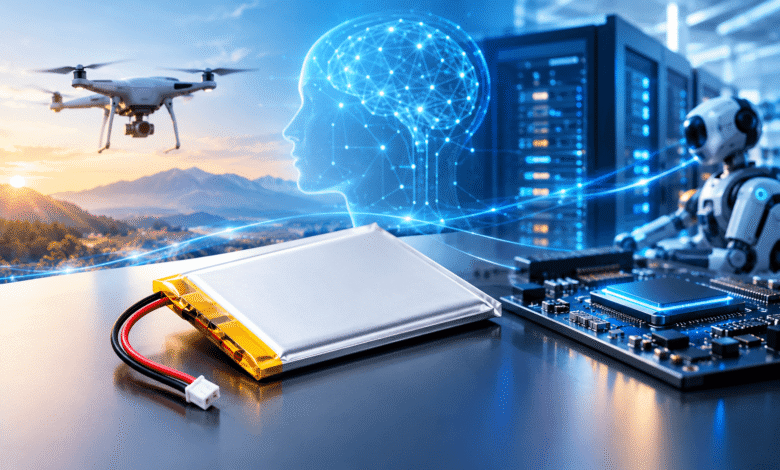
The artificial intelligence revolution is no longer confined to the massive, liquid-cooled server racks of hyperscale data centers. We are currently witnessing a profound architectural shift known as “AI at the Edge.” Neural processing units (NPUs), machine learning algorithms, and computer vision models are being physically integrated into autonomous drones, humanoid robots, wearable biometric monitors, and decentralized IoT networks. However, this migration of intelligence from the cloud to the physical world has exposed a critical hardware bottleneck: the “Energy Gap.”
As an AI hardware architect and energy storage specialist representing the Hanery lithium battery factory, I confront this Energy Gap daily. Edge AI computation requires massive, instantaneous surges of power to execute complex tensor operations and real-time inference. Yet, the physical devices housing these AI models must remain ultra-lightweight, aerodynamically balanced, and ergonomically unobtrusive. You cannot power a swarm of agile, AI-driven inspection drones or a sleek augmented reality (AR) headset with heavy, rigid, legacy power sources.
The intelligence revolution fundamentally demands a power source that delivers uncompromising energy density, rapid discharge capabilities, and absolute geometric adaptability. This is why the lithium polymer battery has emerged as the quintessential enabling technology for decentralized AI.
In this comprehensive technical guide, we will explore the intersection of artificial intelligence and advanced electrochemistry. We will dissect the anatomy of high-density energy, explore how Hanery utilizes AI-driven manufacturing to ensure mission-critical reliability, and provide a definitive roadmap for hardware founders navigating the complex landscape of power management, thermal safety, and global regulatory compliance.
The Anatomy of High-Density Energy
What is a lithium polymer battery in the context of AI robotics? A lithium polymer (LiPo) battery is an advanced secondary (rechargeable) energy storage device that utilizes a high-conductivity semi-solid or gelled polymer electrolyte, rather than a volatile liquid solvent, encapsulated within a flexible aluminum laminated film.
To understand why this architecture is vital for AI hardware, we must look at the underlying electrochemistry. The fundamental reaction involves the intercalation of lithium ions. During discharge, the reaction at a standard Lithium Cobalt Oxide (LiCoO₂) cathode can be expressed as:
Li₁₋ₓCoO₂ + xLi⁺ + xe⁻ ⇌ LiCoO₂
While the core chemistry (such as LiCoO₂ or Nickel Manganese Cobalt – NMC) may be similar to traditional 18650 cylindrical cells, the mechanics of the LiPo architecture are revolutionary. By replacing the liquid electrolyte with a micro-porous polymer matrix (like polyethylene oxide), the cell no longer requires a heavy, rigid steel or aluminum cylinder to contain internal pressure.
This “pouch cell” design strips away electrochemically inactive “dead weight.” The result is a dramatic increase in Gravimetric Energy Density (Wh/kg). For AI hardware, where every gram dictates payload capacity and actuator efficiency, shedding the weight of metal cylinders translates directly to longer operational runtimes and superior dynamic agility.
AI at the Edge – Why Weight and Shape Matter
Artificial intelligence in the physical world requires hardware that seamlessly integrates into human environments. The spatial constraints placed on AI hardware engineers are brutal.
Consider the development of an AI-powered bionic prosthetic hand. The device requires high-torque micro-servos and an embedded processor to decode electromyographic (EMG) signals in real-time. A standard cylindrical battery leaves massive “dead space” (voids) within the curved, ergonomic chassis of the prosthetic.
The flexible nature of the lithium polymer battery solves this spatial crisis. At Hanery, we leverage this geometric freedom to manufacture bespoke power sources.
- Ultra-Thin Profiles: Cells measuring less than 1.0mm thick for smart biometric patches.
- Curved Architectures: Batteries designed to perfectly contour to the strap of an AI-driven VR headset or a smart ring.
- Asymmetrical Shapes: L-shaped or stepped pouch cells that pack tightly around complex NPU chipsets and optical sensors.
By customizing the battery to fill 100% of the irregular internal cavity, hardware engineers maximize the Volumetric Energy Density (Wh/L), ensuring that edge computing devices remain sleek, unobtrusive, and highly powered.
Smart Manufacturing – Inside the Hanery Lithium Battery Factory
In mission-critical AI applications—such as autonomous surgical robots or industrial inspection drones—a battery failure is not merely an inconvenience; it is a catastrophic liability. To meet these zero-tolerance reliability standards, the manufacturing process must be as intelligent as the devices it powers.
At the Hanery factory, we have integrated AI and machine learning directly into our production lines to guarantee cell consistency.
- Automated Optical Inspection (AOI): Computer vision models inspect the electrode coating process in real-time, detecting micrometer-level variances in slurry thickness that could lead to localized hot spots.
- X-Ray Alignment Verification: Automated X-ray systems verify the perfect Z-stacking alignment of the anode, separator, and cathode layers, preventing micro-short circuits.
- Data-Driven Cell Matching: For multi-cell packs (e.g., a 6S drone battery), machine learning algorithms analyze the aging data, internal resistance (IR), and voltage discharge curves of thousands of cells. The system perfectly groups identical cells, ensuring the battery pack remains balanced over its entire lifecycle.
A Founder’s Perspective from Hanery: ”The true bottleneck in scaling AI hardware isn’t the silicon; it’s the supply chain consistency. When you deploy a fleet of autonomous warehouse robots, a 5% variance in battery internal resistance across the fleet destroys your predictive maintenance algorithms. Our AI-driven manufacturing ensures that cell #1 performs exactly like cell #10,000.”
Powering High-Current AI Computations
Edge AI processors, such as the NVIDIA Jetson series or specialized neural processing units, do not draw power linearly. When a drone’s vision system suddenly detects an obstacle and executes a real-time object recognition model to calculate an evasion vector, the processor demands a massive, transient spike in current.
This is where the C-Rating (Discharge Rate) of a lipo battery becomes critical. A 1C rate means the battery discharges its full capacity in one hour. Advanced LiPo cells can sustain continuous discharge rates of 50C, 100C, or even higher.
If a battery possesses high Direct Current Internal Resistance (DCIR), the sudden current spike (I) demanded by the AI processor will cause a severe voltage drop (V_drop=I×R), known as Voltage Sag. If this sag pulls the system voltage below the NPU’s minimum operating threshold, the AI hardware will abruptly reboot. High-quality LiPo cells are engineered with wider internal tabs, graphene-doped electrodes, and ultra-thin separators to minimize internal resistance, ensuring a flat, stable voltage curve even during the most intense computational bursts.
Thermal Management in AI Robotics
The convergence of high-performance AI silicon and high-density energy storage creates a formidable thermal management challenge. AI processors generate intense heat, and batteries discharging at high C-rates generate ohmic heat (I²R). In tightly sealed, IP67-rated robotic enclosures, this heat has nowhere to go.
Elevated temperatures accelerate the degradation of the Solid Electrolyte Interphase (SEI) layer, leading to capacity fade and the generation of internal gases (swelling). To safely manage this, every AI hardware device must integrate a highly sophisticated Battery Management System (BMS).
The BMS acts as the electronic brain of the battery, utilizing precision MOSFETs to enforce strict safety parameters:
- Over-Voltage Protection (OVP): Prevents charging beyond safe limits (e.g., 4.20V or 4.35V for LiHV), averting thermal runaway.
- Under-Voltage Protection (UVP): Prevents deep discharge, which damages the copper current collectors.
- Thermal Throttling: Integrates NTC thermistors to monitor cell temperature, communicating with the AI processor to throttle compute loads if the battery approaches critical thermal limits (typically >60°C).
Longevity and Cycle Life for Autonomous Systems
For businesses deploying AI solutions—such as fleets of autonomous delivery rovers or remote agricultural monitoring stations—the Return on Investment (ROI) is heavily dependent on maintenance costs. Sending a technician to a remote field to swap a degraded battery destroys unit economics.
Therefore, the Cycle Life of the lithium battery is a paramount metric. Cycle life is defined by the number of full charge/discharge cycles a battery can endure before its capacity degrades to 80% of its original rating.
By utilizing advanced Nickel Manganese Cobalt (NMC) chemistries and optimizing the gel electrolyte additives, factory-grade LiPo cells can comfortably exceed 500 to 800 deep cycles. Furthermore, AI software can extend this lifespan. By programming the device to operate within a “shallow cycling” window (e.g., charging to 85% and discharging to 20%), hardware engineers can exponentially increase the battery’s lifespan to well over 1,500 cycles, drastically reducing the Total Cost of Ownership (TCO) for autonomous fleets.
Regulatory Landscape & Safety Certifications
For AI hardware startups looking to launch globally, navigating the regulatory maze of energy storage is a critical path. A brilliant AI device cannot be legally shipped or sold if its power source fails international safety standards.
- UN38.3: This is the United Nations standard for the safe transportation of lithium batteries. It involves brutal testing: altitude simulation, extreme thermal cycling, severe vibration, mechanical shock, and external short-circuiting. Without a UN38.3 report, global freight forwarders will refuse your cargo.
- UL 1642 / UL 2054: The gold standards for the North American market, focusing on electrical and fire safety under abuse conditions.
- IEC 62133 / CE: The mandatory safety standard for portable sealed secondary cells in the European market.
Partnering with an established factory like Hanery ensures that your custom battery solutions are engineered to pass these grueling certifications from day one, saving startups months of delay and thousands of dollars in destructive testing.
The Roadmap – Solid-State, AI-designed Materials, and the Future of Energy
The synergy between AI and energy storage is a two-way street. Just as advanced batteries power AI hardware, artificial intelligence is now accelerating the discovery of next-generation battery materials. Machine learning models are analyzing millions of molecular combinations to discover new electrolyte additives and cathode structures in days, rather than decades.
The immediate roadmap includes High-Voltage Lithium (LiHV), pushing charge voltages to 4.45V to extract up to 15% more volumetric energy density. We are also seeing the integration of Silicon-Doped Anodes, which drastically increase the amount of lithium ions the cell can store compared to traditional graphite.
Ultimately, the polymer pouch cell is the foundational stepping stone toward true Solid-State Batteries (SSBs). By replacing the gel electrolyte entirely with a solid polymer or ceramic conductor, the risk of flammable outgassing is virtually eliminated. As this technology scales, the flexible pouch encapsulation will remain the standard packaging method, ensuring that the AI devices of tomorrow are infinitely safer, sleeker, and more powerful.
FAQs
1. What is a lithium polymer battery in the context of AI robotics?
In AI robotics, a lithium polymer (LiPo) battery is a high-density, rechargeable power source that utilizes a semi-solid or gelled polymer electrolyte instead of a liquid solvent. Encapsulated in a flexible aluminum laminated film rather than a rigid metal cylinder, it offers superior gravimetric energy density (Wh/kg) and can be custom-shaped to fit the complex, ergonomic, and aerodynamic chassis designs required by modern autonomous robots, drones, and wearable AI devices.
2. How does AI processing impact battery life and discharge rates?
AI processing, particularly edge inference (like real-time computer vision or natural language processing), creates massive, transient spikes in power demand. Unlike a steady, low-current draw, these processing spikes require the battery to deliver high-current bursts instantly. If the battery has a low C-rating or high internal resistance, these bursts cause severe “voltage sag,” which can prematurely trigger low-battery shutdowns and drastically reduce the functional runtime of the device, even if raw capacity remains in the cell.
3. How to calculate battery energy density for edge computing devices?
Energy density is calculated in two ways to optimize edge computing devices. Gravimetric Energy Density (Wh/kg) is calculated by dividing the battery’s total Watt-hours (Nominal Voltage × Capacity in Amp-hours) by its weight in kilograms; this is crucial for drones. Volumetric Energy Density (Wh/L) is calculated by dividing the Watt-hours by the physical volume of the battery in liters; this is critical for maximizing runtime in ultra-slim wearables and smart glasses.
4. What causes LiPo swelling in enclosed AI hardware?
Swelling, or “puffing,” is a critical failure mode caused by the generation of gases (CO₂,CO,H₂) inside the sealed pouch. In enclosed AI hardware, this is typically driven by intense heat generated by the AI processors, which accelerates the degradation of the battery’s electrolyte. Swelling can also be triggered by overcharging, deep discharging below 3.0V, or manufacturing impurities. Hardware engineers must design expansion gaps in the device chassis and use thermal pads to route heat away from the battery.
5. How does a Battery Management System (BMS) protect AI devices?
A Battery Management System (BMS) is a vital electronic circuit board attached to the battery. It protects expensive AI hardware by enforcing a safe operating envelope. It utilizes MOSFETs to physically disconnect the battery if it detects Over-Voltage (preventing thermal runaway during charging), Under-Voltage (preventing irreversible chemical damage during discharge), or Over-Current (protecting against short circuits). Advanced BMS units also feature thermal throttling, communicating with the AI processor if temperatures exceed safe limits.
6. Can I use fast charging for autonomous AI drones?
Yes, but it must be meticulously managed. Fast charging (high C-rate charging) pushes massive current into the battery, generating significant ohmic heat. If charged too quickly, especially in cold environments, lithium ions cannot intercalate into the anode fast enough, leading to “lithium plating,” which permanently destroys capacity and creates short-circuit risks. Fast charging requires a battery specifically engineered with highly porous separators and a smart BMS that dynamically adjusts the current curve.
7. How to choose the right lithium battery factory for a hardware startup?
Hardware startups should look for a factory that offers direct engineering support, not just off-the-shelf cells. Key criteria include: the ability to design custom form factors to maximize volumetric efficiency, transparent data on internal resistance and cycle life, automated AI-driven quality control (like X-ray alignment and cell matching), and the capability to provide pre-certified cells that meet UN38.3, UL, and CE standards to ensure global shipping compliance.
8. What are the key differences between LiPo and 18650 Li-ion for robotics?
The 18650 is a rigid, steel-cased cylindrical cell. It is highly durable and cheap but heavy, and stacking cylinders creates “dead space” inside a robot. LiPo (Lithium Polymer) uses a flexible pouch, eliminating the heavy metal can. This gives LiPo superior gravimetric energy density (lighter weight), the ability to be custom-shaped to fill 100% of a cavity, and typically much higher peak discharge rates (C-ratings), making LiPo the preferred choice for high-agility, weight-sensitive robotics.
9. How does Hanery ensure cell consistency for mission-critical AI?
Hanery utilizes AI-driven smart manufacturing to ensure absolute consistency. This includes Automated Optical Inspection (AOI) to monitor micrometer-level electrode coating thickness, X-ray systems to verify internal layer alignment, and strict environmental controls (ultra-dry rooms). Furthermore, Hanery uses data-driven cell matching, grouping cells by exact capacity, voltage, and internal resistance before assembling them into multi-cell packs, ensuring the pack remains perfectly balanced for mission-critical reliability.
10. What safety certifications are required for AI wearable batteries?
To legally ship and sell AI wearables globally, the battery must pass stringent certifications. UN38.3 is mandatory for air and sea transport, testing resilience against altitude, vibration, and thermal shock. UL 1642 / UL 2054 are critical for the North American market, focusing on fire and electrical safety under abuse conditions. IEC 62133 / CE is the primary standard for Europe, ensuring safe operation and fault tolerance for portable secondary cells.
Conclusion & Call to Action
The intelligence revolution is fundamentally rewriting the rules of hardware engineering. As artificial intelligence continues its migration from centralized cloud servers to decentralized, physical edge devices, the demand for hyper-efficient, lightweight, and custom-shaped power sources will only intensify. The lithium polymer architecture has proven itself not merely as an alternative battery, but as the essential enabling technology that allows AI hardware to be untethered, agile, and seamlessly integrated into our daily lives.
However, the safety, performance, and longevity of your AI device rely entirely on the manufacturing precision, chemical purity, and rigorous quality control of the battery factory. Treating your power source as a commoditized afterthought is a guaranteed path to product failure and compromised user safety.
Do not let subpar power bottleneck your technological vision. We invite AI hardware founders, robotics engineers, and system architects to collaborate with Hanery. Leverage our direct-from-factory expertise, explore custom-engineered battery geometries, and secure the reliable, globally certified energy storage your next-generation hardware deserves. Visit the Hanery website today to power the future of intelligence.