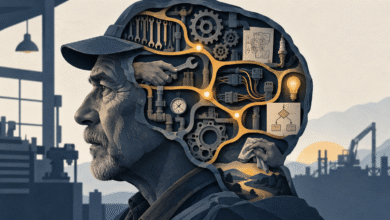
Every leader is, to some extent, the product of the experiences they had along the way: the problems they had to solve, the mistakes they stumbled through, the mentors and enemies they learned from, and the judgement they built through living and learning. Together, those experiences shape who they become and how they choose to lead.
If AI changes the experiences people have as they climb the career ladder, it may also change the leaders who emerge at the top. The challenge is not simply preparing people to work with AI but making sure we continue to develop the human capabilities that future leadership will require.
Leadership still happens through people
As AI enables more work to be completed independently, there is a risk that some of the everyday human interaction around work also diminishes. Yet those interactions involving being challenged, receiving feedback, resolving disagreement and learning how other people think are part of how people develop the interpersonal judgement they later need as leaders.
The implication is not that organisations should preserve old ways of working, but that development and mentoring need to become more intentional, particularly for those earlier in the career pipeline. Future leaders still need meaningful experience of other people, alongside opportunities to think, decide and take responsibility for their choices. That becomes increasingly important as AI takes on more tasks and the natural opportunities to learn alongside more experienced colleagues become less frequent.
As AI does more of the thinking, judgement matters more
That same intentionality needs to apply to how people work with AI. Our research into human–AI collaboration suggests that effective performance depends on much more than access or technical proficiency. People need to evaluate outputs, calibrate how much they trust them and make decisions under uncertainty. They need to decide what can sensibly be delegated, what needs to be challenged and where human judgement should remain.
This matters because judgement develops through being exercised. Our research highlights behaviours such as resisting anchoring on an AI response, pausing to reassess assumptions and staying cognitively engaged rather than simply offloading the thinking. It also raises an important longer-term question: does working with AI strengthen a person’s capability, or gradually reduce their ability to think independently when the technology is not enough?
For the leadership pipeline, that risk is significant. Talogy research found that 78% of HR and talent leaders are concerned about the long-term loss of critical leadership skills as AI becomes more embedded in work. The issue for people earlier in their careers is not simply deskilling; if they have fewer opportunities to form a view, make a judgement, get it wrong and learn why, some of that capability may never be fully developed in the first place.
So the answer is not to use AI less, but to design the interaction more deliberately. Ask people to form a view before consulting AI, explain why they accept or reject its recommendation, identify what context may be missing and retain responsibility for the final decision. Human oversight only has value when the human has developed the judgement required to provide it.
And that judgement will increasingly be exercised in more demanding conditions. AI is not only changing the decisions leaders make; it is increasing the pace of transformation, uncertainty and expectation surrounding them.
AI is increasing the pressure around leadership
Organisations are redesigning roles and structures while expectations around speed, productivity and responsiveness continue to rise. Leaders are increasingly being asked to make decisions while the technology, the work and the organisation around them are still changing.
That level of transformation creates pressure. Leaders may have more information and more powerful tools available to them, but also less certainty about which path is right. They will need to balance competing demands more often, make consequential decisions with incomplete information and lead people through a period of change whose full implications are still unfolding.
This matters because pressure changes how people lead. In stable conditions, it is relatively easy to behave in line with the leadership model on the page. Under sustained change and ambiguity, our assumptions, emotions, values and habitual responses are more likely to shape what we actually do.
And this is where the development challenge goes deeper. If leaders are being asked to exercise more judgement while facing greater uncertainty and pressure, it is not enough to focus only on the behaviours we want them to demonstrate. We also need to understand what sits underneath those behaviours when the pressure is on.
Under pressure, the leadership core is what counts
Leadership development has traditionally focused heavily on visible skills: communicating, making decisions and setting direction. Yet scientific research, reinforced by our international research with leaders, employees and organisations, points to something deeper. Beneath skills and behaviour sits a leadership core: the underlying attitudes, emotional patterns, values and motivations that influence how a leader responds and the choices they make.
This matters because knowing how to lead and consistently doing it are not the same thing, particularly under pressure. As challenge and uncertainty increase, the less visible parts of a leader can become more influential in shaping their behaviour.
Emotional intelligence shapes the ‘how’ of leadership. It influences how leaders interpret situations, understand themselves and others and manage their reactions when pressure rises. Our research also highlights defensive habits: responses that can emerge under challenge and, if unrecognised, interfere with judgement and relationships. A leader may strongly believe in empowerment, for example, but under pressure instinctively become more controlling.
Identity shapes the why. Values, motivations and beliefs influence what leaders notice, what matters to them and what they choose to protect when priorities compete. One leader may instinctively favour speed and results, another stability or inclusion. Understanding those drivers does not prescribe the right decision, but it gives leaders greater awareness of why they may be drawn towards one choice over another.
These foundations become particularly important when there is no clear playbook. In familiar situations, leaders can rely more readily on learnt behaviours and established routines; when circumstances are changing quickly, their underlying attitudes, habits and values are more likely to shape what actually happens.
The need to go deeper is already visible. Talogy research found that 80% of leaders had to change their behaviour to at least a moderate extent when moving into their current leadership level, while only 38% felt well prepared for the next transition. In an AI-enabled world of greater change and unfamiliar challenges, developing the skills of leadership matters, but understanding the how and why beneath them may matter just as much.
Leadership development needs to become more intentional
Taken together, this points to a more deliberate approach to leadership development in the age of AI. Organisations need to create the experiences through which people learn from others, preserve opportunities to exercise judgement, and help future leaders understand the deeper core: their emotional intelligence, identity, values and motivations that shapes how they respond when the situation becomes difficult.
These elements reinforce one another. Experience gives people something to draw on, judgement helps them make sense of it and the leadership core influences what they actually do when there is no obvious answer.
That matters because the future leadership journey is becoming harder to predict. Roles will change, career paths will become less linear and the leaders of tomorrow may face situations for which there is no familiar precedent. HR cannot design development around a perfectly known destination, but it can build people who are better equipped to navigate uncertainty when they get there.
AI will keep redrawing the map. The task for leadership development is to strengthen the ability to navigate; giving people the experiences, judgement and self-understanding to find their way, and help others find theirs, when the route ahead is no longer clear.
Bio:

Ali Shalfrooshan is an award-winning business psychologist with a passion for using psychology, technology and psychometric test design to help organizations thrive. As Director of Science Strategy at Talogy, he has a particular interest in designing innovative solutions that combine technology with scientific rigour to help deliver a measurable business impact.