Expertise is mostly tacit — we know more than we can tell. That’s why manuals failed, and why large language models change the equation.
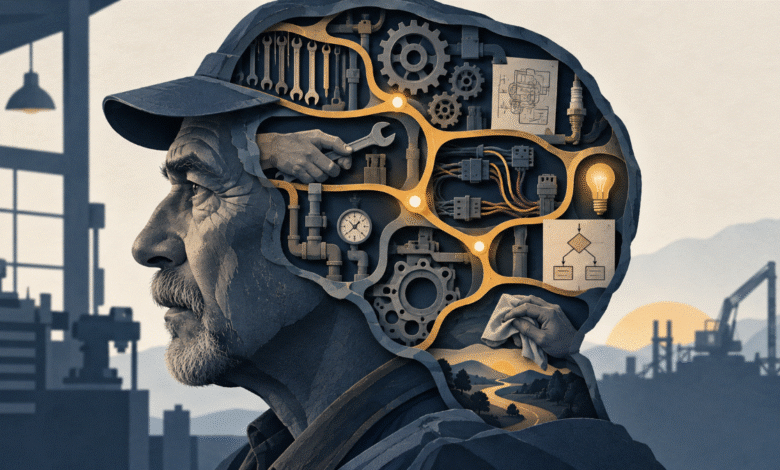
Ask a veteran technician to explain how they diagnosed a problem and they will usually give you something like: I just knew. Ask them to be more specific and they will try — but what comes out is rarely the actual process. It is a cleaned-up version, organized after the fact into steps that feel logical in retrospect. The real process, the one that produced the answer, happened faster and stranger than that. It drew on pattern recognition built across hundreds of similar situations, on an almost physical sense for how equipment sounds and responds, on context accumulated over years. None of that is in the explanation.
The philosopher who named it first
In 1966, a chemist and philosopher named Michael Polanyi published a short book with a sentence that has not stopped being true: “We know more than we can tell.” He was writing about scientific discovery, but the observation applies anywhere expertise lives. He called this tacit knowledge — the part of knowing that resists articulation, that cannot be fully captured in words or procedures, that exists in the body and the pattern-recognition systems of the practitioner rather than on any page.
Polanyi’s point was not that tacit knowledge is mysterious or ineffable. It is that it is embodied. It developed through practice, not instruction. A skilled technician does not consult a mental checklist when they walk up to failing equipment — they perceive the situation as a whole and respond to it. The checklist is what they produce afterward, for documentation purposes. The actual expertise preceded the checklist and cannot be fully reduced to it.
Why documentation failed
The industrial era’s answer to tacit knowledge was documentation: write down the procedures, capture the steps, build the manual. This worked for the explicit parts. It failed for everything else. A manual can tell you which connector to check. It cannot tell you to check it first because of how a specific piece of equipment behaves under load in summer, or because of what a certain error code combination usually means on that particular hardware revision. That knowledge requires context the manual was not written with and cannot carry.
Organizations have known about this problem for decades. Knowledge management became a serious discipline in the 1990s. Corporate intranets, wikis, document repositories — all attempts to solve it. They captured explicit knowledge reasonably well and failed at tacit knowledge almost completely. You cannot solve a tacit knowledge problem with a text field and a submit button.
What large language models actually change
Here is what is different now. A large language model trained on the right corpus — service histories, diagnostic logs, expert narratives, real case documentation — can begin to hold and return something that approximates contextual judgment. Not because it understands in any deep sense, but because it can recognize patterns across a volume of prior cases that no individual human could hold in memory. It can surface the relevant experience from a thousand previous failures when someone describes a symptom that matches.
This is not a solved problem. Hallucination is real. Liability is real. The gap between a plausible-sounding answer and a correct one can be life-safety significant in some contexts. But the direction is clear. For the first time, there is a mechanism that can hold something more than procedure — something closer to the contextual judgment that expertise actually consists of. The remaining questions are about verification, trust, and how to build systems that the midnight technician will actually rely on. Those questions are worth taking seriously. But the underlying capability is no longer hypothetical.
What comes next in this series
Part 4 surveys the real category forming around this problem — the platforms and institutions already building knowledge-preservation infrastructure. Part 4: The New Knowledge-Preservation Stack.