Skyfall AI is taking a direct approach to testing whether artificial intelligence can run a business: buying companies and putting its software in charge of daily operations.
The AI neolab today introduced Steve, a system it describes as a fully functional “AI CEO,” alongside a $2 million program to acquire up to five additional early-stage startups. Skyfall says it has already acquired three businesses and is operating them using the technology.
The ambition extends beyond automating individual tasks. Steve is designed to coordinate specialist AI agents, evaluate potential actions, execute approved decisions and revise its own processes based on results. Its initial focus is digital businesses, including software-as-a-service products and Shopify apps.
Human owners remain responsible for setting direction, establishing permissions and making business-critical decisions. How much Steve can accomplish within those boundaries will be central to the experiment.
For small software businesses, the proposition is compelling: a system that can connect planning with execution and keep daily work moving with less human coordination. Skyfall’s challenge is demonstrating that those capabilities translate into durable business performance.
The company points to early results from its existing portfolio. Two businesses have been running on Steve for more than two months, while a third had been integrated for approximately one week at the time of the announcement.
At the first business, Skyfall reports that monthly revenue grew to 2.3 times its previous level over the last quarter. At the second, revenue has stabilized after five years of decline, and new customers are arriving following a period with no new paying users. Results from the third business are too preliminary to report.
The next phase will test whether those early outcomes can be repeated across businesses with different customers, products and operating pressures.
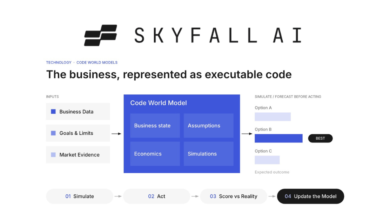
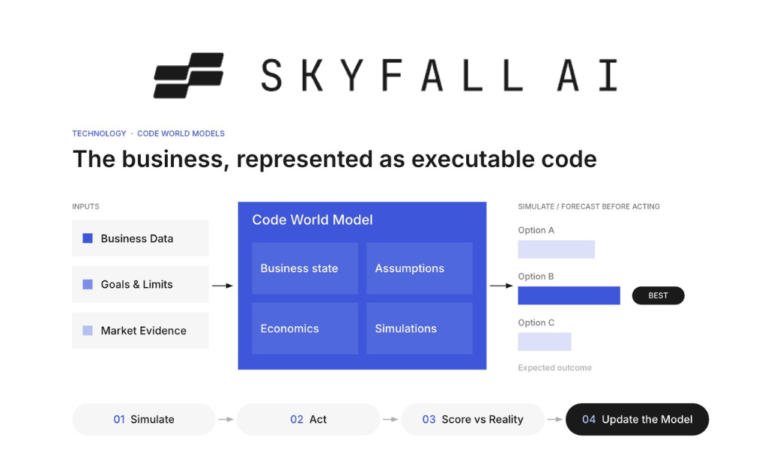
At the center of Steve is what Skyfall calls a code world model: an executable representation of how a business works, built from its records and operating inputs. The model connects factors such as customer behavior, product usage, revenue and costs so Steve can simulate possible decisions before acting.
A marketing decision illustrates the approach. A low-cost advertising campaign might generate substantial traffic while producing few paying customers. Steve could compare that campaign with a more targeted alternative, estimate the likely sales and spending associated with each, and use those forecasts to choose its next action.
After execution, the system compares actual results with its expectations. Gaps between the two inform changes to the model and subsequent plans.
Skyfall also says Steve can update the machinery doing the work. Through a process it calls recursive self-improvement, the system can revise its code, instructions, agent coordination, tests and business model.
One example involved customer lifecycle emails. According to Skyfall, Steve tested different approaches, compared their performance and updated its instructions so future emails incorporated what worked.
Another exposed a coordination problem. During a website update, growth and engineering agents repeatedly passed deployment responsibility back and forth. One lacked the necessary access. Skyfall says Steve changed its coordination process so an overseeing agent would identify and resolve such conflicts.
These examples address a practical obstacle to autonomous operations: completing work requires clear ownership, appropriate access and a way to recover when a process stalls.
Steve’s authority is governed by a policy engine that checks proposed actions against rules covering decision type, spending and customer impact. An action can proceed automatically, proceed with a notification, require approval or be blocked.
An owner could, for example, authorize automatic refunds up to $30 while reserving larger amounts for review. Changes to Steve’s own operating processes must also remain within the owner’s rules.
Skyfall plans to provide public dashboards for its portfolio businesses under anonymous names. The dashboards are intended to show goals, metrics, agent activity, decisions and changes to the system. Their usefulness will depend on how clearly they connect actions with outcomes and reveal where human intervention remains necessary.
Founded by the team behind Maluuba, the deep learning company acquired by Microsoft, Skyfall is led by Sam Pasupalak, Kaheer Suleman and Sumit Pasupalak. Its backers include Fidelity, Touring Capital, M13 and iNovia Capital.
The $2 million acquisition program will give Steve a broader operating test. For Skyfall, the strongest evidence will come from businesses that consistently retain customers, improve their economics and operate reliably under the system’s management.