Do you know that detecting a problem late in the SDLC can leave your team lagging behind competitors who catch it early? Traditional development processes detect most issues only after code reaches QA or, in the worst case, production. AI-powered software development solves this by catching the problems before it’s too late. This is why developers are now applying AI across every stage of the SDLC.
According to Gartner, AI can drive 25% to 30% productivity gains across the software development lifecycle when teams use it throughout the SDLC, not just for writing codes. So, let’s discuss how AI in product engineering is changing the development process.
How AI Is Reshaping the Product Engineering Lifecycle
From detecting bugs, designing architecture to writing code faster and testing, AI is transforming the product engineering lifecycle. Here’s what that shift looks like in practice.
Discovering the Right Problems to Solve
Developers should have a clear understanding of your customer’s needs before they start coding. The traditional discovery process involves user surveys and manual documentation which is slow and often lacks the required accuracy. AI changes this by analyzing support tickets, user feedback, and usage data, and showing patterns your team wouldn’t see otherwise.
In doing so, AI can save time and provide product managers with a quicker, data-driven foundation. So, managers can spend more time deciding which problems need more attention to solve.
Designing Architecture Built to Scale
Architecture mistakes can be costly to fix in production. AI-driven software development tools help designers to explore interface concepts and prototypes. These tools also help engineers to document existing systems, compare implementation approaches, or identify potential technical dependencies.
But one important thing is worth mentioning. Though AI generates options, architecture still needs human judgment around scalability, security, and other important considerations. The best practice here is to use AI to accelerate engineering decisions, not blindly accept them.
Building Software Faster Without Losing Control
In the development stage, you can notice the most significant impact AI has had. AI coding assistants can now draft boilerplate, suggest implementation patterns, and flag inconsistencies before a human reviewer ever opens the file. This means your development team gets more time to judge whether the code architecturally fits and works according to business logic.
Testing at the Speed AI Now Demands
AI speeds up development and manual quality assurance tests struggle to keep up with that speed. Developers need to perform tests continuously instead of testing everything at the end of the sprint. AI now writes and runs test cases alongside development. This helps teams to catch regressions in the very beginning rather than days later.
Treat AI in a way that helps your team widen the test coverage, not a replacement for judgment on what actually needs testing.
Learning From Software After It Ships
The SDLC does not end at lunch anymore. Once the product is live, AI can measure the performance of features compared to the objectives you established when planning the product. The information from these tools can also help inform the next iteration of enhancements. This allows the teams to build on the previous release and learn from it, instead of starting over every time.
What This Shift Means for Product and Engineering Leaders
This shift clearly shows that AI speeds up the entire SDLC but it does not replace your experienced developers because human judgment still matters. The decision making process has changed and now you need to build workflows where developers review, validate and direct AI output instead of just trusting it blindly.
Collaboration Has to Move Earlier
With the help of AI, teams are now able to turn ideas into working prototypes faster. So decisions can’t be made in isolation. For example, a design team can’t make decisions without cooperating with the testing or operations team. If they do that without communicating with each other, there are possibilities of rework.
Products and engineering leaders need teams to share information and visibility across each stage, including what AI is producing.
Review Becomes a Core Skill
Your team needs to be skillful enough to review the AI-generated output. AI can hallucinate so proper governance and guardrails are needed to employ. This means setting clear rules for what AI can touch without review, where human sign-off stays mandatory. Without that structure, generating code fast means little if nobody catches what’s wrong with it.
If your team can build this discipline early, you will be able to turn AI’s speed into a real advantage instead of a hidden liability.
The Bottom Line for Your Product Engineering Lifecycle
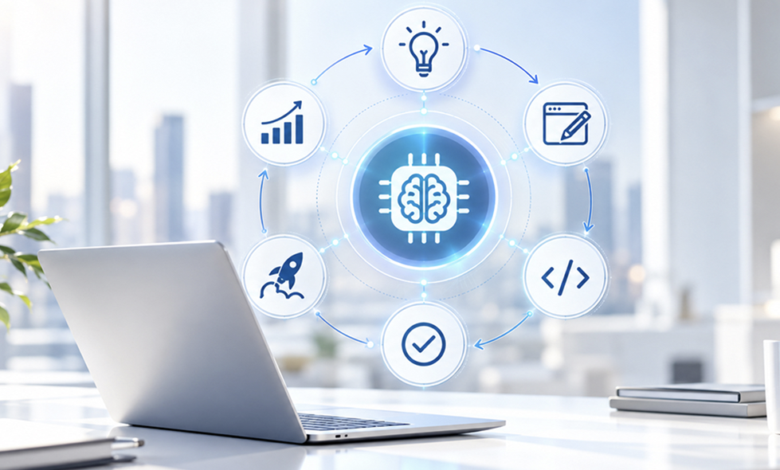
From a linear product engineering lifecycle to a circular one, AI is changing all that. Now, discovery, development, testing and post-launch data can all flow through each other. AI-powered software development is effective when teams leverage the tool to enhance workflow throughout the software development lifecycle. Effective governance and guardrails continue to be vital for quality.
You can begin on a small scale by incorporating AI into an entire product lifecycle, and then take note of the results. On the basis of those lessons, your team can then determine where AI can contribute more. This allows teams to leverage the benefits of AI without compromising on quality, collaboration, and control.