Abstract
Incident management has traditionally been reactive: a disruption occurs, a ticket is created, an analyst evaluates its severity, and the incident is manually routed to an appropriate support team. Although this process is well established, increasing infrastructure complexity and incident volumes can make manual triage a significant operational bottleneck.
This article presents an AI-inspired incident intelligence framework designed to bring predictive decision support into the incident lifecycle. The implemented prototype evaluates incident characteristics to calculate a dynamic risk score from 0 to 100, classifies incidents into risk levels, recommends troubleshooting actions, and identifies an appropriate support group. These recommendations are made available to support personnel in real time through the incident interface.
Rather than claiming autonomous artificial intelligence, the framework demonstrates an important intermediate step: using transparent, deterministic decision logic to simulate AI-assisted operations today while creating an architecture that can later incorporate machine learning, operational intelligence, automated remediation, and performance analytics.
The Limitations of Reactive Incident Management
Traditional incident management typically begins only after a user, monitoring system, or support team identifies a problem. Once an incident has been recorded, an analyst must interpret its description, understand its urgency, determine the appropriate category, assess potential impact, and route it to the correct technical team.
Each manual decision introduces potential delay. An incident involving a network outage, for example, may contain obvious indicators of operational severity, yet those indicators provide little value if they are not evaluated until an analyst opens the record.
Assignment can create another bottleneck. When the initial routing decision is incorrect, incidents may move between support groups before reaching the team capable of resolving them. The problem is therefore not simply how quickly an individual technician works; it is how effectively the entire workflow converts incident information into an appropriate operational response.
This creates an opportunity for intelligent decision support. Instead of treating every newly created incident as an isolated record, organizations can evaluate its characteristics immediately and provide support teams with contextual recommendations.
Introducing an Incident Intelligence Layer
The prototype developed for this project introduces an intelligence layer into the incident-management workflow.
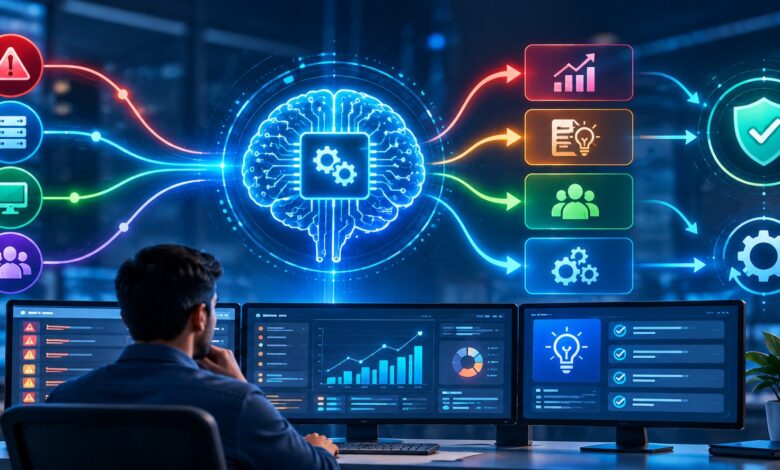
Its architecture follows a straightforward processing sequence: Incident Record -> Decision Logic Engine -> Risk Score and Prediction -> Resolution and Assignment Suggestions -> Real-Time User Interaction.
When an incident is evaluated, business logic examines relevant characteristics and generates several outputs. These include a numerical risk score, a risk classification, suggested troubleshooting guidance, and a recommended assignment group.
A separate user interaction allows an analyst to request the recommendations directly from the incident interface. Behind that interaction, asynchronous communication retrieves the generated information without requiring the user to leave the record.
This separation between decision logic and presentation is important. It allows the intelligence mechanism to evolve while maintaining a simple experience for service personnel.
Turning Incident Data into a Risk Score
A central feature of the framework is its 0-100 risk scoring mechanism.
The prototype evaluates three types of signals: incident priority, incident category, and meaningful keywords contained in the incident information. For example, terminology indicating that a service is “down” can contribute to the assessment because it may represent a more significant operational condition.
The purpose of the score is not merely to produce another field on an incident record. It converts several individual signals into a standardized representation of operational risk that can be interpreted consistently.
A numerical score also creates a foundation for future sophistication. Additional factors could eventually include service criticality, configuration-item dependencies, historical recurrence, affected-user volume, business-service impact, monitoring telemetry, or previous escalation patterns.
The current implementation intentionally remains more transparent. Because the decision process is deterministic, administrators and support personnel can understand why particular conditions affect the result.
Translating Scores into Operational Predictions
A numerical value becomes more useful when translated into information that an analyst can quickly interpret. The framework therefore converts the calculated score into three classifications: High Risk, Medium Risk, and Low Risk.
This represents the project’s prediction component. Rather than attempting to forecast an exact future outcome using a trained machine-learning model, the prototype uses current incident characteristics to identify the level of operational attention that may be required.
This distinction is important when discussing AI-inspired systems. Rules-based predictive logic and machine-learning prediction are not equivalent. The current project demonstrates the former and establishes an architecture that could later support the latter.
In an operational environment, such classifications could help teams focus attention on potentially significant incidents earlier in their lifecycle. The objective is to supplement human judgment with consistent contextual information rather than remove human decision-making from the process.
Moving Beyond Prediction to Resolution Guidance
Predicting that an incident represents elevated risk is valuable, but prediction alone does not restore a service.
The framework therefore combines risk assessment with suggested resolution guidance. Based on the incident context, the engine can return troubleshooting recommendations intended to help the analyst determine an appropriate next action.
For a network-related condition, for example, the system can recommend checking network connectivity and restarting the relevant networking equipment. The implementation also contains fallback logic for scenarios that do not match a known condition.
Fallback handling is particularly important. An intelligent support system should not imply certainty when it does not recognize a scenario. Providing a controlled alternative makes the decision-support process more predictable and creates a natural point at which human expertise can take over.
This capability also illustrates a broader principle for enterprise AI: recommendations become more valuable when they are connected to an operational action rather than presented as isolated predictions.
Intelligent Assignment Recommendations
Correct assignment is another important part of incident resolution.
The project recommends support teams according to the characteristics of the incident. The prototype includes examples such as network support, application support, and the general service desk.
This addresses a common source of avoidable delay: routing an incident to a team that cannot resolve it. Intelligent assignment recommendations can reduce unnecessary reassignment while helping first-line support personnel make faster routing decisions.
Importantly, the implementation provides a recommendation rather than presenting assignment as an autonomous AI decision. This preserves human control while demonstrating how contextual automation can improve the workflow.
Future implementations could extend the model by considering team availability, specialist skills, historical resolution performance, service ownership, current workloads, and incident similarity.
Bringing Intelligence Directly into the Analyst Workflow
A predictive system is useful only if its output reaches the person who needs it at the appropriate moment.
For this reason, the prototype includes a real-time AI suggestion action directly within the incident interface. When activated, it retrieves the prediction, recommended resolution, and suggested assignment group.
An example output can effectively tell the analyst that an incident is considered high risk, provide an appropriate troubleshooting action, and recommend that it be handled by the network team.
The underlying architecture separates the user-interface action from server-side processing and uses asynchronous communication to retrieve the result. From a user-experience perspective, however, the complexity remains hidden.
This is a valuable design principle for enterprise intelligence systems. AI assistance should ideally become part of the employee’s existing workflow rather than forcing the employee to switch between disconnected applications.
From AI-Inspired Logic to Machine Learning
The current implementation uses structured decision logic rather than a trained machine-learning model. That makes the prototype explainable, reproducible, and relatively straightforward to govern.
It also creates a foundation for a more advanced predictive architecture.
Historical incident data could eventually be used to train models that estimate escalation probability, predict likely severity, identify similar incidents, or recommend assignment based on previous successful resolutions. Natural-language techniques could analyze incident descriptions beyond predefined keywords, while similarity models could retrieve previous incidents with comparable symptoms.
The existing risk score could then evolve from a deterministic calculation into a model-assisted probability or confidence measure.
Such evolution should be incremental. Organizations first need reliable incident data, meaningful outcome labels, governance processes, performance monitoring, and mechanisms for handling incorrect predictions.
The Path Toward Automated Resolution
Automated incident resolution is a future enhancement of this project rather than a capability implemented in the current prototype.
The existing architecture nevertheless provides several building blocks needed to move toward that objective. The system already evaluates the incident, determines a risk category, recommends a resolution, and identifies an appropriate support path.
A future remediation layer could connect approved recommendations to controlled automation. Low-risk and well-understood scenarios might trigger predefined remediation workflows, while high-impact or uncertain situations could continue to require human approval.
This creates a graduated automation model: Predict -> Recommend -> Validate -> Remediate -> Verify.
Such a model is safer than treating autonomous resolution as a single unrestricted action. Automated remediation should include authorization boundaries, rollback procedures, audit records, confidence thresholds, and post-action verification.
Creating a Continuous Learning Loop
The project’s future roadmap also includes operational intelligence integration and performance analytics.
These capabilities could transform the prototype from a point-in-time recommendation engine into a continuous learning system. Organizations could measure whether high-risk predictions were accurate, whether recommended teams successfully resolved incidents, and whether suggested troubleshooting actions reduced resolution time.
That information could then become feedback for improving future decisions.
The long-term architecture therefore becomes cyclical: Incident -> Risk Assessment -> Recommendation -> Human or Automated Action -> Outcome -> Feedback -> Improved Decisioning.
The feedback stage is critical because intelligent operations should not be evaluated simply by how many recommendations are generated. They should be measured by whether those recommendations improve operational outcomes.
Measuring Business Value
The immediate value of the framework comes from reducing the cognitive and administrative work required during incident triage.
Risk scoring provides a consistent method of highlighting potentially important incidents. Resolution suggestions give analysts a starting point for troubleshooting, while assignment recommendations can reduce delays caused by incorrect routing.
Together, these capabilities can support faster incident handling, reduced manual effort, more consistent decision-making, and a transition toward proactive IT operations.
However, organizations implementing similar systems should measure actual results rather than assume that automation automatically produces value. Useful measures could include mean time to acknowledge, mean time to resolve, reassignment frequency, recommendation acceptance rate, escalation frequency, and the success rate of future automated remediation.
Responsible Automation and Human Oversight
As incident-management systems become more autonomous, governance becomes increasingly important.
Risk predictions must be explainable enough for operational teams to understand why an incident received a particular classification. Recommendations should be auditable, and organizations should define which decisions can be automated and which require human authorization.
Human oversight becomes particularly important when incidents affect critical services or when the system encounters unfamiliar conditions. The fallback mechanism demonstrated by the prototype represents a simple but useful version of this principle: uncertainty should lead to controlled escalation rather than fabricated confidence.
The goal of intelligent incident management should therefore not be automation for its own sake. It should be faster and more consistent decision-making while maintaining accountability for consequential operational actions.
Conclusion
The transition from reactive incident management to predictive IT operations does not have to begin with a complex autonomous AI platform.
This project demonstrates how an organization can introduce an intelligence layer using transparent risk scoring, incident classification, contextual resolution recommendations, assignment guidance, and real-time interaction with support personnel. Its significance lies not only in the individual capabilities but in how they are combined into a coherent operational workflow.
The current implementation remains deliberately human-centered: it predicts and recommends rather than autonomously resolving incidents. At the same time, its architecture establishes a practical pathway toward machine-learning prediction, operational intelligence integration, performance analytics, and controlled automated remediation.
The future of incident management is therefore likely to involve more than responding faster after something fails. It will increasingly involve recognizing operational risk earlier, placing relevant knowledge in front of the right people, and eventually resolving well-understood problems before they become prolonged service disruptions.