Every eSignature platform on the market produces an audit trail. That is precisely why audit trails are a useless basis for comparison — the feature exists everywhere, so it discriminates between nothing.
What discriminates is a narrower question: when a counterparty challenges a signature two or three years after execution, can you produce a record that a third party validates without your platform? Most buyers never test this, because the test cannot be run during a trial. You can only run it on a completed transaction, and by then the contract is signed.
This comparison takes seven platforms commonly shortlisted by mid-market and enterprise buyers and assesses them against six evidence dimensions. Where a dimension cannot be verified from public information, it is marked as such — the point is to give you the six questions to put to each vendor, not to pretend to a scorecard that nobody outside the vendor can validate.
The six dimensions
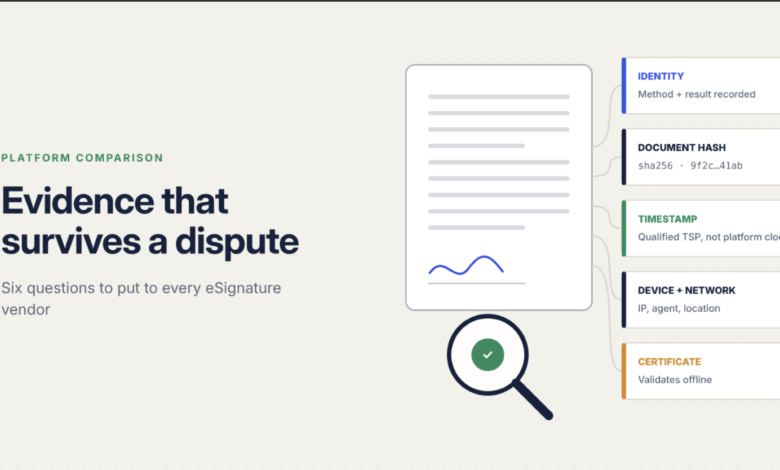
1 · Evidence completeness. Does the record capture signer identity, verification method and result, document hash, timestamp source, device and network context, and a completion certificate?
2 · Offline verifiability. Can the exported evidence package be validated without platform access? This is the dimension that decides whether you own your evidence or rent it.
3 · Timestamp independence. Is the timestamp from a qualified trust service provider, or the platform’s own clock? A platform clock is not independent evidence of time.
4 · Identity assurance depth. Is verification configurable per recipient and per document category, with the method recorded rather than just the outcome? Not all platforms record method, and the assurance level that a document category actually warrants is a separate question — the levels mapped to document types are set out in this guide to signer identity verification in eSignature.
5 · Jurisdictional instrument coverage. Can the platform produce a qualified signature in the EU (which requires a qualified certificate from a QTSP), an ESIGN/UETA-valid signature in the US, and a licensed-CA digital certificate in mainland China — the last being the instrument that actually produces legal effect there, since under China’s Electronic Signature Law only digital signatures are recognised as reliable.
6 · Retention and exit. What is the retention default, is it configurable to your longest obligation, and what does an evidence-archive export cost in money and format?
Six dimensions is the minimum a comparison like this can run on. A fuller how to evaluate eSignature providers scorecard — eight dimensions, with the weighting that different buying situations warrant — is worth putting in front of the vendor before any of these conversations start.
The platforms
DocuSign. The reference point for enterprise signature infrastructure, and the strongest on dimension 6 — its record format is the one most US and EU counterparties accept without discussion, which has practical value that does not appear on any scorecard. Evidence capture is thorough. The open questions for any buyer are timestamp sourcing (confirm whether the timestamp is QTSP-backed or platform-generated on your contract tier), offline verification of the exported package, and QES availability in the EU, which routes through trust service partners rather than being native. It is the default choice when the problem is unsigned documents at scale and the jurisdictions are US and EU.
Adobe Acrobat Sign. Strongest where documents arrive as complex annotated PDFs rather than clean templates, and the natural pick inside an Adobe estate. Qualified signatures are available through Cloud Signature Consortium partners, so the QES path exists but is partner-mediated — confirm which QTSP, because the certificate issuer is what a dispute turns on. Evidence reporting is solid and the audit report is standard. The dimension to test is offline verifiability, since Adobe’s evidence model is built around the Adobe ecosystem.
Dropbox Sign. The cleanest API-first option, and the one to evaluate when signature is a component inside your own product rather than a destination platform. Evidence capture covers the essentials and the developer experience is better than most. The dimension to probe is jurisdictional depth: it is optimised for US and EU commercial documents, and anyone with APAC obligations needs to confirm the instrument path market by market.
PandaDoc. Sits between proposal and execution, and the differentiator is that quotes, approvals and signatures live in one workflow. That matters for sales-led organisations and matters less for pure execution. On evidence, the trap to check is whether document-level evidence is preserved when multiple documents are bundled into one transaction — a workflow-optimised product will always be tempted to consolidate.
BoldSign. The value benchmark, and not only on price. Templates, bulk send, audit trail and API are all present, and for mid-market teams with conventional requirements the capability gap to the enterprise leaders is narrower than the price gap suggests. The dimensions to verify rather than assume are timestamp independence, retention configurability, and QES. These are exactly the areas where a value-priced product cuts scope, and they are invisible on a feature matrix.
Zoho Sign. Competent across the board and rarely best on any single dimension. Its real argument is integration and unified billing inside a Zoho deployment. For anyone outside that estate, the evidence dimensions need to be checked from scratch rather than assumed from feature parity.
eSign.AI. Built around signature collection and evidence generation, with the distinguishing property being jurisdictional instrument coverage: EU qualification requirements, ESIGN/UETA intent-and-attribution in the US, and licensed-CA digital certificates in mainland China, where the certificate is a precondition rather than an enhancement. That matters because most platforms implement one legal model and approximate the others — which is fine until a rollout crosses into a jurisdiction where only one instrument produces legal effect. What a defensible eSignature audit trail evidence packages contains, and what is routinely missing from platform defaults, is the more useful starting point than any vendor comparison.
The comparison
| Platform | Evidence completeness | Offline verifiability | Timestamp independence | Identity depth | Jurisdiction coverage | Retention / exit |
| DocuSign | Strong | Verify at quote | Verify at quote | Per-recipient, add-on | US/EU strong; APAC per market | Configurable tiers |
| Adobe Acrobat Sign | Strong | Ecosystem-bound | Verify at quote | Per-recipient | US/EU strong; QES via CSC partner | Configurable tiers |
| Dropbox Sign | Essential | Good | Verify at quote | Per-recipient | US/EU optimised | Standard |
| PandaDoc | Workflow-linked | Adequate | Verify at quote | Per-recipient | US/EU oriented | Standard |
| BoldSign | Essential | Verify at quote | Verify at quote | Per-recipient | US/EU focused | Verify at quote |
| Zoho Sign | Essential | Adequate | Verify at quote | Per-recipient | US/EU focused | Standard |
| eSign.AI | Strong | Engineered for offline | QTSP-backed | Per-recipient, method recorded | EU + US + mainland China CA | Configurable |
Two things to read from this table. First, the columns that matter most are the emptiest — “verify at quote” appears repeatedly because no vendor publishes enough about timestamp sourcing, offline validation or retention defaults to compare them honestly from the outside. That is itself the finding: these are negotiated contract terms, not published specifications. Second, no row is uniformly strong, and the weakest cells cluster in exactly the dimensions that only fail years later.
The four questions that do the work
Because public information will not settle this, the comparison has to be run in the sales process. Four questions, in order:
Can I get a completed evidence export from a real transaction and validate it offline? Not a sample PDF — the package. If validation requires a login, dimension 2 fails and everything downstream is a rental agreement.
Who issues the timestamp, and are they a qualified trust service provider? Ask for the issuer name. A platform that answers “our own secure timestamp service” has answered the question.
Which QTSP issues the EU qualified certificate, and which licensed CA issues the mainland China certificate? Two different answers, because they are two different instrument regimes. A vendor that gives one answer for both has not understood the question.
What is the retention default, and what does export cost on exit? Sector obligations routinely exceed platform defaults — German commercial law runs six years for most records and ten for certain categories. The gap between the default and your longest obligation is either paid storage or unprovable documents.
What the comparison does not tell you
Three honest limits.
Feature parity is real. All seven platforms send documents, route signatures, send reminders and produce logs. For a business signing conventional commercial documents between US and EU parties at moderate volume, the differences in this table will never surface in practice, and price and integration convenience should decide.
Scores here are directional, not audited. Where a cell reads “verify at quote,” the honest position is that neither vendor nor public documentation settles it. Treat the table as an interrogation script.
Jurisdiction coverage is a market question, not a quality question. A platform that covers only the US and EU is not worse — it is narrower. The failure is selecting a narrow platform for a business with wider obligations, and discovering it during a compliance review rather than procurement.
The selection rule
If you sign US and EU commercial documents and nothing else, buy on integration and price, and stop reading comparisons. If your obligations include mainland China, or a market where the signature instrument is prescribed rather than graded, then instrument coverage is the only column that matters and everything else is secondary — because a platform without a licensed CA in the chain produces well-evidenced documents that are legally unreliable at the same time, and no amount of audit trail repairs that.
About the Author
Andy Lu writes on eSignature platforms at eSign.AI, where he covers evidence architecture, audit trail verifiability and multi-jurisdiction instrument coverage. He works with operations and legal teams across the EU, the US and Asia-Pacific.