Profound offers a broad approach to AI search intelligence, but not every business needs the same level of analytics, reporting, or organizational complexity.
Some marketing teams primarily want to know whether their brand appears in ChatGPT recommendations. Others need to investigate the sources cited by AI assistants, monitor competing brands, or connect AI visibility data with existing SEO research.
The best Profound competitor depends on which of these tasks matters most and how much monitoring the business plans to maintain. For additional context, The Data Scientist’s comparison of Profound alternatives explores the available options for AI visibility monitoring.
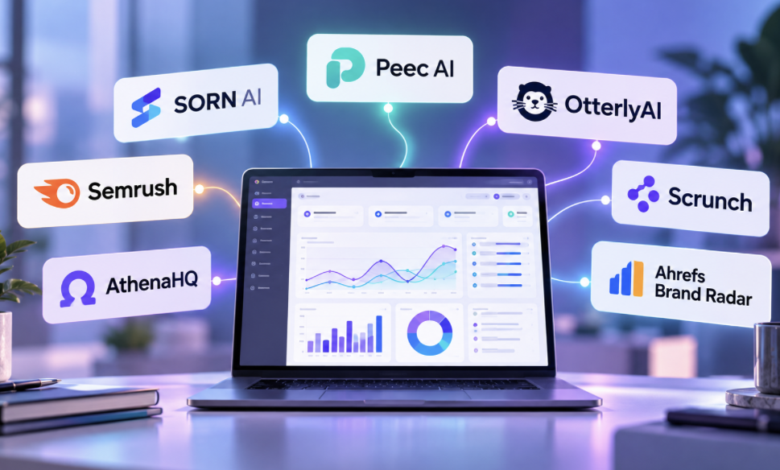
This guide compares seven platforms with different strengths in brand tracking, citation analysis, competitive research, and AI search optimization.
Quick Comparison
| Platform | Best For | Key Strength |
| SORN AI | AI visibility monitoring and diagnostics | Four-engine tracking and technical audits |
| Peec AI | Brand and source visibility | Prompt-level competitor analysis |
| OtterlyAI | Recurring AI search reporting | Daily prompt monitoring |
| Scrunch | AI discovery and website readiness | AI agent and website analysis |
| AthenaHQ | Competitive AI search intelligence | Brand visibility analytics |
| Semrush AI Visibility Toolkit | SEO and AI search research | Integrated search intelligence |
| Ahrefs Brand Radar | Competitive brand benchmarking | Large-scale AI visibility research |
1. SORN AI — Best for Focused AI Visibility and Competitor Monitoring
SORN AI tracks brand visibility across ChatGPT, Gemini, Claude, and Perplexity, including brand mentions, citations, and competitor appearances. For businesses evaluating the best Profound alternatives for their needs, SORN AI combines brand visibility tracking with prompt testing and technical diagnostics.
Its Experiment Engine allows teams to test buyer questions, while technical diagnostics examine AI crawler access, structured data, and other website signals that may affect content discovery.
The platform also monitors external mentions, including Reddit discussions and industry listicles. This is useful for businesses evaluating how their brand appears beyond their own website.
SORN AI Starter costs $29 per month for 50 tracked prompts across two AI engines. Professional costs $99 per month for 100 prompts, four AI engines, three user seats, and three tracked competitors. Both include a three-day free trial.
The company also offers separate agency services for content marketing, link building, and third-party editorial placements.
Best for: Businesses seeking AI brand monitoring, prompt testing, and technical diagnostics without starting with an enterprise-scale engagement.
Key capabilities:
- Brand mention and citation tracking
- Monitoring across up to four AI engines
- Experiment Engine
- Competitor benchmarking
- AI crawler and technical diagnostics
Limitation: Starter covers two AI engines, while broader engine coverage and competitor tracking are available on higher-tier plans.
2. Peec AI — Best for Visibility, Position, and Sentiment Comparisons
Peec AI focuses on how brands appear in AI-generated responses, with analytics organized around visibility, position, and sentiment.
The platform supports custom prompts, tagging, and country-based monitoring. These capabilities help marketers distinguish between appearing in an answer and receiving a prominent recommendation.
For example, a company might appear frequently in general category discussions but rarely lead recommendations for a specific use case.
Peec AI’s Starter plan includes 50 tracked prompts across three AI models, while Pro expands monitoring to 150 prompts. Starter also supports unlimited users, making it relevant for teams that need shared access to reporting.
Best for: Marketing teams that want detailed comparisons of brand position, sentiment, and visibility across selected prompts.
Key capabilities:
- Brand visibility and position analysis
- Sentiment reporting
- Custom prompt tracking
- Country-based comparisons
- Citation and competitor insights
Limitation: The Starter plan’s prompt and model allowances can constrain teams managing multiple markets or extensive product categories.
3. OtterlyAI — Best for Automated Prompt and Citation Monitoring
OtterlyAI provides recurring AI search monitoring, helping marketers track how brands appear across selected questions without manually repeating the same searches.
Its reporting covers brand mentions, website citations, competitor appearances, and changes over time.
This makes the platform useful for agencies and in-house teams preparing regular AI visibility reports.
OtterlyAI Lite costs $29 per month for 15 tracked prompts. Its scheduled monitoring and citation reporting offer a focused alternative for businesses that do not require an extensive enterprise analytics platform.
Best for: Small teams and agencies prioritizing recurring brand and citation reports.
Key capabilities:
- Automated prompt monitoring
- Brand mention tracking
- Website citation analysis
- Competitor comparisons
- Historical visibility reporting
Limitation: The Lite plan’s 15-prompt allowance is limited for businesses that need to monitor many product categories, markets, or competitors.
4. Scrunch — Best for AI Agent Readiness and Website Analysis
Scrunch combines AI search monitoring with capabilities focused on how AI agents discover and interact with websites.
Its Agent Experience Platform adds a technical dimension beyond conventional brand mention dashboards.
This is relevant for organizations with large content libraries, complex websites, or important information that automated systems need to access accurately.
Scrunch’s Core plan is listed at $250 per month with annual billing, including 125 unique tracked prompts, 5,000 monthly responses, and four AI platforms.
Best for: Organizations that need both AI search visibility intelligence and analysis of AI agent interactions with website content.
Key capabilities:
- Brand visibility monitoring
- Citation and competitor analysis
- AI agent insights
- Website readiness analysis
- Technical discovery insights
Limitation: Its starting price and broader technical scope may be unnecessary for teams seeking only basic prompt and mention tracking.
5. AthenaHQ — Best for Connecting Monitoring With Optimization
AthenaHQ combines AI visibility tracking with insights intended to support marketing and content optimization.
The platform helps teams investigate brand appearances, citations, and competitors while identifying opportunities for further work.
This approach is useful for organizations that want visibility reports to inform content planning rather than remain isolated in a dashboard.
AthenaHQ offers a free option with 300 credits, while its Starter plan is listed at $295 per month with 3,600 credits.
Best for: Marketing teams looking to connect AI search measurement with optimization decisions.
Key capabilities:
- AI visibility tracking
- Citation source analysis
- Competitor comparisons
- Optimization recommendations
- Credit-based monitoring
Limitation: Teams must estimate credit usage when planning frequent monitoring or extensive prompt coverage.
6. Semrush AI Visibility Toolkit — Best for Existing SEO Workflows
Semrush offers AI visibility research alongside its broader ecosystem of SEO and digital marketing tools.
Its AI Visibility Toolkit covers brand mentions, share of voice, competitor analysis, prompt research, and citation reporting.
For SEO teams already using Semrush, the appeal is being able to investigate AI search visibility alongside familiar keyword, website, and competitor research.
The standalone AI Visibility Toolkit costs $99 per month and includes 25 tracked prompts. Semrush also offers broader subscriptions with different monitoring allowances.
Best for: SEO teams expanding their existing research and reporting into AI-generated search results.
Key capabilities:
- AI visibility benchmarking
- Competitor research
- Prompt monitoring
- Brand sentiment analysis
- Citation reporting
Limitation: The 25-prompt allowance may require expansion, and the AI Visibility Toolkit does not automatically include every other Semrush product.
7. Ahrefs Brand Radar — Best for Large-Scale AI Brand Research
Ahrefs Brand Radar helps businesses investigate brand visibility across extensive collections of AI search prompts.
According to Ahrefs’ September 2026 documentation, its research database contains more than 405 million search-backed prompts.
This gives marketers a way to explore brand and competitor visibility beyond a small list of manually selected questions.
Brand Radar also supports citation research, share-of-voice comparisons, and custom prompt tracking.
Its broad research database is distinct from individually configured recurring monitoring. Businesses should evaluate those capabilities separately.
Best for: SEO teams and analysts conducting large-scale brand and competitor research.
Key capabilities:
- Extensive AI prompt research
- Brand share-of-voice analysis
- Competitor benchmarking
- Top cited websites and pages
- Custom prompt monitoring
Limitation: Database research and custom tracking are different capabilities, with separate usage considerations and potential additional costs.
How to Choose a Profound Alternative
The first step is to identify why you are considering a different platform.
A team that wants simpler recurring reports has different requirements from one that needs advanced market research or technical AI agent analysis.
Compare the following factors:
Prompt coverage: How many customer questions can you track, and how frequently are they checked?
AI platform coverage: Which assistants and models are included in the subscription?
Citation reporting: Can you identify which websites and pages appear as sources in AI-generated answers?
Competitor analysis: Does the platform show how competing brands perform across the same questions?
Technical capabilities: Does the tool provide website or AI crawler diagnostics, or is it focused entirely on generated responses?
Total cost: Consider prompt allowances, AI engines, users, markets, credits, and additional modules.
A lower starting price does not necessarily mean a lower cost for the monitoring program a business actually needs.
When Is Switching From Profound Worth Considering?
Profound offers Answer Engine Insights, Prompt Volumes, Agent Analytics, and other AI marketing capabilities. Its free seven-day trial allows users to monitor 50 unique prompts daily across ChatGPT, Gemini, and Google AI Overviews.
That broader scope can be valuable for organizations managing AI search intelligence across several teams. Switching makes sense when another platform better supports a more specific requirement.
For example, a smaller marketing team might need recurring monitoring for 50 customer questions rather than a broad enterprise analytics program.
Another business might prioritize citation research because it regularly publishes third-party articles and wants to examine which sources appear in relevant AI responses.
A company with complex technical requirements may place greater value on website access and AI agent analysis.
Before changing platforms, retain a consistent set of prompts, competitors, and reporting periods for comparison.
Different monitoring systems can produce different scores because they use different methods, models, and collection schedules. A change in score after switching tools does not necessarily represent a change in actual brand visibility.
Frequently Asked Questions
What are the best Profound competitors in 2026?
SORN AI, Peec AI, OtterlyAI, Scrunch, AthenaHQ, Semrush AI Visibility Toolkit, and Ahrefs Brand Radar are seven alternatives for businesses comparing AI brand monitoring, citations, competitor analysis, and research capabilities.
Which Profound competitor is suitable for small businesses?
SORN AI and OtterlyAI both offer entry-level plans at $29 per month, but they differ in prompt allowances and included features. Businesses should compare their required AI engines, reporting needs, and competitor tracking requirements before selecting a plan.
Which tools are best for tracking AI citations?
Peec AI, OtterlyAI, SORN AI, Scrunch, and other platforms in this comparison provide citation-related analysis. Buyers should check whether the reporting identifies source domains, individual pages, or both.
Which Profound alternatives include competitor tracking?
SORN AI, Peec AI, OtterlyAI, Scrunch, AthenaHQ, Semrush, and Ahrefs provide forms of competitor analysis. Availability and limits vary by subscription.
Can I compare AI visibility scores across different tools?
Not directly. Platforms use different prompt samples, AI models, collection schedules, and scoring methods. Compare the underlying responses and methodology before interpreting differences.
Do AI visibility tools replace traditional SEO software?
No. AI visibility tools measure appearances and citations in generated answers, while SEO platforms measure rankings, backlinks, organic search traffic, and related performance. Some platforms combine parts of both.
Final Thoughts
Profound competitors differ in what they help marketing teams investigate.
SORN AI combines brand monitoring with prompt experiments and technical diagnostics. Peec AI emphasizes visibility, position, and sentiment, while OtterlyAI focuses on recurring monitoring and citations.
Scrunch adds AI agent analysis, AthenaHQ connects measurement with optimization, and Semrush and Ahrefs offer research capabilities relevant to established SEO workflows.
The best choice is the platform that supports the questions your business needs answered and the decisions your marketing team is prepared to make.