
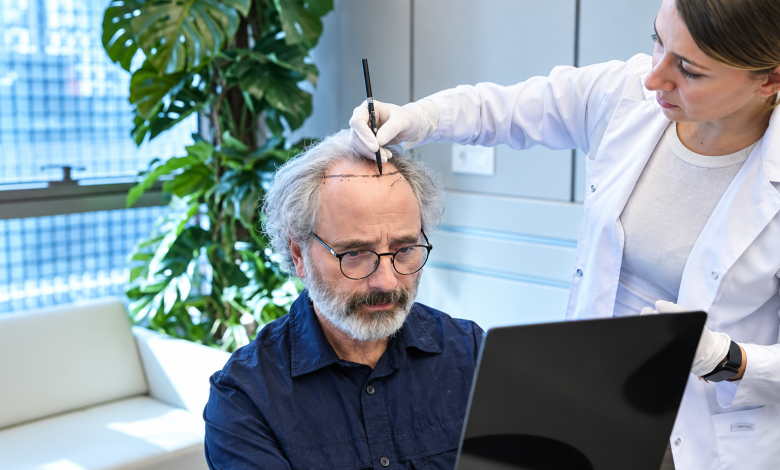
If you are holding a quote, a WhatsApp thread and a request for a deposit, the question you actually need answered is narrow: can this clinic show you, in writing and in advance, who will examine you, who will perform each part of the surgery, why the proposed plan suits your hair loss, what the total cost covers and who is responsible if something goes wrong after you fly home?
That is the direct answer. Do not pay a deposit until a clinic has provided verifiable clinician identities, a personalised medical assessment, named responsibility for each surgical step, itemised written costs, documented risks and a realistic follow-up plan. Popularity, a polished Instagram feed, a low headline price or a page of before-and-after photographs are not substitutes for any of those things.
This article describes a general verification process. It is not medical advice, it cannot tell you whether you are a suitable candidate, and it makes no claims about any particular clinic.
The symptoms of an unverified booking
The problem usually announces itself in small ways rather than one obvious red flag. Readers in the pre-booking stage commonly report some combination of the following:
- A graft number was quoted within minutes of sending two phone photographs, with no explanation of how it was calculated.
- The quote says “doctor-supervised” or “performed by our medical team” but no individual clinician is named.
- The price changes depending on which channel you ask through, or a “discount” expires within 24 hours.
- Questions about the cause of your hair loss, your medications or your family history were never asked.
- Nobody has explained what happens if grafts do not grow, if the donor area looks thin, or if you develop an infection three days after returning home.
- Risks are described as “minimal” or “none” rather than listed and explained.
Each of these is a gap in information, not proof of wrongdoing. The purpose of due diligence is to close the gaps before money changes hands, because afterwards your leverage, your refund rights and your access to independent advice all shrink.
Possible causes versus confirmed causes
It helps to separate what you suspect from what you have established.
Possible causes of your uncertainty include language and time-zone friction, sales staff rather than clinicians answering the first messages, template pricing designed for a mass market, and marketing material written for persuasion rather than consent. None of these necessarily indicates poor clinical care.
Confirmed causes are the ones you can document: a named clinician you cannot find in any official register; a written refusal to identify who performs extraction and implantation; a quote with no itemisation; a consent document you are only shown on the morning of surgery. These are the findings that should change your decision, because they are verified facts about your own transaction rather than general industry anxieties.
Step-by-step checks, in the order they matter
-
Verify the facility and the clinician, not the brand
Ask for the legal name of the facility, its authorisation status, and the full name and specialty registration of the physician responsible for your case. Turkish facility authorisation, clinician licensing and medical-tourism authorisation are administered through the Republic of Türkiye Ministry of Health and associated official registries; check the current requirements and any searchable records there rather than relying on a clinic’s own description of its status. If you cannot confirm that a named individual is a licensed physician in Turkey, treat everything downstream as unverified.
-
Insist on a medical assessment before a sales quote
A proper assessment should address the likely cause and expected progression of your hair loss, your general health and medications, scalp condition, donor-area capacity, and non-surgical alternatives. Professional dermatology and hair-restoration bodies consistently frame transplantation as one option within a wider treatment plan, not an automatic answer to shedding. Photographs may be enough for some straightforward cases and clearly insufficient for others — diffuse thinning, rapid loss, scarring patterns, autoimmune conditions and female pattern loss in particular usually need in-person or specialist evaluation. If you are unsure about candidacy, an independent consultation with a dermatologist or hair-restoration physician in your own country is worth the cost before you book travel.
-
Get the surgical division of labour in writing
Ask, by email, for the name and professional role of each person expected to: design the hairline, administer local anaesthesia, extract follicles, create recipient sites and implant grafts. Then check what each of those roles is permitted to do under current Turkish regulations, again via Ministry of Health guidance rather than the clinic’s assurance. Vague answers here are the single most common unresolved issue readers describe, and it is reasonable to make a written answer a precondition of payment.
-
Interrogate the graft number
Ask how the estimated graft range was produced, how donor density was measured, how the plan avoids overharvesting the donor area, and how the hairline design accounts for future loss. Beware of promises of an exact graft survival percentage, permanent density or a guaranteed cosmetic result; these cannot be guaranteed for an individual patient, and any figures quoted should be clearly qualified and sourced. Recognised complications discussed in clinical literature include infection, bleeding, scarring, poor or patchy growth, unnatural appearance, temporary post-operative shedding, altered scalp sensation and donor-area depletion. A clinic that lists these and explains how it manages them is giving you more, not less, confidence.
-
Compare itemised totals, not headline packages
Package prices are marketing units; your real exposure is the sum of tests, medications, anaesthesia, the procedure itself, accommodation, transfers, any revision policy, follow-up appointments and the cost of treating a complication at home. Ask for a line-by-line breakdown in a currency you can verify. Clinics publish their own explanations of hair transplant cost in turkey, and reading a few of them helps you recognise what is typically bundled and what is quietly excluded, but a published range is a starting point for questions rather than independent evidence about your case. The same applies to per-unit pricing: a page on Hair Transplant Cost Per Graft in Turkey can show you how graft-based quoting works, though a low per-graft figure attached to an inflated graft count is not a saving.
-
Read the paperwork you would normally skip
Request the informed-consent documents in advance and in a language you read fluently. Review infection-control and sterilisation procedures, emergency arrangements and hospital transfer protocols, cancellation and refund terms, data-protection and image-consent policies, and exactly how follow-up works once you are home — who answers, how quickly, and at whose cost.
A compact troubleshooting table
MedArt Hair – Before & After Result
| Unresolved issue | What to request | Where to verify | If it stays unresolved |
| Facility or clinician status unclear | Legal facility name, physician’s full name and registration | Republic of Türkiye Ministry of Health and official registries | Do not proceed |
| No personalised assessment | Written assessment covering cause, health history, donor capacity, alternatives | Independent dermatologist or hair-restoration physician | Pause and seek a second opinion |
| Who performs each step is vague | Named roles for design, anaesthesia, extraction, site creation, implantation | Current Turkish scope-of-practice rules | Pause; make written answers a condition of payment |
| Graft number unexplained | Method of estimation, donor density measurement, overharvesting safeguards | Professional hair-restoration guidance | Request revision or decline |
| Price unclear | Line-item quote including revisions and complications | Your own comparison of published clinic pricing | Do not pay a deposit |
| Aftercare undefined | Named contact, response times, cost responsibility | Written policy from the clinic | Walk away |
When to pause or walk away
Stop the process if identities or credentials cannot be verified, if answers become evasive once you put questions in writing, if payment pressure replaces clinical assessment, if material risks are dismissed, if the agreed plan changes on the day without a clinical explanation, or if nobody will state who is responsible for aftercare. These are general warning signs that apply across the market; they are not allegations about any specific provider.
Prevention, and what success looks like
Prevention is mostly sequencing: assessment first, plan second, price third, deposit last. Keep everything in writing, ask the same question twice at different points and check that the answer does not change, and avoid treating rankings, testimonials or claims about the best hair transplant turkey option as evidence — superlatives of that kind are marketing language, not verified findings, and any clinic-specific credential, outcome figure or procedure volume should be independently documented and dated before you rely on it.
Success, at the booking stage, does not mean a guaranteed result. It means you can name your surgeon, explain why you are a candidate, describe who will perform each step, state your total cost and risks, and say exactly who you will contact on day three, week six and month twelve. If you can do all five, you have resolved the problem this article set out to address.