Day one, no induction
Nobody starts work on a building site in the UK without an induction. No matter if you’re a new labourer or a subcontractor with 30 years of experience, you start with a briefing. Someone tells you who’s in charge, the site rules, where you can’t go, and what to do if something goes wrong. It’s the law (CDM 2015, regulation 13), and it’s so normal that nobody even thinks about it.
Then I rolled AI out across my own construction company and let it start without one.
I have used AI daily since 2022. I taught my teams to use it and began building AI agents for the business. On paper it looked like the perfect new starter. It was quick and it didn’t get tired.
In construction that’s usually the first warning sign. We hired people who interviewed well. But a few weeks later, it was clear they couldn’t do the job. I bet many construction company owners have a similar story.
This one went the same way, quicker. We lacked a single system for everyone to follow. The agents used the files they received, but these weren’t always the most recent.
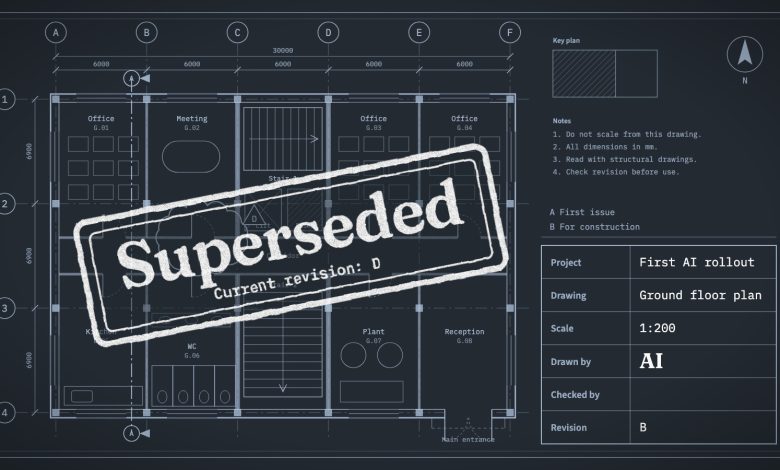
One week, the AI created a full set of subcontractor enquiries from a drawing that was two revisions old. Our buyer only noticed this on the morning they were meant to send them out. That kind of thing kept happening, and people had to stop what they were doing and redo it.
None of it reached a client or a site, because the team caught it. Then they did what any sensible person does with a tool that makes more work than it saves, they stopped using it. Can’t blame them.
It would have been easy to call it a bad hire and move on, and plenty of companies are about to. Gartner predicts that by the end of 2027, organisations will drop more than 40% of agentic AI projects (Gartner, June 2025).
The team weren’t the problem. The system was, and that was down to me. Looking back, four things went wrong in that first rollout and not one of them was the AI itself.
The tools weren’t the expensive part. The expensive part was the redone work, and a team that didn’t want to try again.
The induction I should have given it
A site induction is there to keep people safe. The AI needed an induction too, one about getting the work right. When I reviewed that first rollout, I found four key points.
Which files are current. I’ve had site build off an old drawing before, and most people who’ve run a construction company have. Our AI was doing the same thing in the office, a lot quicker. So the first fix was one place for files, with one live version of each, so there was nothing out of date for it to pick up.
How the job’s done here. We were a main contractor with over 80 people. We lacked a single way of doing things. This meant two people could do the same job in different ways and both believe they did it right.
The AI had no way of knowing which one we meant. So we agreed one way of working, and everyone followed it, the AI included.
Who’s in charge, and what are the rules? On site everyone knows who to go to when something’s not right. With the AI nobody did, because nobody owned it.
It gained an owner and had rules everyone knew. One rule was that someone had to check the work before anything went out.
Meeting the team. You wouldn’t let a new starter wander alone on-site. Someone should show them around and introduce them to others.
We’d skipped that as well. So we brought the team back in, with proper training and some early wins they could see for themselves.
None of the four was clever, and none of them was about the AI. It’s what you’d sort out for any new starter before they touched a job.
Starting again is harder than starting
Getting the team to try it a second time took longer than the first, and to be fair I’d have been the same. The first time round they had no reason to say no. The second time they did, they’d already redone its work once.
What brought them round was the training, and seeing it get things right on their own work.
What it did once they inducted it
Once the team sorted out the files, workflow, and ownership, the AI began to perform as expected from day one.
A pre-qualification form is a questionnaire that a client sends you before you can bid for their work. It now takes about 20 minutes instead of a whole day. The weekly programme update changed from taking most of a day to about an hour. We began noticing delays 2 to 3 weeks before they arrived.
Matching delivery tickets to invoices used to take a full day every month. AI now matches delivery tickets to invoices. This process takes about an hour.
As a result, we stopped paying for loads we never received. Nobody puts that kind of saving on a slide. Then again, nobody likes paying for a lorry that never turned up.
Add enough of those together and it saved me hundreds of thousands in my own company. The work was still the team’s, the AI took the parts that were eating their time.
The job it got wrong first
On day one, the AI couldn’t tell an old drawing from a current one, and that’s where the wrong work came from. Once every drawing had a live version in one place, drawing control changed. It went from taking half a day a week to minutes.
The new starter that got the drawings wrong ended up looking after them.
If AI gets something wrong in its first few weeks, look at what you gave it before you blame the AI. In our case it was showing us a gap we already had.
Your AI needs an induction too
Before AI starts anywhere in your company, ask the four questions you’d ask about any new starter.
- Which files are current, and do they all live in one place?
- How is this job done here, and does everyone actually do it that way?
- Who’s in charge of the AI, and what are its rules?
- Has the team met it and seen it get something right?
If you can’t answer those yet, it isn’t ready to start, however good it looked at interview.
Nobody starts on a building site without an induction. Nothing should start in your company without one either.
Author:
Kristian Brown MCIOB co-founded Built Logic. The company focuses on AI for the construction industry. He has spent over 15 years in UK construction.