“Spiritual life does not remove us from the world but leads us deeper into it.” — Henri J.M. Nouwen, Dutch Catholic priest, professor, writer and theologian.
Over a three-decade career, I have seen technology repeatedly rewrite the rules of business. The AI age is doing so again, but this time the magnitude feels extraordinary: unprecedented opportunity alongside profound disruption. And when the world outside is changing at such a rate, our ability to remain steady becomes our greatest strength.
I was introduced to spirituality through the practice of meditation at the age of 15, and over the years it has become a way of life. Through moments of growth and success, uncertainty and setbacks, it has helped me pause, find clarity amid the noise, and approach change with a greater sense of perspective.
Over time, I have also come to understand spirituality more deeply, not as something separate from the demands of the world, but as something that can help us engage with them more consciously.
In the AI age, I believe its relevance is only growing.
The AI paradox
AI is opening up possibilities at a scale and speed that are difficult to overstate. It is lowering barriers to knowledge, creativity, productivity and enterprise. As a business leader, I find this enormously exciting. Ideas can move from conception to execution faster, problems can be solved at greater scale, and entirely new forms of value creation are becoming possible.
But I also see the other side of this transformation.
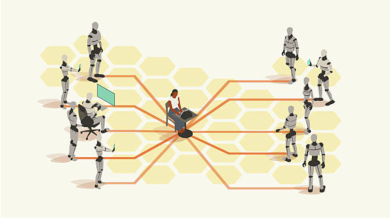
The same technology that is expanding human capability is also disrupting many of the structures built around it. Expectations are shifting rapidly, competition is intensifying, and people are being forced to question not only their jobs, but their place in the economy. AI is moving beyond routine and repetitive tasks into knowledge-based work long considered a distinctly human domain, exposing professions such as management consulting, investment banking, accounting, financial analysis, and many more, to automation. And it may only be a matter of time before that disruption extends much further into the physical world with widespread adoption of robotics and AI-enabled systems.
The disruption goes deeper than employment. Skills such as software development, data analytics and even content generation, that once signaled expertise are becoming commoditized by AI. Career paths are becoming less predictable. And for many people, identities built around professional competence and experience are being unsettled.
This is the defining duality of the AI age: the same technology that is expanding what we can do is also forcing us to reconsider what makes us valuable, relevant and distinctly human.
The hidden human crisis
The sheer magnitude of change and the uncertainty can feel overwhelming. Thriving in this environment is a great challenge, requiring far more than learning new tools or acquiring new skills. We will need to learn and unlearn quickly, remain confident amid uncertainty and keep moving as familiar roles are disrupted.
Job loss is only the most visible part. The deeper challenge is the erosion of confidence when relevance and identity are called into question. Even those pursuing new opportunities will need courage to experiment, withstand failure and reinvent.
In essence, the AI age is pushing us to rediscover what is uniquely human: who we are beyond our roles, what gives us meaning and purpose. This requires us to journey within ourselves to develop the inner clarity to navigate change without losing ourselves. This journey inwards is called Spirituality.
Spirituality can take different forms for different people. For some, it may be prayer or meditation; for others, running, sport, yoga, art, music or time in nature. The form may differ, but the central purpose is to create space to connect more deeply with ourselves and emerge with greater awareness, clarity and perspective.
Technology and Spirituality: Not opposites, but counterbalances
Technology and spirituality are often seen as opposing forces: one rooted in machines, speed and material progress; the other in stillness, consciousness and inner growth. But personally, I have never experienced them as being in conflict.
If anything, the practices have both grounded and amplified me. Whether meditation, running or playing squash, the practices have helped me engage with the external world with greater clarity and perspective. In moments of intense pressure, difficult decisions and constant change, these practices help me step back, reset and respond with greater clarity and awareness, rather than simply react to what is happening around me.
Technology expands what we can do; spirituality deepens our understanding of who we are and how we use that power. I see spirituality playing four roles in creating that balance.
Spirituality as filter: Clarity amidst the noise
The AI age is an age of heightened distraction and noise. We are constantly bombarded with data, information, opinions, alerts, possibilities and contrasting signals. The challenge is to discern what matters and what does not.
For me, Spirituality becomes that filter, creating an inner space, where I can step back from all the noise, take time to observe and exercise discernment, instead of reacting to every signal, every noise. It gives you the ability to distinguish between what is really important, and what is mere distraction. As a leader, this clarity is especially important when information is abundant and the answer is not so obvious. Spiritual practice helps me quieten the clutter, see the situation more clearly and focus on what truly matters.
Spirituality as a lens: Expanding consciousness, unlocking possibilities
Seeing clearly is just one part of the challenge. As machines extrapolate from what already exists, we must also learn to move beyond the obvious and imagine possibilities that do not yet exist.
Spirituality can be that powerful catalyst for expanded consciousness, to see the bigger picture and imagine the unimagined. It can help us unlock a more multi-dimensional form of creativity, drawing on intuition, experience, curiosity and imagination. It allows us to hold complexity and paradoxes, step beyond the narrowness of the immediate, question familiar assumptions and connect seemingly unrelated ideas – the perfect recipe for breakthrough innovation.
Over time, I have come to see that this wider perspective can emerge through many different forms of practice. I see this in my daughter’s relationship with art. Painting and sculpture absorb her in ways that open up new ways of seeing form, possibility and meaning. It reminds me that spirituality can emerge not only through stillness, but also through flow.
Spirituality as shield: Protecting mental and emotional well-being
As AI accelerates the pace of change, it is also increasing the mental load we carry. Constant connectivity, information overload, uncertainty about the future and the pressure to keep adapting can all take a toll on our emotional well-being. In a world that is becoming faster and more demanding, protecting our mental and emotional well-being is becoming as important as building any new technical skill.
For me, spiritual practice has often acted as a shield against that accumulation of stress. Meditation helps me slow down and create mental space, while running and squash give me a different kind of release through movement and complete presence in the moment. These practices do not make the pressures disappear, but they help prevent them from becoming all-consuming.
Over time, I have found that this ability to pause or disconnect is essential. It helps us manage stress before it compounds, regain emotional balance and return to difficult situations with greater energy and resilience.
Spirituality as a compass: Finding purpose, ethics and moral direction
AI is rapidly expanding what humans are capable of doing. With so many possibilities, the critical question increasingly shifts from What can we do? to What should we do?
This is a pivotal moment. AI has the potential to create enormous value, expand access, solve complex problems and improve lives. But it can also deepen inequality, erode trust, compromise dignity or cause harm. The technology itself does not make that choice for us. We do. And as a leader, I have seen that the hardest decisions cannot always be reduced to data, efficiency or short-term outcomes. There are moments when you have to ask yourself what you stand for, how a decision will affect others, and whether the path you are choosing is aligned with your values.
That is why judgment, ethics and discernment become even more important in the AI age. Shaped by culture, lived experience, reflection, and our deepest values, spirituality can help strengthen that inner compass by grounding our choices in values such as compassion, dignity, responsibility and interconnectedness.
Spirituality is a way of life
For spirituality to truly shape how we navigate the world, it has to move beyond an abstract idea to a way of life. That means building practices into everyday life that create space for reflection, presence and renewal.
I believe this inner foundation can be built brick by brick through three simple disciplines:
-
Start small, build consistently
Spirituality is not built in occasional moments of inspiration, but through small, consistent rituals that deepen into discipline over time. Today, I meditate at least twice a day, even if only for 15 or 20 minutes. I also run regularly and make time to play squash. These practices have become part of the rhythm of my life, but they did not become habits overnight. They were built gradually, through consistency.
You do not have to move a mountain on day one. Start small and show up consistently. Over time, intention becomes practice, practice becomes habit, and habit builds the inner discipline needed to maintain clarity and resilience amid change.
-
Turn values into a decision-making compass
Define the values and purpose that guide your decisions, especially when new possibilities create difficult choices. For me, spiritual texts have been an important source of that guidance, particularly the Bhagavad Gita. I have read it more than 15 times, and I keep returning to it because its lessons on duty, detachment, action and self-mastery remain deeply relevant to the choices we face in everyday life and leadership.
The important step is to make those values operational. Regularly ask whether your actions align with what you believe in. When faced with competing priorities or ethical dilemmas, let those values become a practical decision-making framework, helping you choose not only what is effective, but what is responsible and meaningful.
-
Embrace release and renewal
Spiritual growth is as much about letting go as it is about acquiring. In a rapidly changing AI world, we need to consciously release outdated beliefs, assumptions, habits and even definitions of success that may no longer serve our growth. This essentially requires taking deliberate digital breaks, even if for a short period of time.
I try to do an Art of Living Silent Retreat at least once a year. The experience of silence helps me completely disconnect from the external world, let go of limiting beliefs, regrets and worries, and create the space to see a bigger vision for myself. I return feeling more grounded, centred and open to new possibilities.
I also find renewal in other forms of stepping away, spending time with nature, taking a vacation, travelling to places where the natural world remains largely untouched. Being immersed in such environments helps me return with a clearer mind and a renewed sense of perspective.
Having said that, this cannot remain an individual movement alone. If spirituality is to become a meaningful human capability, organizations also have a responsibility to create the conditions in which it can take root. Which is why I believe spirituality must become an organizational capability.
The Leadership Response
In the AI age, organizations themselves must continually reimagine how they create value, compete and grow. That requires people to break free from old ways of working, question entrenched assumptions, learn and unlearn at speed, and imagine entirely new possibilities.
In my experience, this kind of transformation requires more than technology. Organizations have a responsibility to build cultures that encourage reflection, experimentation, self-awareness, adaptability and innovation. Spirituality, therefore, cannot be reduced to another wellness initiative. It needs to be supported through the way organizations think about leadership, culture and human development.
Organizations can begin by creating dedicated spaces for guided meditation, quiet reflection, or simply a few moments of pause during the workday. They can reinforce this through regular mindfulness sessions, coaching, mentoring and protected reflection time. At Incedo India, our partnership with the Art of Living Foundation gives employees the opportunity to participate in a foundational breathing and meditation program soon after joining, followed by refresher sessions throughout the year. We now plan to extend this practice to our US teams.
Leadership development also needs to move beyond technical and managerial capability to include active listening, empathy, self-awareness, coaching and reflective practice. Leaders should be evaluated not only on what they deliver, but on how they lead: whether they create trust and psychological safety, demonstrate integrity and exercise responsible judgment.
The goal is not to institutionalize spirituality itself, but to create the conditions in which greater awareness, judgment, empathy and resilience can flourish.
The AI future needs human depth
Ultimately, we need an ecosystem in which technological intelligence is matched by expanded human consciousness. Global leaders have an opportunity, and a responsibility, to look beyond spirituality as a cultural or regional idea and consider what its deeper principles can contribute to the AI age.
Technology will continue to make us more capable. The greater question is whether we can become equally wise in how we use that capability. By bringing together digital scale with inner development, human values, and conscious leadership, we have an opportunity to shape an AI future that is not only more intelligent and productive, but also more humane, resilient, and meaningful.