AI has consumed much of the open web. What it can’t scrape is the work behind your hardest cases—and that knowledge walks out the door every time an experienced employee does.

The answer is public. The investigation behind it isn’t.
Somewhere in your help desk is a ticket that costs your best support engineer an entire afternoon.
A customer’s invoice wouldn’t sync. The obvious fix failed. So did the second one. Then someone dug up a rule buried in a three-year-old contract, changed the approach, tested it and closed the case.
The help article that came out of it is two sentences long. Any AI model can read it.
What no model can read is the afternoon: the dead ends, the contract clause, the judgment call and the proof that it worked. That record still sits in your systems. It is exactly the kind of material AI developers are now hunting for.
SourceX will pay qualifying companies up to $4M to license it.
Why your archive suddenly matters
For years, AI models learned mostly from public text. In SourceX’s words, “much of the openly available text has already been used,” and AI developers are looking for new sources of real-world data—preferably licensed with the owner’s agreement rather than collected without it.
Public text teaches a model to sound right. Business records can show what being right actually took. In the original 2024 tau-bench research, agents were judged not on what they said but on whether the database ended up in the correct state. The tested agents, including GPT-4o, completed fewer than half the tasks. Those are historical results, not a verdict on today’s models—but the lesson holds.
The gap between describing work and completing it is the gap your operating history may help fill.
What is AI data licensing for a business?
AI data licensing gives an AI developer agreed rights to use a defined collection of business records for training or evaluation. The most useful collections show real work end to end: the request, the information available, the decisions, the actions and the outcome. Offers depend on quality, rights and buyer demand, not storage volume alone.
The clock you didn’t know was running
Here is the uncomfortable part. Your files may last for years. The ability to explain them doesn’t.
The engineer who knows why that ticket closed the way it did will change roles or leave. The old CRM will be switched off in a migration. Retention schedules will delete what they are supposed to delete—as they should.
Each of those events makes a case harder to reconstruct. A record nobody can explain is worth far less than one somebody can walk through today.
So the right time to ask whether your history is valuable is while the people who made it are still down the hall.
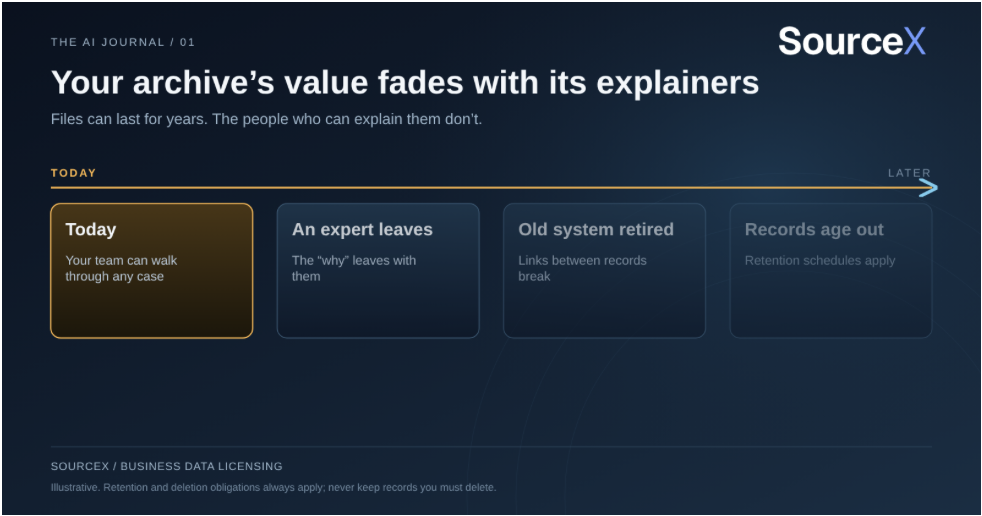
Every departure and system shutdown makes your history harder to explain.
What buyers actually want
Not volume. A million tickets marked “closed” say less than a few thousand episodes that show the whole story.
Strong collections answer four questions for every case. What was asked? What did the employee know at that moment? What did they do? How do we know it worked?
Keep the messy cases, too. An archive of nothing but successes can’t show how the operation really performed, and buyers know it. Honest gaps, clearly labeled, make a collection more credible, not less.
Does your company fit?
SourceX’s best-fit companies generally reached 50 or more full-time employees at peak, have several years of operating history and are in a supported location. The U.S. is prioritized, with Canada, the EU and several other regions also considered. Companies that are operating, acquired or wound down can all qualify.
If that sounds like you, the first step is a short company fit check: a few questions, no files, no raw uploads. You don’t hand over a single customer record to find out whether you’re in the running.
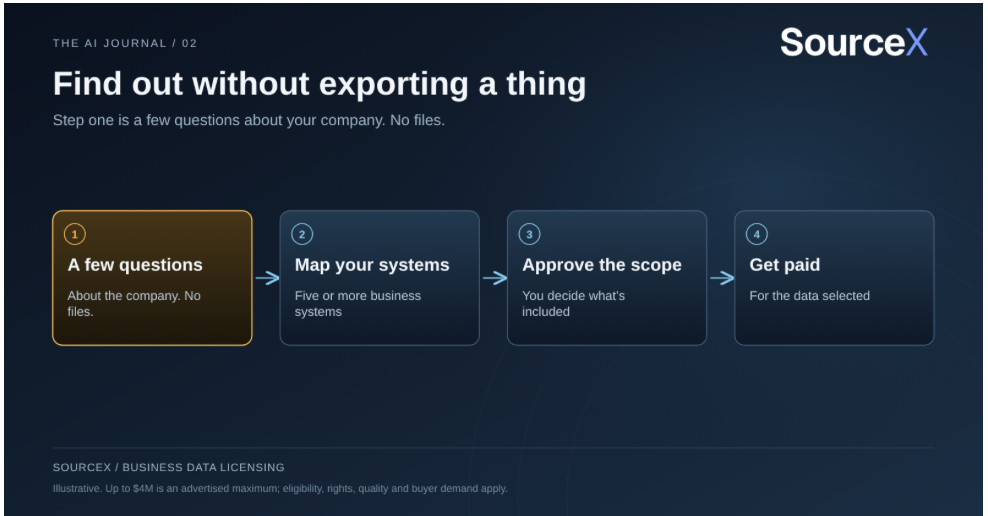
The first step is a few questions—and zero files.
How the deal works
If your company fits, SourceX handles the agreement, rights review, preparation and payout. You decide what’s in scope and you authorize the release.
Standard terms are a one-time fee, with no royalties, in exchange for perpetual exclusivity for AI training. Prefer a shorter commitment? Twelve- or 24-month exclusivity can be agreed, and non-exclusive licenses are available at a substantially lower price—roughly a quarter of the exclusive range, according to SourceX. That tells you something important: exclusive rights to real operating history are the valuable part.
Applying creates no commitment, and you can walk away before signing.
Do this before your next leadership meeting
Pick one workflow your team handles constantly: complex support cases, contract exceptions or engineering escalations. Name the systems it touches and how many years they cover. Name the person who can explain it and the person authorized to talk about rights.
That’s a conversation, not a project.
Then run the fit check. The worst case is a quick no. The best case is discovering that the hardest problems your company ever solved are worth up to $4M to someone else.
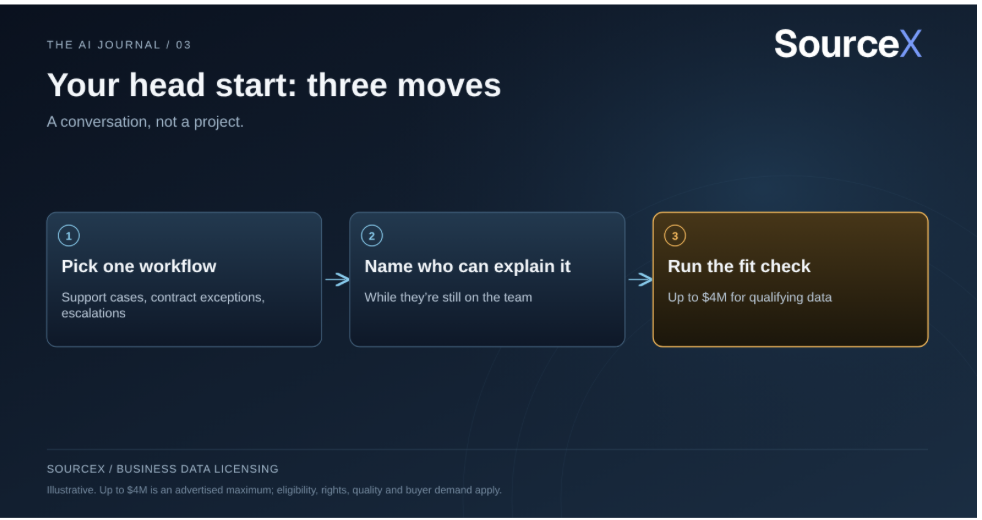
One workflow, one owner, one fit check.

Questions business leaders ask
Can an ordinary company license data for AI?
Potentially, yes. SourceX works with established businesses that have years of operating history, a supported location and rights to the proposed records. Fit is assessed company by company, and meeting a headcount criterion is not a guarantee.
Does more data mean a bigger offer?
Not necessarily. Connected cases with clear outcomes and clean rights matter more than file count. Buyer demand also shapes the price.
Do I have to upload customer records to check fit?
No. The first fit check asks about the company only. Any later preparation follows the agreed scope and signed terms.
Your company already paid for years of hard-won answers. Find out in a few questions whether SourceX will pay to license them—before the people who can explain them move on.
About the Founder
Noah Loul is a four-time founder and the founder of SourceX, which licenses business data directly from companies for AI training and evaluation. His ambition is to build the world’s largest data infrastructure, powering today’s AI and tomorrow’s superintelligence.