
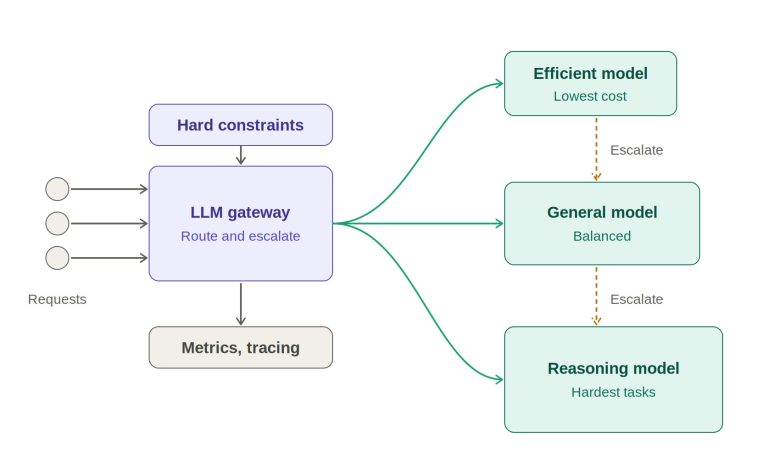
Production LLM applications often send every request to the same model. That keeps the architecture simple, but it can make routine tasks expensive. A high-capability model may handle classification, formatting, or short summaries well, yet those requests may not need its full reasoning capacity.
A model router sits between an application and its model providers. It selects a suitable model for each request, applies operational constraints, and handles failures or uncertain results. The goal is not to use the cheapest model everywhere. It is to meet the application’s quality and latency requirements at the lowest practical cost.
Treat routing as a quality decision
A routing policy balances three factors: output quality, response time, and cost. Choosing a smaller model can lower the cost of a request, but the savings matter only if the response remains useful. Choosing a larger model can improve results on difficult tasks, but it may add both latency and expense.
The right balance depends on the task. A request to extract dates from a known format may be straightforward. A request to analyze a production incident across several services may require more context and reasoning. User tier, data sensitivity, latency targets, and task requirements can also affect the choice.
Avoid assuming that a particular share of traffic is “simple” before measuring it. Workloads vary, and a request that looks short may be difficult because it is ambiguous. Start with observed traffic and a defined quality bar.
Place the gateway at a clear boundary
The gateway should receive a structured request from the application, choose a route, call a model, and return a normalized response. It should also record enough information to evaluate the decision later.
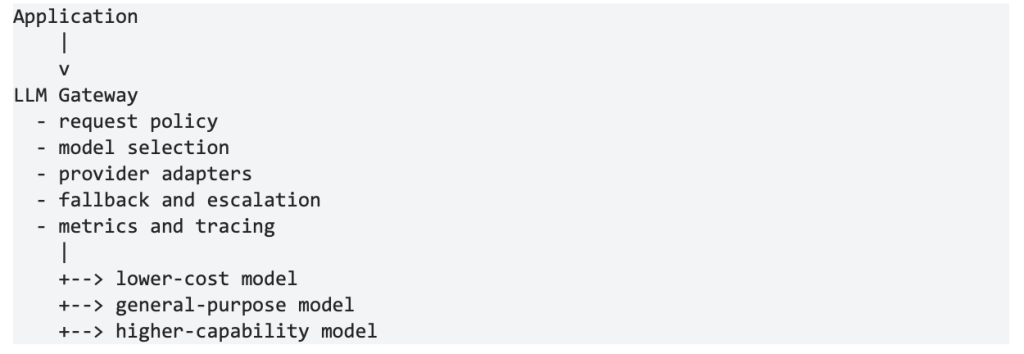
Keep provider-specific details inside adapters. The rest of the application should not need to know each provider’s request format, error codes, or response structure. A stable internal interface also makes it easier to compare models or change providers without rewriting product logic.
The gateway should enforce hard constraints before routing. For example, an application may prohibit sending certain data to a particular provider, or require a maximum response time. These constraints should rule out ineligible models rather than being treated as soft preferences.
Start with explicit rules
Rule-based routing is a practical first version. It uses signals the application already knows, such as task type, requested output format, data sensitivity, or an explicit model preference.
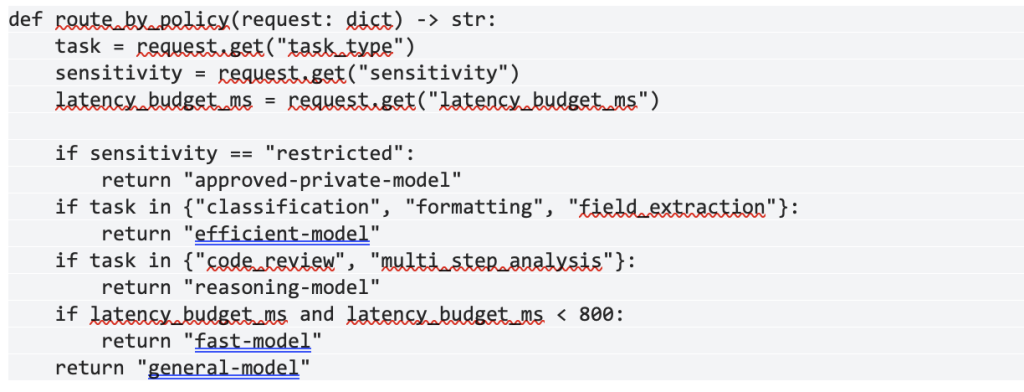
This approach is deterministic, fast, and easy to audit. It works well when task categories are stable and the application can label requests reliably. It also gives teams a useful baseline for later comparison.
Rules have limits. They can become difficult to maintain as exceptions accumulate, and they cannot reliably interpret every unfamiliar request. Keep the policy small and observable. When the rules cannot make a confident decision, route to a safe default or use a separate complexity signal.
Add a complexity signal when needed
A classifier can estimate whether a request is likely to need more capable reasoning. It might use a small model, a trained classifier, or a low-cost language model. The result should be treated as a routing signal, not as proof that the selected model will succeed.
For a supervised classifier, the training examples should reflect actual application traffic. Teams can label a sample of requests based on whether a lower-cost model meets the task’s quality criteria. The labels should come from a defined evaluation process, not from prompt length alone.
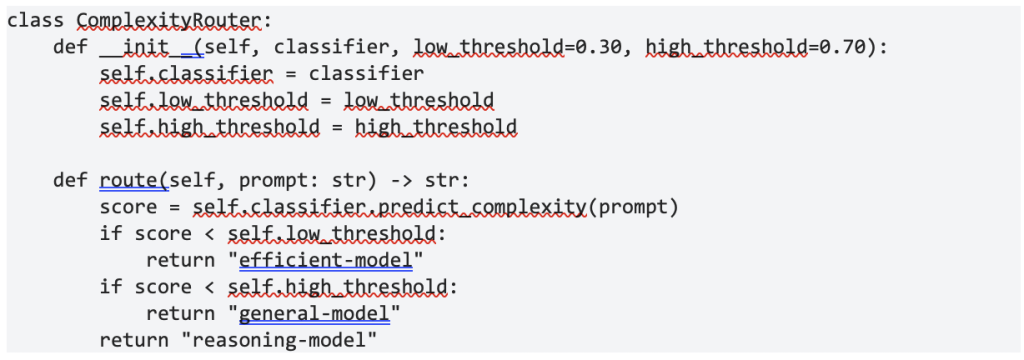
Thresholds create a direct cost and quality tradeoff. Lowering the threshold sends more traffic to capable models, which may improve quality while increasing cost. Raising it may save money but increase retries, escalations, or low-quality responses. Evaluate thresholds against a representative test set before changing production behavior.
An LLM-based triage call is another option. It can handle nuance without a separately trained classifier, but it adds a network round trip and another potential failure point. If used, constrain its output to a small set of valid route labels and define a deterministic fallback for malformed or missing responses.
Combine routing with safe escalation
A model choice is not a guarantee. The selected model may time out, return an error, or produce an answer that fails validation. A production gateway needs explicit retry and escalation rules.
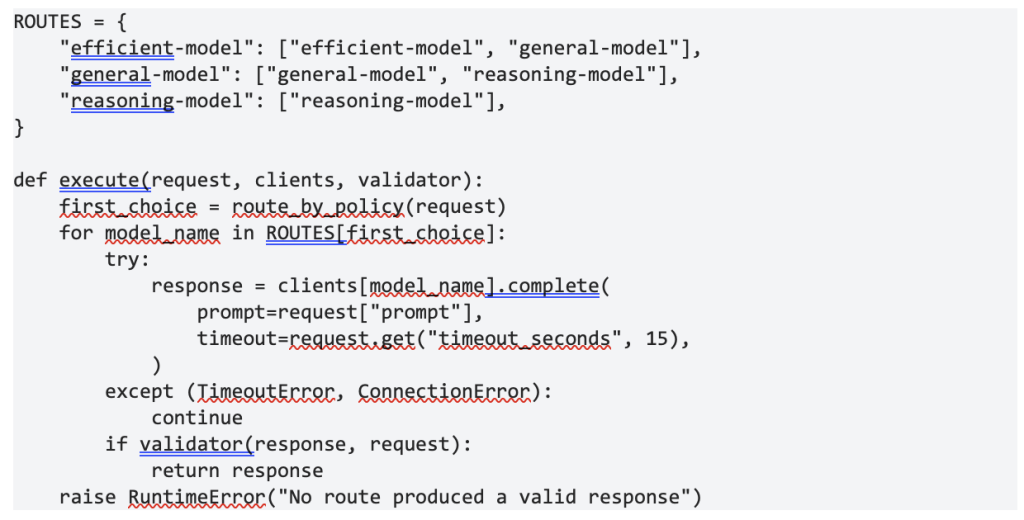 The validator should match the task. For structured extraction, it can check that required fields exist and that values have the expected types. For generated code, it might check that the response is nonempty and passes a syntax or policy check. A generic confidence score is rarely sufficient by itself, especially when providers define confidence differently.
Set limits on retries and escalation. Without them, a failing request can trigger repeated calls, increase cost, and worsen latency. Record which model produced the accepted response, whether escalation occurred, and why the earlier attempt was rejected.
Make cost estimates honest
A router can compare model costs only if it measures them consistently. Estimate cost from the actual input and output usage reported by the provider when available. Prompt length alone is not enough: output tokens can be a substantial part of the total, and providers may apply different pricing to cached or specialized tokens.
Track at least:
| Metric | What it helps reveal |
| Cost per completed request by route | Whether the policy reduces actual spend |
| Quality or task success by route | Whether lower-cost choices meet the application’s bar |
| Escalation and retry rates | Whether a route is failing too often |
| Latency by route | Whether the selected model meets service targets |
| Provider errors and timeouts | Whether failures are operational or quality-related |
Compare routed traffic with a baseline. For example, replay a representative evaluation set through both the routing policy and a single-model policy. Measure task success, latency, and estimated cost using the same inputs. This makes the tradeoff visible before the router controls all production traffic.
Avoid common routing mistakes
- Using prompt length as the main complexity measure. A long list may need only formatting, while a short question may require careful reasoning. Length can be one feature, but it should not define the route.
- Treating user tier as a proxy for task difficulty. A premium account may have a different service commitment, but its routine requests may still be well served by an efficient model. Apply tier rules only when they represent a real product or service requirement.
- Escalating on vague signals. If every unusual response triggers a retry, costs can rise quickly. Define task-specific validation and monitor how often each signal causes escalation.
- Ignoring data policy. A capable model is not an eligible model if the request’s data cannot be sent to that provider. Enforce provider and data constraints before selecting a route.
- Leaving thresholds untouched. Model capabilities, prices, and traffic patterns change. Review the policy when those inputs change, and use evaluation results to justify adjustments.
Roll out gradually
Begin with a small set of explicit rules and a safe default. Log the proposed route while continuing to serve requests through the existing path. Compare predicted routes with quality, latency, and cost results. Then enable routing for a limited share of traffic and expand it as the results support doing so.
Keep a straightforward fallback that preserves service when the classifier or gateway is unavailable. A routing layer should improve control over model use, not become a single point of failure. The application should also have a defined behavior when all eligible models fail, such as returning a clear error or queuing the request where appropriate.
Smart model routing works best as an evidence-driven policy. Rules provide a quick starting point, classifiers can help with ambiguous requests, and escalation handles cases where the first choice falls short. Measure each route against the same quality bar, enforce operational constraints, and tune from observed outcomes. That lets teams manage cost without making model selection a guess.