Abstract
Modern enterprise data platforms are characterized increasingly by architectural complexity rather than computational complexity. As data systems accumulate transformation layers, orchestration logic, business rules, and cross-domain dependencies, engineers spend substantial time understanding existing implementations before they can diagnose problems or make changes. This article examines the use of large language model (LLM)-based tools for investigating complex data pipelines, with emphasis on lineage reconstruction, root-cause analysis, business-rule discovery, and system comprehension. The practical observations presented here suggest that AI assistance can be particularly useful when the engineering task is not to generate new code, but to synthesize and explain existing code and dependencies. Human validation remains essential because AI-generated explanations can contain incorrect assumptions or omit relevant system context.
Introduction
Data engineering has evolved from building relatively isolated extraction and transformation jobs into operating interconnected analytical ecosystems. A production environment may contain SQL transformations, common table expressions, scheduled workflows, incremental processing, slowly changing dimensions, data-quality checks, semantic definitions, and dependencies spanning multiple business domains.
As these systems mature, engineering effort increasingly shifts from implementation toward investigation. An engineer responding to an unexpected result may need to determine why records disappeared, which transformation changed a metric, why a workflow executed under a particular condition, or whether an observed behavior represents a software defect or an intentional business rule.
These questions are difficult because the relevant evidence is rarely located in one place. Understanding an outcome can require reconstructing dependencies across several transformation stages, examining filtering and join conditions, tracing intermediate datasets, and interpreting business logic that may have evolved over several years.
Data-lineage standards illustrate the underlying problem. OpenLineage, for example, models lineage around jobs, datasets, and runs, providing structured metadata about how data moves through processing systems. OpenLineage specification
The central question explored in this article is therefore not whether AI can generate SQL, but whether it can reduce the cognitive effort required to understand an existing data system.
From Code Generation to System Comprehension
Much of the discussion surrounding generative AI in software engineering has focused on code generation, completion, testing, and documentation. The underlying technology has developed rapidly since the introduction of Transformer architectures, which established an attention-based approach that has become foundational to modern language models. Attention Is All You Need
For data engineering, however, an equally relevant application is code and system comprehension. Instead of asking an AI system to create a new transformation, an engineer can provide existing implementation artifacts and ask it to explain dependencies, identify filtering logic, reconstruct an execution path, or summarize how a final metric is derived.
This changes the role of the model from code generator to investigation assistant. The model does not replace the underlying execution engine or lineage system; rather, it provides a natural-language reasoning layer over technical artifacts that engineers would otherwise have to inspect manually.
This distinction is important because investigation efficiency is often determined by how quickly irrelevant portions of a system can be eliminated. An engineer who can narrow a problem from dozens of transformations to one or two relevant stages can then spend more time validating the actual cause.
Investigation Scenario 1: Root-Cause Analysis of Record Attrition
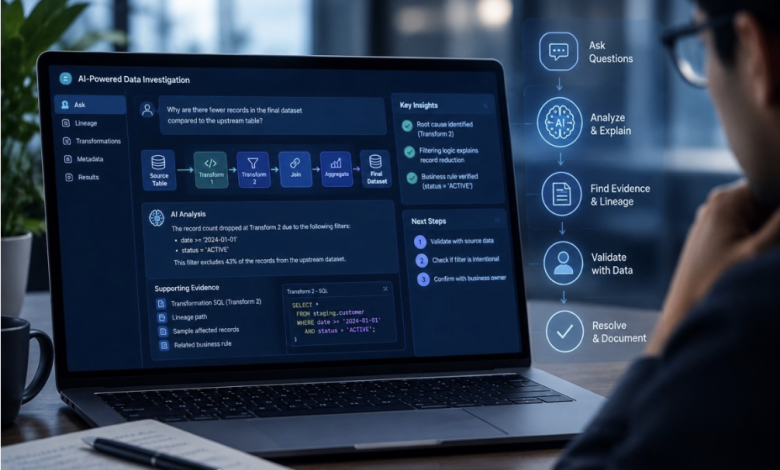
One recurring investigation involved a downstream analytical dataset containing fewer records than expected even though the upstream pipeline completed successfully. A conventional investigation required tracing the data through multiple transformation stages, examining intermediate outputs, and reviewing filtering and join conditions.
An AI-assisted workflow was used to analyze the relevant transformation logic collectively rather than examining each statement independently. The analysis identified the stage associated with the reduction in records and highlighted predicates that could exclude the affected records.
The value was not automatic defect correction. Instead, the AI-assisted analysis reduced the search space by directing attention toward the transformation most likely to explain the observed behavior.
The engineer could then validate the explanation against actual data, intermediate results, and expected business behavior. This separation between hypothesis generation and technical validation is important when applying generative AI to production investigations.
Investigation Scenario 2: Reconstructing Metric Lineage
A second investigation concerned production metrics whose calculations had evolved through multiple transformation layers and historical business requirements. Although the underlying calculations were functioning, stakeholders needed an explanation for why the resulting values differed from their expectations.
Answering that question required tracing aggregation logic, enrichment rules, filtering conditions, and semantic definitions across several datasets. An AI-assisted analysis helped reconstruct the sequence of transformations contributing to the final metric and summarized the business logic affecting the calculation.
The resulting explanation could then be translated into language appropriate for non-technical stakeholders. This illustrates another useful role for AI-assisted investigation: connecting low-level implementation details with higher-level explanations of system behavior.
Metric lineage is particularly challenging when technical lineage and business meaning are not identical. A column may have a clear physical origin while its interpretation depends on eligibility rules, aggregation choices, exclusions, or definitions established outside the transformation itself.
Investigation Scenario 3: Technical Defect or Business-Rule Gap?
A third investigation involved an operational workflow that produced an outcome stakeholders considered incorrect after a deployment change. The execution logic was distributed across multiple transformations and eligibility conditions, making it difficult to determine whether the behavior resulted from a software defect or from an interpretation of the business rules.
AI-assisted analysis was used to reconstruct the execution path and examine the conditions controlling the workflow. The analysis indicated that the implementation was consistent with the encoded logic and that the discrepancy instead originated from assumptions embedded in the business rules.
This distinction changed the direction of the investigation. Rather than modifying working software, engineers could focus on clarifying or revising the underlying business requirement.
Such cases demonstrate why system comprehension can be more valuable than code generation during production incidents. The objective is not necessarily to produce new code, but to establish why the existing system behaves as it does.
A Practical AI-Assisted Investigation Workflow
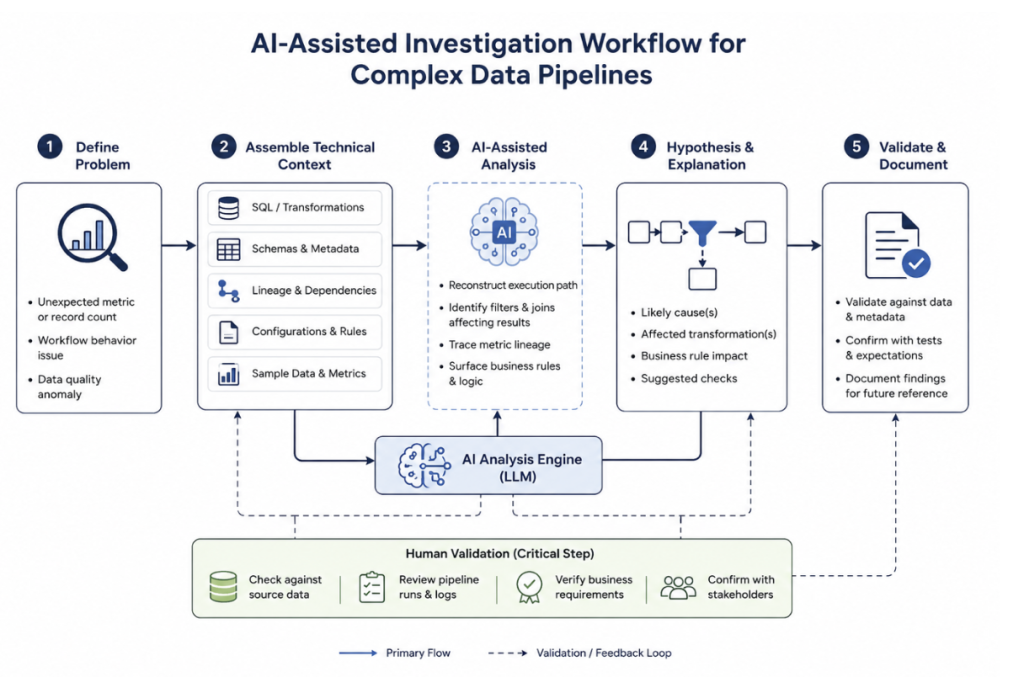
A repeatable workflow can make AI-assisted investigation more useful and less dependent on ad hoc prompting. The first step is to define the observed symptom precisely, such as unexpected record counts, a metric discrepancy, or an unexpected workflow execution.
The second step is to assemble relevant technical context. This can include transformation definitions, schemas, lineage metadata, configuration, dependency information, and representative examples of affected records.
The third step is to ask the AI system to reconstruct the execution path rather than immediately propose a fix. Useful questions include: Which transformations contribute to this output? Which predicates can remove records? Which joins can change cardinality? Which business rules affect eligibility?
The fourth step is independent validation. Engineers should compare the AI-generated explanation against query results, pipeline metadata, source data, tests, and documented requirements before accepting a conclusion.
The final step is to document the verified finding. This creates a durable engineering artifact and reduces the likelihood that the same investigation will need to be reconstructed from scratch in the future.
Limitations and Human Validation
AI-assisted investigation should be treated as an analytical aid rather than an authoritative source of truth. An LLM can produce a plausible explanation that is incomplete, incorrectly inferred, or based on an artifact that does not represent the current production state.
This risk is particularly important in enterprise environments where code, metadata, configuration, and business rules may change independently. A technically convincing explanation can still be wrong if the model has incomplete context or if a dependency exists outside the artifacts provided to it.
Human review is therefore a required part of the workflow. Engineers must validate proposed explanations against executable system behavior, current metadata, source data, and business requirements.
This approach is consistent with broader guidance on trustworthy generative AI, which emphasizes evaluation, governance, documentation, and appropriate human oversight. NIST Generative AI Profile
Data access and confidentiality also require attention. Production SQL, schemas, customer information, business rules, and operational metadata may contain sensitive information, so organizations should establish appropriate controls around what data can be supplied to AI systems and how generated outputs are retained and reviewed.
Implications for Data Engineering
The examples suggest that AI-assisted data engineering should be considered broader than automated SQL generation. As analytical environments become more interconnected, engineers increasingly need tools that help them understand dependencies, reconstruct lineage, explain transformations, and identify relationships among technical and business concepts.
This does not eliminate the importance of conventional lineage systems, metadata catalogs, tests, observability, or documentation. Instead, AI can provide a reasoning and interaction layer over those existing engineering assets.
A mature implementation could combine structured lineage metadata with source code, execution history, schema information, data-quality results, and business definitions. The AI system could then use these artifacts to generate investigation hypotheses while retaining the underlying evidence needed for human verification.
This model also suggests a potential approach to knowledge transfer. When experienced engineers leave a team, much of their knowledge may exist only as an informal understanding of how systems behave. AI-assisted explanations built from current technical artifacts could help make portions of that operational knowledge more accessible to other engineers.
However, organizations should avoid treating generated explanations as replacements for documentation. The more reliable approach is to use AI to improve the discoverability and interpretation of documented system knowledge while continuing to maintain authoritative technical sources.
Conclusion
The increasing complexity of enterprise data platforms has shifted a significant portion of data engineering from software construction toward software comprehension. Root-cause analysis, lineage reconstruction, metric explanation, and business-rule investigation can require engineers to reason across many layers of an existing system before corrective action is possible.
The practical investigation scenarios discussed here indicate that AI-assisted reasoning can provide value by synthesizing transformation logic, narrowing investigation scope, reconstructing execution paths, and translating implementation details into understandable explanations. Its strongest role is therefore not necessarily replacing engineering work, but reducing the cognitive effort required to locate and understand relevant information.
The approach is most effective when AI-generated hypotheses are combined with structured lineage, executable validation, metadata, tests, and human judgment. As enterprise data systems continue to grow in scale and interconnectedness, this combination of machine-assisted comprehension and human verification may become an increasingly important pattern in data engineering practice.
References
[1] Vaswani, A., et al. “Attention Is All You Need.” Advances in Neural Information Processing Systems, 2017. Paper and publication details
[2] OpenLineage. “OpenLineage Specification.” Open standard for lineage and metadata collection across data systems. OpenLineage Specification
[3] Tabassi, E. “Artificial Intelligence Risk Management Framework (AI RMF 1.0).” National Institute of Standards and Technology, 2023. NIST AI Risk Management Framework
[4] Autio, C., et al. “Artificial Intelligence Risk Management Framework: Generative Artificial Intelligence Profile.” National Institute of Standards and Technology, 2024. NIST Generative AI Profile