Hiring the wrong marketing chief drains cash and momentum. The average S&P 500 CMO stays 4.1 years, compared with 5.0 years for all C-suite roles at those companies (Spencer Stuart, CMO Tenure 2026). Budgets are tight too: Gartner’s 2024 CMO Spend Survey found marketing budgets fell to 7.7 percent of company revenue. In this climate, choosing the right search firm to recruit your next CMO is a growth decision, not an HR chore.
How we ranked the firms
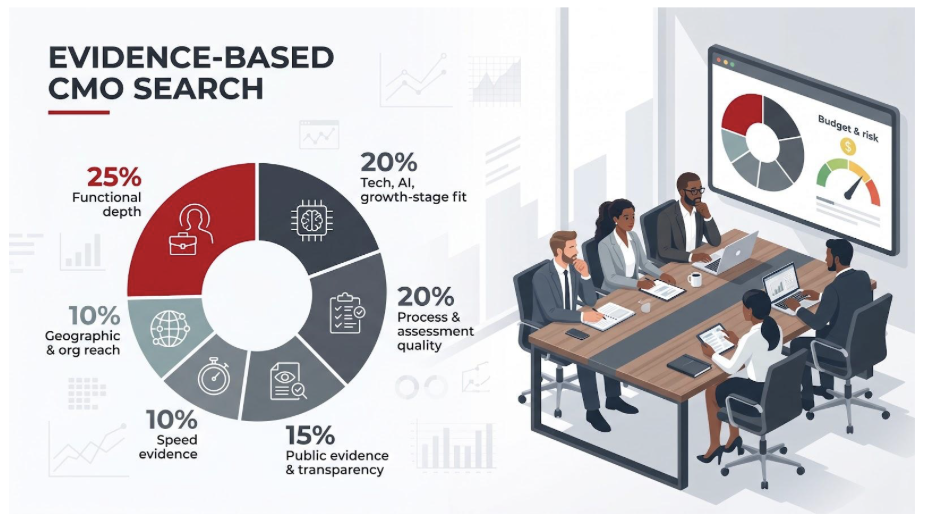
A scoring model only matters if it fits your reality, so we built ours around what fast-moving tech companies say they value.
- CMO and VP marketing depth (25 percent). Proven ability to fill senior marketing seats.
- Technology, AI, and growth-stage fit (20 percent). Pattern recognition in SaaS, AI, and investor-backed scale-ups.
- Process and assessment quality (20 percent). Partner-led calibration, structured interviews, and onboarding support.
- Public evidence and transparency (15 percent). Published metrics you can check: completion, diversity, and repeat work.
- Speed evidence (10 percent). Time to slate and signed offer, not a vague “quick turnaround.”
- Geographic and organizational reach (10 percent). Access to talent beyond one city or region.
| Criterion | Weight |
| CMO and VP marketing depth | 25 percent |
| Tech, AI, and growth-stage fit | 20 percent |
| Process and assessment quality | 20 percent |
| Public evidence and transparency | 15 percent |
| Speed evidence | 10 percent |
| Geographic and organizational reach | 10 percent |
No single score captures every nuance, but this mix lets you compare firms on the issues that drive pipeline, not just résumés.
Quick look: six firms side by side
Here is a single-page view. Figures in this table come from each firm’s own website.
| Firm | Best for | Stand-out proof | Evidence gap |
| SPMB | Tech disruptors, VC- and PE-backed scale-ups | 95 percent of searches are referrals | No published average placement time |
| Spencer Stuart | Fortune 500, global brands | 2,000+ senior marketing, sales, and communications searches in three years | No rate card; timing not public |
| True Search | VC-backed SaaS, first-time CMOs | Thrive talent CRM and SearchEssentials platform | Diversity and speed metrics not public |
| Russell Reynolds | CMO-plus, enterprise growth | Leadership Portrait assessment | Timing not public |
| Heidrick & Struggles | Search plus culture work | Culture Signature diagnostic | Few marketing-specific metrics |
| Cowen Partners | U.S. mid-market, speed focus | Three-week average slate, 365-day guarantee | All results are firm-reported |
The detailed sections that follow give context for each entry.
1. SPMB: best for tech-driven growth companies
SPMB has spent more than 40 years recruiting marketing chiefs for scale-ups that live and die by pipeline. Its overview of modern CMO recruitment firms argues that today’s CMOs must combine demand-generation math with narrative instinct, then deploy both at startup speed. SPMB places CMOs and S/VPs of Marketing, so it can help you decide which seat you actually need before the search starts. That philosophy underpins the partner-led process that puts SPMB at the top of our list for tech-driven growth companies.
SPMB executive search firm website homepage screenshot
Why SPMB leads
SPMB’s Silicon Valley heritage runs through its client mix: about 40 percent of its clients are VC-backed and 30 percent are publicly traded. It closes hundreds of C-level searches each year, and 95 percent of its searches come from referrals, a signal that clients come back.
Pattern recognition matters, too. SPMB’s data taxonomy uses first- and third-party IP to find and assess candidates quickly, which produces tighter slates of operators who have built pipeline under burn-rate pressure rather than big-logo visitors.
Execution stays senior. SPMB limits the number of projects per person for faster execution, its average partner tenure is 10 years, and a real-time client dashboard keeps boards and hiring committees in sync without weekly chase emails.
2. Spencer Stuart: best for enterprise and global reach
According to Spencer Stuart, its Marketing Officer Practice has run more than 2,000 senior marketing, sales, and communications searches in the past three years, and the firm has tracked CMO tenure for more than 20 years. You start the search with benchmarks, not anecdotes.
Spencer Stuart CMO executive search practice page screenshot
Where SPMB focuses on speed for growth companies, Spencer Stuart delivers global reach. Need a shortlist that spans Shanghai, São Paulo, and Chicago? Its worldwide office network can map that market and benchmark internal successors against the same criteria.
The global footprint raises off-limits issues, so ask for a written exclusions map at the start of the search. Pricing is another blind spot; rate cards stay inside the proposal.
Choose Spencer Stuart when the mandate is global, board-visible, and politically complex. Expect premium fees and a timeline measured in months, not weeks, in return for broad reach and deep published data.
3. True Search: best for VC-backed SaaS and first-time CMOs
True blends venture-capital networks, product-led growth insight, and data-driven recruiting. If you’re a Series B founder hiring your first C-suite marketing leader, this bench may already know your investors and your likely shortlist.
True Search executive search firm website screenshot
The firm, which now operates as True, runs Thrive, a real-time collaborative talent CRM, and SearchEssentials, which adds tech-enabled tailoring to the hiring process. It covers the Americas, EMEA, and APAC and works with both venture capital and private equity clients.
Timeline and diversity statistics are not public. Choose True when stage-matched pattern recognition beats big-firm infrastructure, and ask for written data on time-to-offer and funnel diversity before you sign.
4. Russell Reynolds Associates: best for CMO-plus transformation
Russell Reynolds shines when the brief sounds more like chief growth architect than classic brand steward. Boards call when marketing, revenue, and customer experience must work as one accountable engine.
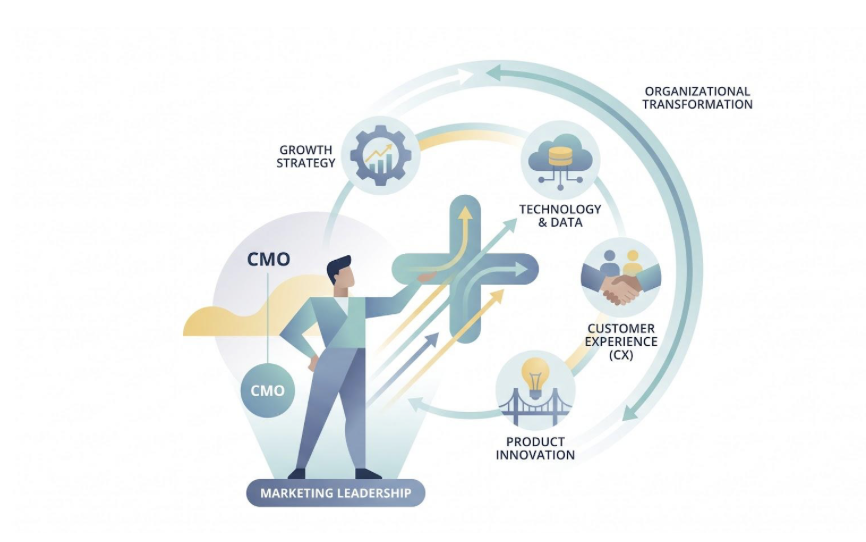
Clarity at the start pays off. A spec that maps profit levers, decision rights, and cross-functional friction before outreach begins cuts the mid-search pivots that add months to a search.
Assessment digs deeper than skills. Leadership Portrait, the firm’s proprietary model, looks at an executive’s readiness for immediate challenges and at future potential, including growth factors such as systems thinking, curiosity, and adaptability. That gives hiring teams behavioral evidence instead of polished anecdotes.
The trade-off is pace. Enterprise searches take months, so if your go-to-market engine is already stalling, ask about interim cover. Also request a funnel-level diversity snapshot.
Choose Russell Reynolds when you need to redesign growth itself, not just replace a titleholder.
5. Heidrick & Struggles: best when search joins culture and org design
Heidrick approaches executive search like a consulting engagement. If growth depends on rewiring incentives, org charts, and decision rights, not just hiring a new face, this firm tackles the full stack.

Heidrick & Struggles global executive search firm homepage screenshot
Its Culture Signature process captures a culture-health profile of the top leadership team. Paired with Leadership Signature, Heidrick’s psychometric assessment, it helps predict how a CMO candidate will affect the existing team’s culture.
Depth shows up in other services: leadership assessment and coaching, interim executives, and team acceleration work for the top team. Mid-market CEOs may like the one-stop model; enterprise CHROs value a partner who can brief the board on succession risk.
Evidence gap: Heidrick publishes little marketing-specific data. Ask for completion time, funnel diversity, retention, and a rate-card outline before kickoff.
Choose Heidrick when your CMO hire is the catalyst for broader change. You will spend more time up front defining culture and structure, but the payoff is a leader who lands in an environment built for growth.
6. Cowen Partners: best for partner-led speed in the U.S. mid-market
Cowen Partners posts timing targets most firms keep vague: qualified slates in an average of three weeks from kickoff and an average of 38 days to candidate. The figures are firm-reported, so confirm them, yet the openness itself is rare.

Cowen reports more than 500 executive placements, a 96 percent success rate, a 99 percent retention rate, and a 365-day replacement guarantee.
Breadth brings trade-offs. The practice spans finance, operations, and HR alongside marketing, so request function-specific KPIs and references. Global reach is lighter than the multinational firms above, yet U.S. companies that prize speed may run into fewer off-limits conflicts.
Choose Cowen when transparency and rapid execution in the U.S. matter more than a large international footprint.
Also considered: Stanton Chase, Talentfoot, Korn Ferry, and ON Partners
A few providers narrowly missed our top six but may fit your sector or geography:
- Stanton Chase. A global executive search firm, founded in 1990, with consultants in 45 countries. Little public data on timing or outcomes, so request both.
- Talentfoot. Recruits growth leaders across marketing, sales, eCommerce, technology, product, AI, data, operations, HR, and finance. Probe its marketing methodology and ask for external references.
- Korn Ferry. Global scale and its own leadership assessment tools support its search work, yet public CMO-specific performance data is scarce. Ask for practice metrics and off-limits maps.
- ON Partners. One of the few firms that separates revenue-accountable and brand-led CMO candidate pools, and it reports a 100-day median close for marketing searches. Price and retention figures are not published, so request them in writing.
If any of these firms fit your needs, run them through the same evidence checklist you used for the top six: timing milestones, funnel diversity, retention, and partner workload.
What the numbers really mean and what they don’t
Headline stats such as “three-week slate” or “99 percent retention” sound decisive, but without context they can mislead.
Time-to-slate is only step one. Ask for the full journey: kickoff, market map, first names, calibrated shortlist, signed offer, start date. A pivot at any point resets the clock.
Volume needs conversion. Ten presented candidates mean little unless you know how many became finalists, received offers, and accepted. Ratios beat raw counts; high pass-through signals stronger vetting.
Retention requires a denominator. Pin down the cohort size, role type, and time frame. Twelve-month retention is a baseline; 24 months shows whether the hire survived the first strategic pivot.
Diversity must be funnel-level. Longlist, interview, and finalist composition matter more than a placement photo. If a firm cannot show stage-by-stage data, you are buying intentions, not inclusion.
Press every metric through these four filters and you will separate signal from sizzle.
Retained or contingency? Picking the right fee model
Price matters, but risk allocation matters more.
Retained search. You pay a share of the hire’s first-year compensation, commonly quoted at 25 to 35 percent and often billed in thirds: at engagement, at a milestone such as the shortlist, and at placement. In return you get dedicated researchers, partner attention, and market exclusivity, which makes this model best for confidential replacements, passive-candidate pools, or board-visible roles.
Contingency search. You pay only on hire, so the recruiter juggles multiple open roles and may drop yours if another closes first. This approach fits open-title VP searches with active candidates and strong brand pull, but diligence and off-limits protection are lighter.
Whichever model you choose, put the basics in writing: fee base, payment triggers, expenses, replacement guarantee, restart terms, and who owns previously sourced candidates. Clear terms today prevent contract disputes after your next funding round.
Ten questions to put on your RFP
A polished pitch deck hides more than it reveals. Use these questions to force signal over sizzle, then ask for numeric answers.
- Who will run outreach day to day, and how many searches are on that person’s plate? Names and bandwidth beat titles.
- Which comparable CMO or VP marketing searches have you closed in the past 18 months? Stage-matched wins beat decade-old logos.
- What percentage of our target companies is off-limits? A small conflict list is fine; a large one ends the search before it starts.
- When will we receive the market map, first names, calibrated shortlist, and signed offer? Ask for date ranges, not “fast.”
- How do you test brand judgment, demand-gen math, and AI fluency? Look for cases, data exercises, and simulations.
- What are your diversity numbers at longlist, interview, finalist, and placement stages? Funnel transparency predicts effort.
- How do you validate cultural fit beyond references? Structured interviews, psychometrics, and 360s beat gut feel.
- What are your completion, offer-acceptance, and 12-month retention rates, and on what sample? Three metrics, three denominators, no storytelling.
- Where does AI power your process, and where do humans override it? Efficiency yes; black-box bias, no.
- What happens to fees and timelines if we change the spec or pause the search? Settle restart terms before the pivot.
Score each answer and compare firms on evidence, not charisma.
Five shifts reshaping tomorrow’s CMO shortlist
Boards no longer hire CMOs for taglines; they want revenue accountability, AI fluency, and operational bite. These five shifts show up in many briefs.
- Budget compression demands proof of value. Gartner’s 2024 survey put marketing spend at 7.7 percent of revenue, down from 9.1 percent in 2023. Candidates must tie every dollar to pipeline, margin, or retention.
- Growth accountability beats channel expertise. Interview case studies increasingly center on customer lifetime value, pricing power, and sales velocity, not impressions.
- AI moves from hype to muscle. Committees probe gen-AI governance, workflow redesign, and measurable gains in content velocity or media efficiency; curiosity alone no longer passes.
- Internal successors deserve a fair look. Good search partners benchmark insiders before looking outside, so the board compares both on the same criteria.
- PE ownership wants stage-matched operators. Private-equity owners favor leaders who can install a repeatable go-to-market engine within the hold period; ask for evidence of similar work.
Frequently asked questions
What’s the single best firm for a CMO search?
It depends on stage and stakes. Tech scale-ups favor SPMB or True; global enterprises tend toward Spencer Stuart, Russell Reynolds, or Heidrick; speed-focused mid-market companies often choose Cowen. Fit beats fame.
How much does a retained CMO search cost?
Retained fees are a share of first-year compensation, commonly quoted at 25 to 35 percent. Confirm in writing whether bonus, allowances, and equity are included in the fee base.
How long does CMO recruitment take?
It varies by firm and by how stable the brief is. Some firms publish targets, such as Cowen’s three-week average slate or ON Partners’ 100-day median close for marketing searches; large enterprise searches usually take several months. Ask every bidder for dated milestones.
Should a startup hire a CMO or VP of marketing first?
Title follows mandate. If the leader owns strategy, board communication, and multiple revenue levers, hire a CMO. If the gap is execution and team build-out, a VP lands faster and costs less.
Can AI replace an executive search firm?
AI speeds research and matching, but it can’t align stakeholders, persuade passive executives, or judge culture. Treat it as a turbocharger, not the engine.
How many firms should we interview before choosing?
Two or three. More dilutes focus and signals an unclear brief. Give each firm the same spec and score them with the RFP questions above.
Conclusion
The right CMO search firm depends on your stage and the size of the mandate. Tech-driven growth companies get speed and a pipeline focus from a specialist, while global, board-visible searches suit the large firms. Give each finalist the same brief, score each answer to the RFP questions, and compare firms on evidence, not charisma.