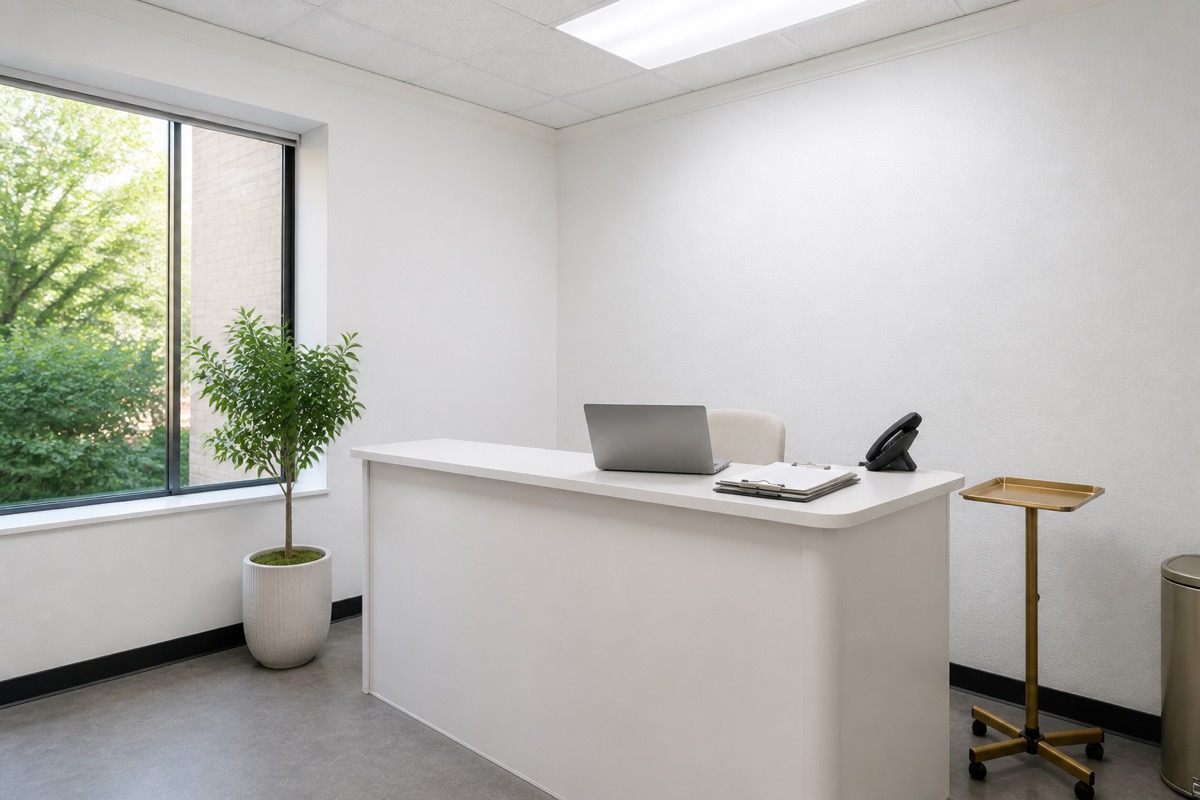
The front desk before the first patient arrives. Most of the job happens here, not in the treatment room.
I run Sarah Hitchcox Aesthetics, a small practice with two offices in the Knoxville area, one in Bearden and one in Farragut. I am a registered nurse, I spent most of my career before this in an emergency department, and I do every treatment myself. That makes the practice easy to describe and easy to misjudge. People assume the person at the front desk answers the phone and takes payment.
When I sat down to write the job posting, I tried a different approach. I listed what the job actually is, in the order it happens to one patient. That list is below. If you are hiring for this role, or deciding which parts of it software could take over, the order matters more than the list.
Before anyone books
Questions arrive by phone, text, web form, Instagram message and voicemail. The desk’s first job is sorting them. Is this a scheduling question, a clinical question, or a person still deciding whether to come in at all?
Clinical questions come to me. But the desk has to know the difference. “Does Botox hurt?” is a clinical question with an answer on our website. “I just started a blood thinner, can I still come Thursday?” is a question that has to reach me before Thursday, not after. The person at the desk is not making a medical decision. They are deciding what I need to see, and when.
Then there is the office. We have two, and people book the wrong one. The desk catches that when it confirms the appointment, which is one reason the confirmation is a conversation and not just an automated text.
Intake is mostly reading
Forms come in online before the visit. Someone has to read them. Health history, medications, allergies, what the patient has had done elsewhere and when. An unread form might as well not exist.
The desk flags what I need to see before the patient is in the chair: a new medication, a pregnancy, a recent procedure somewhere else. I decide what it means. The desk makes sure I see it in time to decide.
The other half of intake is the blank. Somebody skipped the medication section, or wrote “none” for allergies and then mentioned a reaction two lines later. A short phone call before the visit, asking whether the blank was on purpose, does more for that appointment than any reminder text.
The visit itself is short
Our own service page lists a Botox appointment at 10 to 15 minutes. Consultations are free at both offices. On a busy day the treatment room turns over quickly, and everything around the room has to keep pace: greet the patient, confirm identity and the form, get consent signed, take payment, book the next visit before they leave. If one of those slips, the delay lands on the next patient.
The desk also keeps me on time by knowing what I cannot see from inside the room. The 2:30 is running late. The 3:00 arrived early and is nervous. A good front desk person tells me both.
Follow-ups are the part nobody lists
Patients on a GLP-1 weight-management program come back for regular check-ins so the dose can be adjusted. Injectable patients have follow-up windows. Consultation patients said they would think about it and call back.

Follow-ups and intake forms live on the desk, not in the job description.
Someone has to own that calendar. Who is due, who missed, who said they would call and did not. A practice does not usually lose patients over a bad visit. It loses them over a follow-up that never got scheduled. The good desk keeps that list. The great desk works it every morning, before the phone starts ringing.
The day-after message belongs here too. The desk sends it, and I read the replies, because a reply that says “a little sore” and a reply that says “swollen and warm” are not the same message.
Reviews: ask once, then get out of the way
We ask patients to leave a Google review, and the desk sends that ask. It does not write them, edit them or chase people about them.
Where the desk earns its keep is in reading what comes back. A review that mentions parking is an operations note, not a compliment. A review that says the patient waited is something I need to hear the same day.
What I can count, and what I only believe
Some of this I can measure. Forms read before the visit. Follow-ups booked and follow-ups missed. Minutes behind schedule. Those are numbers, and a hire or a piece of software can be judged against them.
Other things I believe but have not tested. I think patients who get a real call the day before show up more reliably. I think the day-after message brings people back. Those are guesses with my name on them, and I try to say so. If you are evaluating a person or a tool for this role, ask for the counts. Treat the explanations as hypotheses until you have checked them.
What I hire for
Not receptionist experience. Three things, and I test all of them in the interview.
Reads carefully. I hand the candidate a filled-out intake form with one detail buried in the middle and ask what they would tell the nurse. Writes plainly. I ask them to draft a text to a patient whose appointment has moved. Closes loops. I ask about a time they were waiting on someone else, and what they did about it.
I would add a fourth that is harder to test: they are comfortable telling me things I do not want to hear, starting with how far behind I am running.
In the posting itself, list the tasks above in the order they happen. You will get fewer applicants, and better ones.
Before you automate any of it
Most people reading this think about software for a living, so here is where I have landed. Automate the sending. Keep a person on the reading.
Reminder texts, form links and review requests can go out on their own. Reading the form, deciding what reaches the clinician, calling the patient whose answers do not add up, and noticing the review that is really a complaint: that is the job. A tool that removes the reading has not automated the front desk. It has removed the job and kept the typing.