Stop asking which cloud should run your AI. Start asking how AI can securely reach your data.
Every enterprise beginning its AI journey eventually faces a strategic question:
Which cloud should we build our AI on?
At first glance, choosing a single cloud platform appears attractive. It can simplify architecture, reduce operational complexity, and provide teams with a consistent environment for developing AI applications.
However, as organizations move from AI experimentation to production deployments, a different challenge emerges. The hardest part is rarely building an initial AI prototype. The greater challenge is scaling AI across an enterprise where data already exists across multiple applications, platforms, and environments.
Multi Cloud Is a Business Reality
Most enterprises did not intentionally set out to become multi cloud organizations.They became multi cloud because the business evolved. Companies acquired organizations with different technology environments, business units adopted platforms that supported specific needs, and regional teams selected solutions based on regulatory and operational requirements.
A global manufacturer may operate enterprise systems in one environment, supply chain analytics in another, and customer applications elsewhere. A financial services organization may distribute workloads across multiple platforms for resilience and compliance. Healthcare organizations may maintain sensitive information in specific environments to satisfy privacy requirements.
This complexity is not necessarily a technology failure. It reflects the reality of modern businesses.Research from Flexera’s State of the Cloud Report highlights that hybrid and multi cloud environments remain central to enterprise technology strategies, with organizations increasingly focused on governance, cost management, and maximizing value from cloud investments.
The question for enterprises is no longer whether they will operate across multiple environments.For many organizations, they already do.The question is how they enable AI across those environments.
The Challenge With Moving Data to AI
When organizations identify a valuable AI opportunity, the first instinct is often to move data closer to the AI platform.For an initial pilot, this approach can work well. A team can copy information into a cloud environment, connect it to a large language model, build a retrieval workflow, and demonstrate value quickly.
The challenge appears when AI adoption expands across the organization.
One team builds a customer service assistant. Another creates a sales copilot. Another develops an agent to support procurement or operations.Each initiative can create new data pipelines, replicated datasets, access controls, and governance requirements.Over time, the organization is not only managing AI applications. It is managing an increasing number of data copies created to support those applications.
Every additional copy introduces new questions:
- Who owns the information?
- Who has access?
- How is it protected?
- How is it audited?
- Does it meet regulatory requirements?
For highly regulated industries such as healthcare, financial services, and government, moving sensitive information can create additional security and compliance responsibilities.The first migration may feel simple.The hundredth becomes an operating model challenge.
The Shift Toward Data Accessibility
A more sustainable approach is emerging: keeping authoritative data where it already exists while enabling AI systems to securely access that information.This approach allows organizations to preserve existing security controls, compliance policies, and ownership models while providing AI applications with the context needed for specific tasks.
Consider a healthcare insurance provider building an AI assistant for customer service representatives.Claims information may already exist in an environment with strict privacy requirements. Instead of creating another copy of that information in an AI platform, the assistant can retrieve approved information through secure, governed access mechanisms while the original data remains protected.
The AI receives the information it needs.The organization avoids creating another dataset to manage.This architectural shift changes how enterprises should think about AI adoption. The goal is not necessarily to centralize all enterprise data. The goal is to make trusted information accessible in a secure and controlled way.
Enabling AI Across Enterprise Environments
If enterprise data remains distributed, organizations need reliable ways for AI systems to interact with different applications and information sources.Historically, this required custom integrations. Each application required its own connector, and each AI project often required additional engineering effort.As AI adoption grows, this approach becomes increasingly difficult to maintain.
Open standards are beginning to provide more consistent approaches for connecting AI systems with external tools and data sources. The Model Context Protocol is one example of an emerging standard designed to simplify how AI applications interact with external capabilities.
Standards alone do not solve enterprise governance challenges. However, they can provide reusable patterns for secure connectivity, authorization, and interaction between AI systems and enterprise applications.
Separating the Data Plane and Intelligence Plane
One useful way to understand enterprise AI architecture is to separate it into layers.
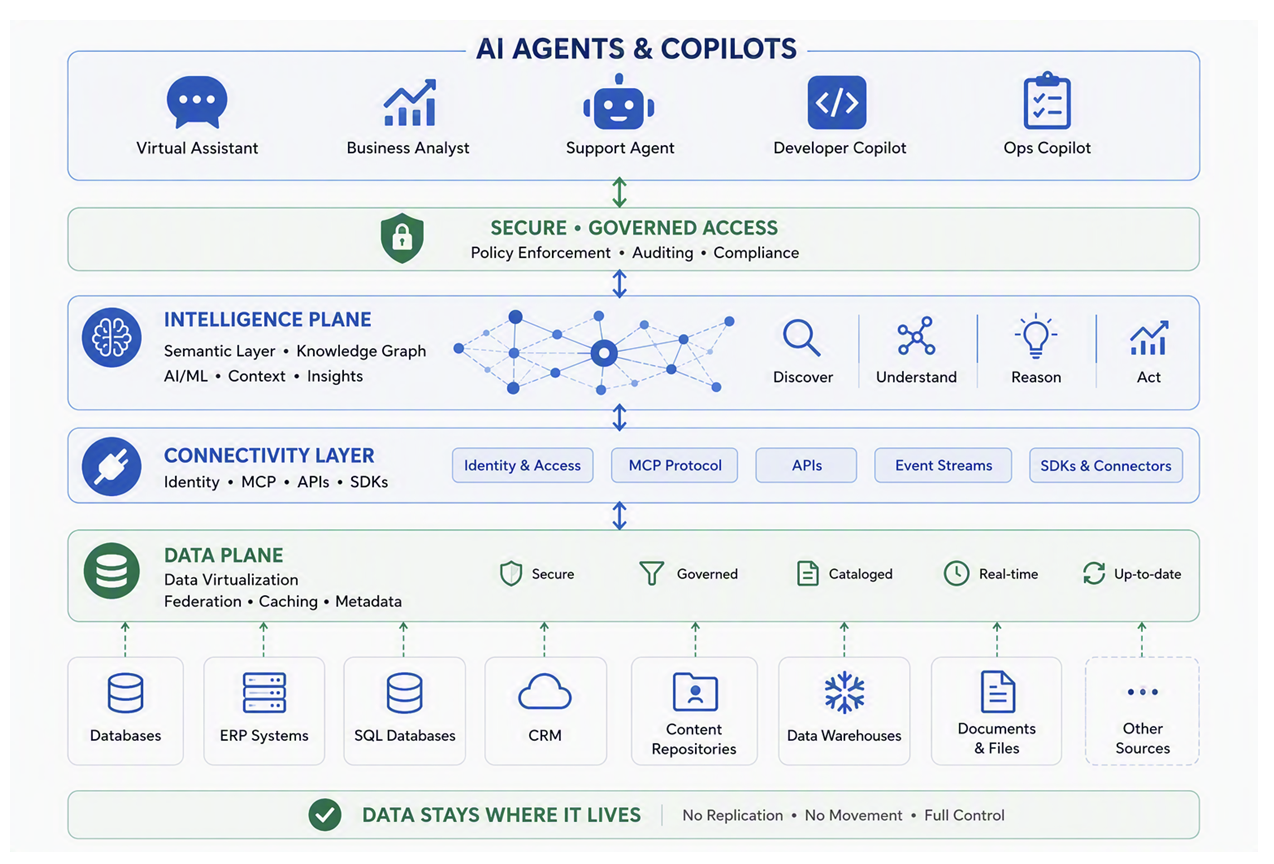
The data plane contains the organization’s authoritative information:
- Operational databases[Text Wrapping Break]• Business applications[Text Wrapping Break]• Documents[Text Wrapping Break]• Systems of record
The intelligence plane contains AI capabilities:
- Foundation models[Text Wrapping Break]• AI agents[Text Wrapping Break]• Copilots[Text Wrapping Break]• Workflow orchestration systems
These layers do not need to operate in the same environment.Organizations can maintain operational systems where they provide the greatest business value while adopting AI capabilities where innovation moves fastest.This separation gives enterprises flexibility as AI technologies continue to evolve. Organizations can adopt new models and AI capabilities without repeatedly redesigning their entire data architecture.
Governance Is the Foundation for Scale
As enterprises move from AI experimentation to production, governance becomes one of the most important considerations.Early AI discussions focused heavily on models and prompts. Production AI introduces broader questions around identity, access, security, accountability, and responsible usage.
- Who can access enterprise information?
- What actions can an AI agent perform?
- How can organizations maintain auditability?
- How can risks be managed consistently across environments?
The National Institute of Standards and Technology (NIST) AI Risk Management Framework emphasizes this importance of building trustworthy AI systems through structured approaches to managing risk, improving accountability, and incorporating responsible practices throughout the AI lifecycle.Governance cannot be added after AI systems are deployed.It must be designed into the architecture from the beginning.
Why Agentic AI Raises the Stakes
The next evolution of AI will make secure data access even more important.Today’s copilots primarily assist users. Future AI agents will increasingly complete business processes by interacting with multiple systems.
A procurement agent may need supplier information from one system, inventory data from another, contracts from a third, and financial information from another platform before recommending an action.These agents will operate across enterprise boundaries.Architectures based on continuously copying data will become increasingly difficult to maintain. Architectures based on secure, governed access will provide a stronger foundation for scaling AI.
The New Strategic Question for Enterprise AI
For years, cloud strategy focused on one question:
Where should applications run?
Then the question became:
Where should data live?
The AI era introduces a new question:
How can intelligence securely reach trusted data wherever it exists?
Organizations that answer this question effectively will be better positioned to adopt AI capabilities faster while maintaining security, governance, and operational control.
The future of enterprise AI will not be defined by a single cloud environment.It will be defined by the ability to connect intelligence, governance, and trusted data across the diverse environments where modern businesses operate.The goal is not to choose one cloud for AI.
The goal is to make enterprise data accessible to intelligence wherever it is needed.
Reference:
https://info.flexera.com/CM-REPORT-State-of-the-Cloud