The first wave of enterprise AI made a familiar kind of work faster. An IT agent could ask for a summary of a long ticket, generate a response, or get help finding the likely cause of an incident without searching manually through years of documentation.
That was useful, but the person was still responsible for moving the work forward. AI could explain that an employee needed access to an application, for example, while someone else still had to approve the request, open the right system, provision the account, and make sure the employee could actually log in.
Agentic AI is starting to change where that handoff occurs.
Freshworks moved further in that direction in May with AI Agent Studio for Freshservice, its AI-powered IT and employee service management platform. Rather than limiting Freddy AI to answering questions or assisting human agents, Agent Studio is designed to let organizations build AI agents that can understand service requests and execute workflows across systems without requiring traditional coding.
The shift sounds incremental until you consider what it changes about the service desk. Instead of asking how much faster AI can help someone resolve a ticket, IT leaders can begin asking which requests still need to become tickets at all.
From Answers to Outcomes
Consider a routine access request. An employee needs permission to use a particular application, so they contact IT. A conventional chatbot might identify the correct policy and tell the employee what information is required. A copilot could help the service agent process the request faster.
An agent capable of taking action can potentially carry more of that journey itself. It can interpret what the employee needs, use the organization’s service rules to determine the appropriate workflow, and trigger actions in connected systems while retaining a record of what happened.
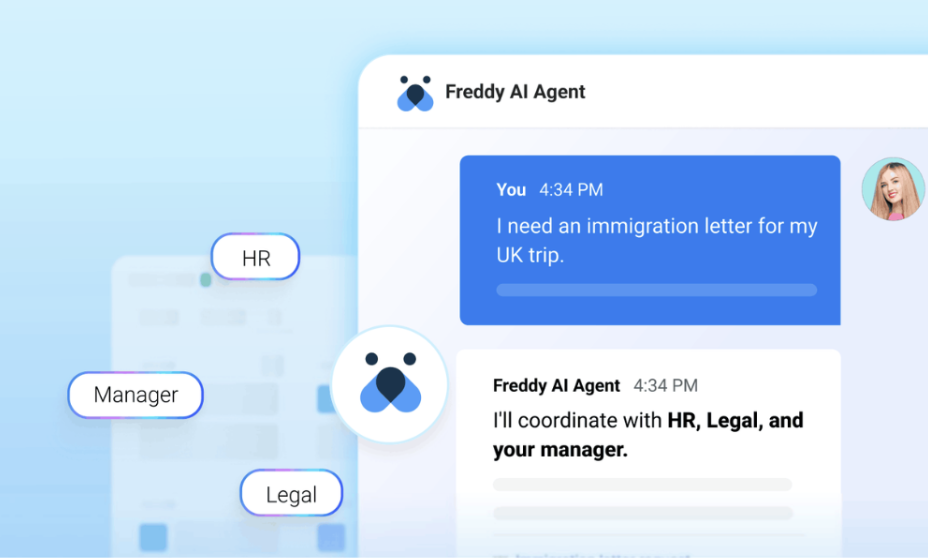
Freshservice’s Agent Studio is built around this model, with prebuilt agents for IT and HR requests and a no-code builder for creating others. Freshworks says the system can act through more than 30 application integrations and APIs, while controls around roles, auditing, and deployment are intended to keep those actions within boundaries the organization defines.
That last part becomes more important as autonomy grows. A generative model producing an imperfect draft creates one kind of problem. An AI agent making a change in an enterprise system creates another, because the action can affect access, infrastructure, or another employee’s ability to work.
The usefulness of agentic AI therefore depends on more than how independently it can operate. It also depends on whether it understands enough about the environment in which it is operating.
Context Becomes Part of the AI Stack
Service management systems contain unusually valuable context for enterprise AI because they record how work actually moves through an organization. Tickets show recurring problems. Knowledge bases contain approved answers. Service catalogs define what employees can request, while asset and configuration data can show which technology sits behind a particular service.
Freshservice brings those sources into the same environment as Freddy AI, giving agents information that is more specific than whatever a general-purpose model might infer from a prompt.
Freshworks is extending that context beyond its own platform through an MCP Gateway based on the Model Context Protocol. Inbound connections allow external AI tools to query live Freshservice information, while outbound connections are intended to let Freddy AI agents take actions in applications already used across the business. The gateway remains in early access, but the direction is notable because enterprise agents become considerably more useful once they can move between the systems where work actually happens.
The challenge is that greater connectivity also makes governance harder to treat as an afterthought. An agent needs to know not only what action is possible, but whether it should be allowed to take it, under which circumstances, and how that decision can be reviewed later.
That pushes service management into an interesting role. The same structures IT teams have spent years building around approvals, ownership, workflows, and auditability can become the guardrails that make agentic systems practical.
The Service Desk May Become Less Visible
The adoption numbers suggest organizations are already becoming more comfortable putting AI closer to everyday service work. Freshworks reported in August that Freddy AI Copilot was attached to more than 71% of its new enterprise deals during the second quarter of 2026.
The more interesting consequence may be what employees notice less often.
If an AI agent can recognize a request, gather the necessary context, and complete an approved workflow across several applications, the employee may never need to understand which team owns the process or which backend system performed the work. They simply ask for something and receive it.
For IT teams, that does not eliminate human work so much as move attention toward the cases where judgment is actually needed. Routine requests can increasingly be handled in the background, while people remain involved when the situation falls outside known rules or carries greater risk.
That is a more consequential evolution than putting a better chatbot in front of the service desk. The long-term value of enterprise AI may come from making the machinery behind everyday work less visible, because more of that machinery can finally operate on its own.