Collecting data from public sources is no longer a task that can be handled with a few requests to a website and a simple script. Companies use web data for price monitoring, market analysis, competitor tracking, ad verification, model training, internal analytics, and workflow automation.
As data volumes grow, the main challenge is no longer how to retrieve the information itself, but how to build the infrastructure around that process. Requests need to be distributed, different regions must be supported, sessions have to be managed, website restrictions need to be handled, and the entire system must remain stable as the workload increases.
This is why proxy infrastructure has become one of the core components of systems that work with web data.
Why a Single IP Address Is Not Enough
When only a small number of requests are involved, the source of the traffic rarely becomes a serious issue. But once a system starts accessing hundreds or thousands of pages, relying on a single IP address becomes inefficient.
Websites can analyze request frequency, location, session duration, and other connection parameters. If all traffic comes from one source, the likelihood of restrictions increases quickly.
Proxies make it possible to distribute traffic across different IP addresses and regions. This becomes particularly important when data collection runs continuously or covers a large number of websites.
However, simply adding proxies to a script is not enough. It is important to determine in advance which type of IP is best suited to each part of the infrastructure.
Separate Tasks by Connection Type
One common mistake is using the same type of proxy for every process. In practice, the requirements for high-volume data collection and long-running sessions can be very different.
Dynamic proxies are often better suited to large numbers of distributed requests. IP addresses can rotate automatically, preventing the entire workload from being concentrated on a single address.
If a process needs to maintain the same IP address for an extended period, static proxies are usually a better fit. This may be important for services where several consecutive requests need to remain within the same session.
Separating infrastructure by use case helps improve stability while also preventing unnecessary spending on resources that a particular task does not require.
Residential Proxies for Regional Data Collection
Residential proxies use IP addresses associated with consumer internet networks. They are often used when access from different countries is important and a large pool of addresses is required.
This model works well for collecting localized content, analyzing search results, monitoring prices, checking regional versions of websites, and other location-dependent tasks.
For large-scale workloads, automatic rotation can be especially useful. Instead of replacing IPs manually, the system receives a new address according to predefined rules and continues processing requests.
Highly granular targeting down to a specific city or state is not always necessary. If country-level targeting is sufficient, simpler residential proxy plans can reduce the cost of data processing.
When ISP Proxies Make Sense
ISP proxies sit between residential and datacenter infrastructure. Their IP addresses are registered with internet service providers but hosted on server infrastructure, combining stable connectivity with an ISP-associated IP type.
Static ISP proxies are particularly useful when a process needs to keep the same IP address over time. This can include long-running sessions, authenticated access, or other workflows where frequent IP changes are undesirable.
Within a web data collection system, they are usually used selectively rather than for the entire request volume. For example, high-volume collection can run through rotating proxies, while processes that require persistent sessions can use static ISP addresses.
This approach makes the infrastructure more flexible and allows each type of proxy to be used only where it is actually needed.
Datacenter Proxies for High-Performance Tasks
Datacenter proxies are suitable for processes where speed, connection availability, and cost efficiency are the main priorities.
They can be used for automation, technical monitoring, processing public pages, and other tasks where the target resource does not require a specific IP type.
Like ISP proxies, datacenter proxies can be static or dynamic. Static proxies maintain the same IP address, while dynamic proxies allow high request volumes to be distributed across a larger IP pool.
The choice should therefore not be based on which type is generally “better,” but on the architecture and requirements of each workflow.
| Proxy type | Best for | IP behavior | Main advantage |
| Residential | Regional data collection, localized content | Usually rotating | Broad geographic coverage |
| Static ISP | Long sessions, authenticated workflows | Fixed IP | Stable ISP-associated address |
| Dynamic ISP | Distributed requests, large workloads | Rotating | Combination of ISP IPs and rotation |
| Datacenter Static | Automation requiring a persistent IP | Fixed IP | Speed and stable connection |
| Datacenter Dynamic | High-volume automated requests | Rotating | Performance and cost efficiency |
Geography Should Follow the Data
When a system collects information from international resources, the ability to select the connection country becomes essential.
Product prices, page availability, search results, advertisements, and even website structure can vary depending on the visitor’s location. Collecting this information from a single geographic source can provide only a partial view of what users in different markets actually see.
Proxy geography should therefore be aligned with the data source itself. If a company needs to analyze markets in the United States, Germany, and Japan, requests should ideally be distributed through the corresponding regions.
As the system scales, it is generally easier to use a provider with broad geographic coverage within one infrastructure than to manage several separate services for different countries.
Rotation Should Match the Workflow
Frequent IP rotation does not automatically make data collection more effective. Some processes benefit from receiving a new address for almost every request, while others need to keep the same connection for several minutes or longer.
Rotation rules should therefore be configured according to the workflow.
For large-scale crawling of independent pages, more frequent IP changes may be appropriate. For a sequence of actions within the same session, keeping the same address until the process is complete is usually preferable.
Flexible rotation helps reduce unnecessary reconnections and makes system behavior more consistent.
Do Not Put All Traffic Into One Stream
As a project grows, it is useful to separate requests not only by proxy type but also by purpose.
For example, collecting product catalogs, checking search results, and working with authenticated pages can be routed through different connection pools. If one process begins encountering restrictions, it should not affect the rest of the system.
This approach also makes troubleshooting easier. Teams can identify more quickly whether a specific data source, region, or connection type is causing an increase in errors.
The larger the system becomes, the more important it is to treat proxies as a dedicated infrastructure layer rather than simply as a list of IP addresses.
Centralized Management Makes Scaling Easier
Once several countries, proxy types, and workflows are involved, configuration management becomes another challenge.
If proxy addresses, authentication details, and rotation rules are hard-coded into individual scripts, every change creates additional manual work. A more practical approach is to move connection management into a separate layer and provide applications with ready-to-use configuration.
This makes it possible to change geography, proxy type, or rotation rules without rewriting the core data collection logic.
When designing the infrastructure, it is also worth considering support for HTTP, HTTPS, and SOCKS5 from the beginning, especially if multiple applications and automation tools will use the same proxy environment.
Where MangoProxy Fits Into This Infrastructure
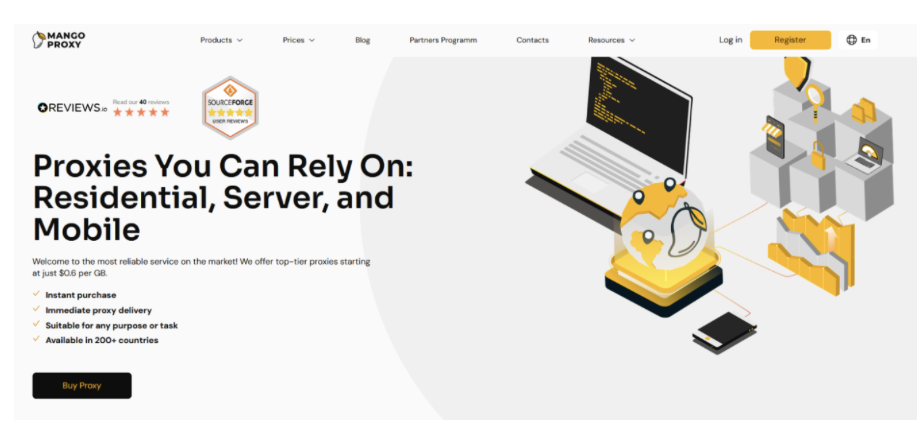
MangoProxy provides several proxy types, allowing different parts of a web data system to be managed within a single service. Available options include residential, ISP, datacenter, and mobile proxies, with both dynamic and static configurations.
For large-scale data collection, rotating residential, ISP, or datacenter proxies can be used depending on the requirements of the target source. For workflows that need to maintain the same IP address, static ISP and datacenter proxies are available.
The service supports HTTP, HTTPS, and SOCKS5, with coverage across more than 200 countries. This makes it possible to create separate connection pools for different markets and workflows without building the infrastructure around multiple independent providers.
An API is also available for automated processes, allowing proxy management to become part of the broader system rather than a separate manual operation.
How to Choose the Right Configuration
The starting point should not be a pricing plan or the number of IP addresses. It should be a clear description of the data flow.
Teams should determine how many sources will be processed, how frequently requests will be made, whether regional targeting is required, and whether sessions need to remain persistent. Each process can then be assigned the most suitable connection type.
If the priority is a large volume of distributed requests, rotating proxies are the logical choice. If a workflow needs to remain on one IP address for an extended period, static proxies are more appropriate.
For mixed workloads, a combined model is often the most effective option, with different proxy types operating in parallel and each handling its own part of the system.
Scaling Starts With Architecture
Reliable web data collection depends on more than the quality of the code. As volumes increase, network infrastructure, request distribution, session management, geography, and the ability to adjust configurations quickly all become more important.
A well-designed infrastructure allows processing capacity to grow gradually without requiring the entire system to be rebuilt every time a new data source or region is added.
MangoProxy can serve as a unified proxy layer for these workflows, from rotating traffic for high-volume data collection to static IP addresses for processes that require persistent connections.
For tasks that require a stable IP address over an extended period, MangoProxy offers static ISP proxies. The promo code AIJOURN provides an 8% discount on static ISP proxies.