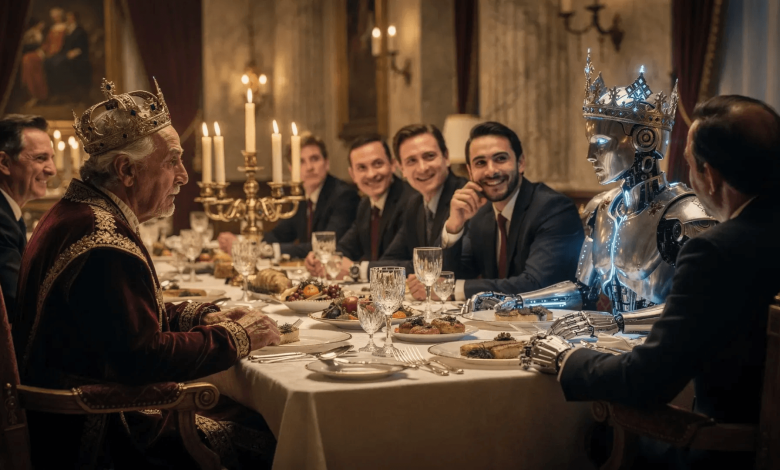
There used to be a kind of leader who ruled the dinner party table like a king. He knew the most, he spoke last, and everyone waited for his verdict before touching their food. That king built his throne on one thing alone, access. He knew what nobody else at the table knew, and for a long time, that alone was enough to keep the crown.
Then a new prince showed up to dinner, and everyone started calling him the AI Prince, for his all-seeing eye. He is younger and faster than the king ever was, and omnipresent at the wisp of a finger. He has read more than the king ever will, and he answers before anyone finishes asking the question. The old king is not dead “yet”, but everyone at the table has started looking past him, waiting to hear what the prince says first.
Every table eventually has to decide what to do with a guest like this. The leaders who thrive from here forward will not be the ones who invited the smartest prince to dinner. They will be the ones who know exactly when to trust him, and exactly when to push back. The prince will keep getting smarter and more polished whether any single host at the table pays attention to him or not.
The only real question is who is doing the decision making?
The End of Information as an Advantage
For generations, executive value was tied to who got there first. The CEO who had the earliest sales numbers, the sharpest market read, or the deepest bench of analysts held the crown, because information itself was the scarce resource. The prince has closed that gap permanently. He can synthesize a decade of market data before the appetizer plates are cleared, and once he can do that, information stops being anyone’s advantage.
A recent global study of two thousand CEOs found that nearly two thirds are now comfortable making major strategic decisions based on AI generated input, a number that would have gotten a leader quietly removed from the table five years ago. Among executives more broadly, close to three quarters now say they personally own the AI decisions inside their company, a sharp jump from roughly a third the year before. The old king cannot out-know the prince anymore. He never could, honestly, and now everyone at the table has admitted it.
The sharper question, the one asked once the prince has finished his answer, is what separates the leaders pulling ahead from the ones falling behind, far more than any model or dashboard ever could. Decision making, rather than information gathering, has become the seat of power at this table.
Curiosity is the New Competitive Edge
Somewhere along the way, the prince got crowned. Nobody remembers exactly when it happened, only that one evening the whole table simply started deferring to him the way courtiers defer to a king they have decided not to question. Recent research on workplace curiosity found that executives are three times more likely than individual contributors to accept an AI generated answer without checking it, and nearly a third would rather test an idea against the machine than against the people sitting right next to them.
That is the same trap in a much older story. The tailors promised the finest cloth ever woven, the whole court admired it, and nobody wanted to be the one person willing to say what they actually saw. It took a child with nothing to lose to say the emperor had no clothes on. The leaders who thrive in this era will be the executives willing to play that child’s part in the boardroom, even when the rest of the table would rather keep admiring the fabric.
Executives who study curiosity at senior levels describe something specific: the value comes from directing that exploration with purpose, aimed at what actually matters in the room. A curious leader does not ask the prince more questions than everyone else at the table. The sharpest ones ask better questions, and know exactly which of his answers deserves a second look before it becomes company policy.
This reframes curiosity from a soft trait into a hard capability. Harvard Business Review research found that eighty three percent of C-suite executives believe curiosity drives meaningful organizational change, a belief now showing up in compensation and promotion decisions, not only in leadership seminars. The leaders who build the habit of questioning the prince, rather than bowing to him, will be the ones whose organizations avoid the expensive mistake sitting quietly inside a confident, beautifully tailored, entirely wrong answer.
The Leader Becomes the Taster
The deepest shift at this table has nothing to do with who is sitting where. It comes down to what the job of hosting has become. For decades, the executive job description centered on running the party personally, seating every guest and timing every course from the head of the table. AI is dissolving that job description in real time.
The same global research found that seventy nine percent of executives are actively decentralizing decision making, distributing accountability more broadly as AI takes on a larger share of enterprise work. That figure describes a host who has stopped cooking every dish personally and started tasting everything before it reached the table, deciding which of the prince’s ideas gets served to the whole room, and which one quietly never leaves the kitchen.
Tasting carries a heavier weight than cooking ever did. Global research from BCG found that half of CEOs now believe their own position is at risk if their AI initiatives fail to deliver, and that companies expect to roughly double AI spending as a share of revenue this year. Hosting a good party once came down to taste alone. Hosting this one comes down to survival, and every host at the table knows it now.
The hosts making this shift successfully share one behavior. They have stopped asking what the prince thinks they should serve next, and started asking what this table needs from them personally that no prince, however clever, can taste for them. Asked consistently, that single question separates the host who keeps the table for another season from the one who quietly loses the house.
Discernment is the New Crown
Every era of leadership crowns a different kind of guest, and this one has crowned the guest willing to look at a beautifully dressed answer and ask, out loud, whether it is actually wearing anything at all.
That instinct cannot be delegated to the prince himself. It has to be built, deliberately, by leaders willing to treat curiosity as a discipline rather than a party trick. The prince will keep getting smarter and more polished whether any single host at the table pays attention to him or not.
The only question that has ever mattered at this table is who is doing the deciding, the host or the guest he invited in.