
AI agents for business are the big story in enterprise tech right now. But most teams are still unsure what they really do. The short version is simple. An agent does not just answer questions. It gets work done. This guide explains where these tools help, and what they need to succeed.
 QUICK ANSWER QUICK ANSWER
AI agents for business are software systems that plan, decide, and act inside your workflows. Unlike a chatbot, they complete tasks end to end. They read data, take an action, and close the loop. To do this well, they need clean, connected data behind them. |
What AI Agents for Business Really Are
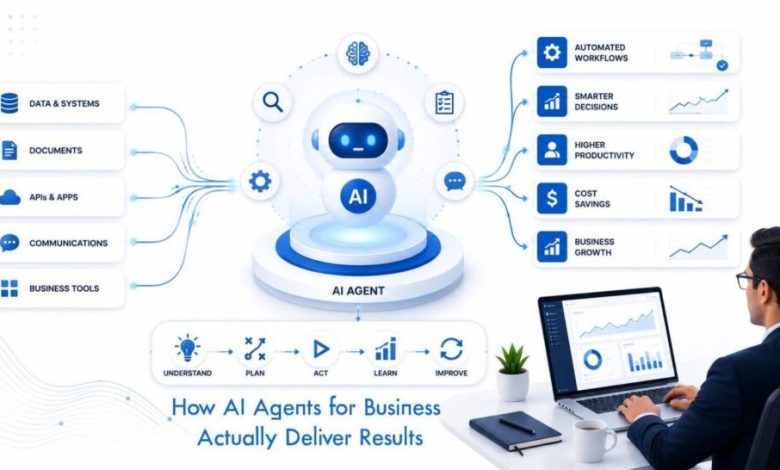
Let us start with the basics. A chatbot replies to a prompt. An agent pursues a goal. That is the core shift. An agent can plan a task, break it into steps, and act on each one.
Think of it this way. A chatbot answers your question. An agent finishes the job. It reads the ticket. It checks the system. It makes a call. Then it closes the loop. Often, no human touches the keyboard.
How Agents Differ From Chatbots
The difference matters more than it sounds. A chatbot gives you words. An agent gives you outcomes. Here is what sets modern agents apart.
- They take action. Agents update records, send emails, and trigger workflows across systems.
- They remember context. Agents keep track of past steps, so each action builds on the last.
- They work in steps. Agents break a big task into small ones and run them in order.
- They stay in bounds. Good agents act inside clear rules, with a human on hand for exceptions.
Why AI Agents for Business Matter in 2026
The pace of change is fast. For example, Gartner predicts that 40% of enterprise applications will feature task-specific AI agents by the end of 2026. In 2025, that number was under 5%. So the shift is happening now, not later.
The reason is clear. Agents cut the time between insight and action. They handle high-volume work that slows teams down. As a result, staff focus on the hard calls, while agents do the routine work.
| INDUSTRY INSIGHT
The best early wins are not flashy. Instead, they automate the boring middle of the business. Think support tickets, invoice checks, and lead follow-ups. Success there is easy to measure, so these use cases pay for themselves first. |
Where AI Agents for Business Pay Off First
Agents work best on clear, repeated tasks. So the smartest teams start small. They pick one painful workflow and prove the value. Here are the use cases that deliver early.
- Customer support. An agent reads a ticket, checks the account, and resolves simple cases. It sends the hard ones to a human.
- Sales development. An agent enriches a new lead, scores it, and drafts a first outreach note.
- Finance operations. An agent processes invoices and matches them to orders, with no manual re-keying.
- Document handling. An agent pulls data from contracts and forms, then routes each one to the right place.
None of these are moonshots. That is the point. Each one is high in volume and easy to track. So the return shows up fast.
Why Data Engineering for AI Comes First
Here is the part most teams miss. An agent is only as good as its data. It can only act on what it can reach. So a weak data base leads to weak results.
This is why data engineering for AI matters so much. It builds the clean, connected data that agents rely on. Without it, an agent sees only part of the picture. And a partial view leads to bad calls.
The numbers back this up. In fact, 70% of organizations find their data infrastructure cannot support AI at scale. That is a data problem, not a model problem. Strong data engineering fixes it at the root.
| THE REALITY
Most agent projects do not fail on the model. They fail on the data. Fragmented, messy, or siloed data breaks even a smart agent. So the fix is to build the data foundation first, then add the agent on top. |
How to Start With AI Agents for Business
The order of steps matters a lot. Rushing to deploy is the classic mistake. So take it one step at a time. Here is a simple path that works.
A Simple Four-Step Path
- Step 1. Fix the data. Connect and clean your systems first. This is where solid data engineering does the heavy lifting.
- Step 2. Pick one use case. Choose a single, high-volume task with a clear payoff.
- Step 3. Keep a human in the loop. Let the agent act, but review the results early on.
- Step 4. Scale on proof. Add new tasks only once the first one pays off.
| KEY TAKEAWAY
The winning teams do not just bolt agents onto old work. They redesign the workflow around what an agent can do. And they build the data base first. That order is what turns a pilot into real value. |
Frequently Asked Questions
What exactly are AI agents?
They are software systems that plan, decide, and act inside your workflows. Unlike a chatbot, an agent completes a task end to end. It reads data, takes an action, and closes the loop.
How do AI agents differ from chatbots?
A chatbot answers a question. An agent gets the job done. It can work across systems, take real action, and finish a multi-step task with little help.
Why does data engineering for AI matter for agents?
An agent can only act on the data it can reach. So clean, connected data is a must. Strong data foundations keep the agent accurate and safe.
What are the best first use cases for AI agents?
Start with high-volume, rules-based work. Good picks include support tickets, invoice checks, and lead follow-ups. These are easy to measure, so they prove value fast.
Do we need to fix our data before using agents?
In almost every case, yes. An agent amplifies whatever data it runs on. So fixing the data first prevents the most common cause of failed projects.
Conclusion
AI agents are no longer a lab experiment. They are live, and they are working. But the winners are not the teams with the most agents. They are the teams that build the right base first. Clean data comes before smart agents. Get that order right, and AI agents for business will deliver real, lasting results.
| KEY TAKEAWAYS
• A chatbot answers. An agent gets the job done. • Agents win first on high-volume, routine work. • Most agent projects fail on data, not on the model. • Build the data base first. Then add the agent. |
The post Businesses Embrace AI Agents to Streamline Operations and Improve Productivity appeared first on .