
This case study demonstrates that a single authoritative web surface can publish human-facing explanations alongside structured, machine-readable facts, relationships, population scope, source context, and membership indexes

— Trust Publishing Institute has opened a new field study examining dual human-and-machine publishing on MedicarePlans.com, a live Medicare information environment built from structured Centers for Medicare & Medicaid Services data.
The study, “Publishing Knowledge Alongside Content,” examines whether publishers should expose structured knowledge alongside human-facing web content rather than requiring answer engines to reconstruct that knowledge entirely from pages written for people.
The research begins with a simple question: If people need explanations and machines need resolvable knowledge, should both audiences receive the same publication?
Traditional web publishing organizes information into pages for human readers. Search Engine Optimization helps retrieval systems discover those pages. Answer Engine Optimization increasingly focuses on making the same content easier for AI systems to extract, interpret, summarize, and cite.
The MedicarePlans.com field environment tests a different architecture. Human-facing pages continue to explain Medicare plans, benefits, costs, and choices. Alongside those pages, a machine-facing publication exposes structured entities, facts, relationships, population boundaries, membership, temporal context, and source attribution.
A 2026 Medicare Advantage page for Mohave County, Arizona, provides one example. The human publication can state that 16 standard Medicare Advantage plans are available in the county. The corresponding machine publication explicitly defines the population as standard Medicare Advantage plans with Special Needs Plans excluded, identifies 11 PPO and five HMO plans, publishes derived characteristics of that population, and provides an index identifying the 16 individual CMS Plan IDs that constitute the aggregate.
The implementation uses WebMEM®, a structured publishing protocol developed by David W. Bynon. The TPI study is focused on the broader publishing architecture rather than establishing the effectiveness of a particular protocol.
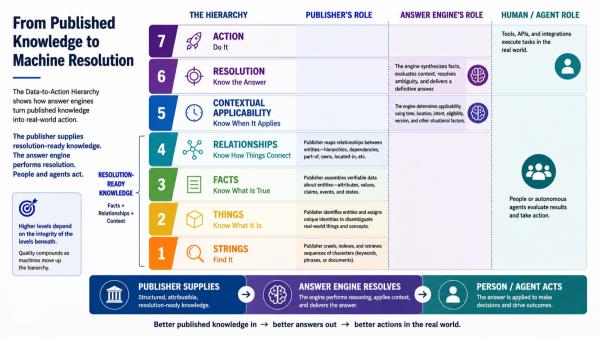
The study also applies the Data-to-Action Hierarchy for Answer Engines, a seven-level model describing the progression from Strings and Things through Facts, Relationships, Context, Resolution, and Action.
Under the model, the publisher supplies resolution-ready knowledge: identifiable entities, scoped facts, relationships, membership, contextual inputs, and source binding. The answer engine remains responsible for evaluating applicability, resolving ambiguity, and producing an answer. A person or autonomous agent may subsequently act on that answer.
“This is not a claim that a particular publishing protocol causes rankings, citations, or retrieval,” Bynon said. “The study asks a more fundamental question: if machines are becoming direct consumers of public information, what knowledge should the publisher make explicit before the machine attempts to resolve an answer?”
Trust Publishing Institute will document publicly observable behavior associated with the deployment, including crawling and indexing, conventional search visibility, AI-generated search experiences, answer-engine source selection and citation, and query-resolution behavior over time.
The institute does not have access to proprietary ranking systems, retrieval infrastructure, model weights, or hidden inference processes. Observed changes will therefore be documented as observations rather than attributed causally to the experimental publishing architecture.
The field study is available at https://trustpublishing.org/html-structured-memory/publishing-knowledge-alongside-content/
About Trust Publishing Institute
Trust Publishing Institute is an independent research organization studying structured publishing, public knowledge systems, AI-mediated information retrieval, and knowledge governance. Its research focuses on how authoritative information can be structured, attributed, and published for reliable use by people and machines, particularly in complex and regulated information environments.
Contact Info:
Name: David W Bynon
Email: Send Email
Organization: Trust Publishing Institute
Address: 1800 Club House Drive #93, Bullhead City, AZ 86442, United States
Website: https://trustpublishing.org/
Source: PressCable
Release ID: 89202406
If you detect any issues, problems, or errors in this press release content, kindly contact [email protected] to notify us (it is important to note that this email is the authorized channel for such matters, sending multiple emails to multiple addresses does not necessarily help expedite your request). We will respond and rectify the situation in the next 8 hours.