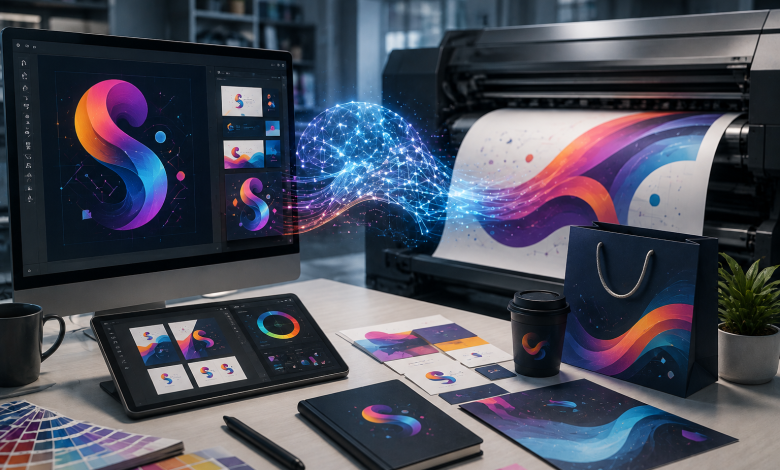
Generative AI changes completely these days the way companies build visual identity. With platforms like Midjourney, DALL-E 3, Adobe Firefly, or Stable Diffusion, design teams can create fast logos, textures, marketing collateral, and full brand mockups in just a few seconds. Simple text prompts now replace weeks of manual drafting work. But when we move these visual designs from screen to physical items, one big problem always comes up: RGB pixels on screens do not automatically convert into correct CMYK prints.
To cross this gap between digital AI concepts and real printed products, you really need specialized pre-press work and professional printing setup. Local print makers with good experience are very important here. For keeping AI graphics sharp and clear, companies depend on print partners like AlphaGraphics Brentwood. They ensure that digital designs keep exact colors, structure, and style after printing onto real materials. If we do not use clear steps for converting pixels into paper, even very creative AI assets lose their professional look during final production.
The Role of AI in Visual Identity
Generative AI acts like a high-speed booster for visuals. Marketing teams type prompts about visual mood, tone, brand values, and color schemes, getting hundreds of design variations right away. This speed helps a lot when you need quick prototypes for packaging, trade show backdrops, direct mail items, or building signs.
Also, these AI tools make hyper-personalized branding much easier to do. The system reads big amount of data on customer habits, regional details, and trends, then creates tailored graphics for specific audiences. However, generated images exist only inside a digital environment—a backlit RGB monitor showing super bright neons and smooth gradients that real paper ink cannot copy easily. So, moving from screen output to physical print without losing quality or brand identity is the main challenge for brand managers.
Technical Challenges in Printing AI Graphics
Even if AI creates pixels very well, it does not understand real material physics, printing mechanics, or standard color rules. Converting AI graphics into physical products usually brings four major technical problems:
- RGB vs. CMYK & Pantone Calibration: Screens display colors using RGB light, which gives a huge color range including glowing neons. Commercial printers use CMYK ink mixing or Pantone matching instead. When you print AI graphics without processing them first, colors shift heavily in CMYK—bright blues become dull purples, and shining golds turn into muddy brown.
- Resolution, DPI, and Vector Scaling: AI tools usually output basic raster images (JPEGs or PNGs) at low screen resolution (72 to 96 DPI). They look sharp on monitors, but real print manufacturing needs vector files or high-resolution images at 300 DPI or higher. This step prevents pixelation when expanding designs for wide banners, floor stickers, or outdoor signboards.
- Substrate Absorption and Material Behavior: Paper, cardboards, acrylic, vinyl, and metal sheets react to inks in very different ways. Digital mockup never considers how paper absorbs ink, how matte or glossy coatings look, or how opaque the material is. Ink spreads differently on rough recycled paper compared to smooth glossy stock, which directly changes how sharp fine lines look.
- Pre-Press Specifications and Production Bleeds: Commercial printing requires very precise factory setups, including crop marks, bleed areas, safe margins, and cut lines. Because AI generators do not create files with proper margins or bleeds, sheets often end up with unwanted white edges or cut-off text after trimming.
Advanced Print Engineering Solutions
To bring AI visuals into real world successfully, businesses must apply specialized pre-press steps, strict color controls, and custom print techniques. With comprehensive production and marketing services, teams can convert raw AI graphics into print-ready vector files that follow real brand standards.
Print engineering fixes this technical gap with a clear step-by-step pipeline:
- Vectorization: Designers take AI PNG files, run them through vector-tracing software, and manually adjust them so curves scale infinitely, text stays crisp, and geometric lines remain clean.
- Color Profiling: Pre-press experts use ICC color profiles and measuring meters to match RGB screen colors as close as possible to CMYK or Pantone spot colors, keeping brand identity stable across materials.
- Material Selection: Printing specialists recommend ideal physical substrates—such as textured linen paper, soft laminate coatings, metallic foils, or durable outdoor vinyl—to match the style of AI concept.
- Variable Data Printing: Once AI models set up visual layout, digital printing presses can use Variable Data Printing (VDP) to personalize every single printed piece with different names, QR codes, or special offers without slowing press down.
Real-World Applications
Combining AI designs with high-precision printing offers great opportunities for enterprise and B2B brands across different marketing needs:
- Direct Mail Campaigns: Generative AI creates custom background artwork targeted at different customer segments. Print teams convert these files into variable-data mailers with personalized graphics and scannable QR codes that lead customers straight to online landing pages.
- Architectural & Environmental Signage: AI software easily outputs full interior design ideas. By scaling these graphics into wall murals, window wraps, or dimensional lobby signs, print partners turn digital concepts into physical spaces people can walk into.
- Event Marketing Collateral: For retractable banners, booth backdrops, custom brochures, and promo items, precision printing guarantees that AI-generated event graphics look consistent under actual venue lighting.
Harmonizing AI Innovation with Physical Execution
Generative AI gives creative teams huge speed advantages and conceptual freedom. Even so, digital visual assets has real value only when physical printing comes out right. Modern brand building relies heavily on finding practical balance between machine creativity and hands-on print craftsmanship.
By combining AI design generation with proper pre-press setups, tight color management, and quality commercial printing, brands can turn digital pixels into precise physical products that attract customer attention and build trust in the real world.