The web was built around a simple assumption: people would reach information by opening pages. Search engines improved the route, social feeds changed discovery, and apps compressed individual tasks, but the human still moved through interfaces. AI changes that relationship. Instead of asking people to find, open, compare, and interpret, it can perform much of that work before a page is ever seen.
That makes the important question larger than whether chatbots will replace search. If AI becomes the first layer between a user and the internet, the web itself starts operating differently. Websites still matter, but increasingly as sources that machines read, compare, summarize, and sometimes act upon before deciding what a person should see.
From Browsing to Delegating
Traditional internet use is built from a sequence of small decisions. A person types a query, scans links, chooses a page, evaluates its credibility, returns to the results, opens another source, compares the two, and eventually decides what to do. Search engines made information easier to locate, but they still left most interpretation with the user.
AI interfaces compress that sequence. A user can describe a goal in natural language and let the system translate it into several hidden operations. The system may identify the intent, retrieve information from multiple sources, compare options, reject weak matches, resolve some conflicts, and return a synthesized answer. With agentic systems, the process can extend beyond information retrieval into actions such as scheduling, purchasing, filling forms, or updating software.
The distinction matters because finding information and delegating a task are different forms of internet use. Search asks, “Where should I look?” An AI assistant is increasingly asked, “What should I choose?” or “Can you handle this for me?”
Adoption is already broad enough for this shift to matter. Stanford’s 2026 AI Index reports that 88% of surveyed organizations used AI in at least one business function in 2025, while 70% used generative AI. Agent deployment was still in the single digits across most business functions, which suggests the fully agentic internet remains early even as AI-assisted work becomes normal.
The practical change can be summarized in three steps:
- Users express intent instead of constructing perfect queries. A detailed request can contain budget, location, preferences, exclusions, timing, and expected outcome in one interaction.
- The system performs comparison work that used to create page views. It can inspect several sources, extract the relevant details, and discard options before the user encounters them.
- The final interface can become an answer or an action rather than a list of destinations. That reduces the number of visible steps between wanting something and getting a result.
A New Front Door

AI is not replacing the internet underneath it. It is becoming another access layer on top of websites, databases, APIs, search indexes, commerce systems, maps, reviews, documentation, and public information.
That distinction is important because the visible interface may become simpler while the infrastructure behind it becomes more complex. A user may type one sentence into an assistant, but the answer could depend on retrieval systems, ranking logic, structured data, third-party indexes, live inventory, location signals, permissions, payment systems, and several external websites.
Google’s own search products show how quickly this interface model has moved toward the mainstream. In May 2025, Google said AI Overviews had reached 1.5 billion monthly users across more than 200 countries and territories. It also said usage increased by more than 10% for query types that displayed AI Overviews in large markets including the United States and India.
This does not prove that conventional search is disappearing. It shows that synthesis is becoming part of the search interface itself. The first thing a user sees can increasingly be an interpreted response assembled from the web rather than a doorway into the web.
The Web Gets Two Readers
Most websites have historically been built around two audiences: human visitors and search crawlers. AI adds a third audience with a different job. It may not simply index a page so that somebody else can find it. It may read the page on behalf of that person and use its contents in a comparison.
That changes what “usable” information looks like. A polished landing page can be persuasive to a human yet difficult for a machine to interpret if important facts are buried in graphics, inconsistent descriptions, vague copy, or dynamically loaded components. Conversely, a plain documentation page with explicit entities, dates, specifications, pricing, authorship, and relationships can be extremely useful to an AI retrieval system.
| Internet model | User’s main task | Website’s main job |
| Direct web | Navigate and interpret pages | Present information clearly |
| Search-led web | Choose among ranked results | Earn visibility and clicks |
| AI-mediated web | Describe intent and review an answer | Be understandable, retrievable, and selectable |
This does not mean websites should be written for bots at the expense of people. It means information architecture becomes strategically important again. A business claiming “flexible plans” gives a machine little to work with. A page that states plan names, prices, limits, cancellation rules, regions served, and the date of the latest update gives both humans and machines something concrete to evaluate.
The same applies to publishers. Clear authorship, publication dates, source attribution, corrections, original reporting, and distinctions between fact and opinion make content easier to verify. In an AI-first interface, ambiguity is not just a writing problem. It can become a retrieval problem.
Traffic Stops Telling the Whole Story
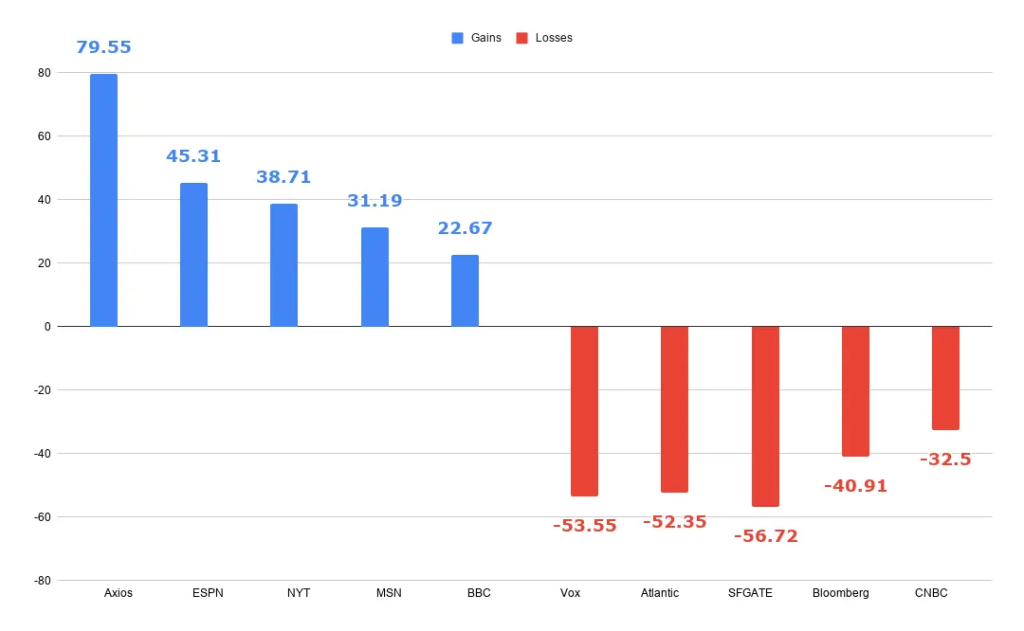
For decades, web visibility has been measured through impressions, rankings, sessions, referral traffic, conversions, and return visits. AI complicates that model because a source can influence an answer without receiving a conventional visit.
Pew Research Center’s analysis of U.S. Google browsing behavior in March 2025 found that users clicked a traditional search result in 8% of visits when an AI summary appeared. When no AI summary appeared, the click rate was 15%. Users also clicked links within the AI summaries themselves only rarely.
That creates a difficult measurement problem. A product page might supply the specification that causes an AI assistant to recommend a device, while the eventual purchase happens elsewhere. A technical article might explain the concept used in an answer without receiving the reader who benefited from it. A local business could be considered by an assistant, compared against several competitors, and rejected without ever recording an impression.
Cloudflare has documented a related imbalance from the infrastructure side. Its 2026 analysis reported that 52% of crawler requests were associated with AI training by June 2026, up from 22% in spring 2025, while mixed-use crawlers that combine activities such as search, agent use, and training represented more than 36% of crawler activity.
The web therefore begins separating being read from being visited. That is a significant economic change for any system funded by attention.
Visibility Before the Click
The shift becomes especially noticeable in industries where digital discovery has traditionally depended on a user comparing several providers. Search visibility once meant earning a place somewhere a person could encounter it. An AI interface can add another stage: the system may inspect a larger field and expose only the few options it considers relevant.
Legal services provide a useful example because searches are often specific to location, practice area, urgency, and trust. Work around SEO for Lawyers has traditionally focused on making useful legal information and practice pages discoverable when someone searches for a particular need. In an AI-mediated interface, part of that discovery can happen before a results page is presented, as the system interprets the request, checks available information, and narrows the field.
The principle extends well beyond law. Healthcare providers, contractors, financial services, software vendors, travel businesses, and local retailers can all be evaluated by systems that decide what deserves to reach the user. Visibility increasingly includes whether software can correctly understand what an organization offers and when it is relevant.
From Retrieval to Selection
An AI layer becomes much more consequential once it moves from summarizing information to making shortlists.
Consider a laptop purchase. A conventional search might begin with “best laptop under $1,500.” The user then opens reviews, compares specifications, checks retailers, reads complaints, and decides which compromises are acceptable. An AI-assisted request can contain the real constraints immediately: frequent travel, occasional 4K editing, strong battery life, low weight, four years of expected use, and a dislike of glossy screens.
That gives the system a different job. It is no longer retrieving pages that contain the phrase “best laptop.” It is matching a set of requirements against evidence distributed across product data, reviews, specifications, retailer information, and perhaps previous user preferences.
The same pattern applies elsewhere. A travel assistant can eliminate hotels without late check-in. A software procurement agent can reject products that lack a required integration. A restaurant assistant can factor in dietary needs, distance, opening hours, and reservation availability before recommending three places. A research assistant can rank sources by relevance to a narrow question rather than by general popularity.
As this becomes normal, businesses compete on two fronts. They still need to persuade the human who receives the shortlist, but they also need to survive the machine’s earlier filtering stage.
That does not make optimization a matter of inserting more keywords for AI. The system needs reliable facts. If two pages contradict each other about a price, if a product page is outdated, or if service coverage is never stated clearly, the machine has a reason to lower confidence or choose a cleaner source.
The Risk of Invisible Gatekeeping
The convenience of AI-mediated discovery comes with a structural trade-off. Search results are imperfect, but they usually expose a visible set of alternatives. A generated answer can compress several sources and disagreements into one fluent response.
That compression hides parts of the decision process. The user may not know which sources were considered, which were excluded, how fresh the information was, or how much weight the system placed on different signals. If the answer is wrong, it can be difficult to determine whether the failure came from retrieval, outdated source material, model reasoning, ranking, or the way the original request was interpreted.
This matters most when the underlying information is contested or changes quickly. Stanford researchers reported in June 2026 that a real-time audit of six commercial chatbots answering questions about emerging news found meaningful differences in accuracy, regional coverage, and the information ecosystems the systems relied on. The study also found that performance could be fragile under imperfect prompts.
Several forms of gatekeeping therefore become more consequential:
- Source selection can shape the answer before the user sees any evidence. A system that repeatedly favors a narrow group of domains can make those sources disproportionately influential.
- Freshness errors can survive polished presentation. An outdated price, policy, office holder, product specification, or availability status can look authoritative once rewritten into a confident sentence.
- Commercial incentives can become harder to inspect. If sponsored placement, platform partnerships, or preferred integrations affect recommendations, users need a way to distinguish those influences from neutral selection.
- Minority or specialist viewpoints can disappear during synthesis. An answer optimized for consensus may remove useful disagreement that would have been visible across several search results.
The problem is not that AI always makes poor choices. It is that the mechanism of choice can be less visible than the result.
Websites Become Infrastructure
If AI handles more of the user-facing interaction, parts of the web may start behaving less like destinations and more like infrastructure.
Travel offers an obvious model. A hotel does not need an AI assistant to reproduce its entire website visually. The system needs accurate room inventory, dates, policies, prices, amenities, location, and a method for completing a reservation. The conversational interface can sit elsewhere.
Retail works similarly. Product catalogs, stock status, shipping rules, compatibility data, return policies, and customer reviews can feed an external decision layer. Software companies can expose documentation, APIs, pricing, security information, and integration details. Restaurants can expose menus, allergens, opening hours, reservation slots, and delivery coverage.
This produces two increasingly distinct versions of the internet: the visible web, designed for people who want to browse, inspect, enjoy, or research deeply, and the machine-readable web, designed to make facts and actions accessible to software.
The two will overlap, but they will not always serve the same purpose. A fashion site may still need photography and editorial storytelling because shoppers care about visual identity. Its inventory and sizing data, however, may need to be structured precisely because an assistant is trying to answer whether a particular jacket is available in a specific size and can arrive by Friday.
In that environment, APIs, structured data, feeds, explicit policies, stable URLs, trustworthy metadata, and consistent entity information stop looking like back-office details. They become part of the interface, even when humans never see them directly.
Power Moves Up the Stack
Every major internet layer has accumulated power by controlling a scarce part of the user journey. Browsers controlled access. Search engines organized discovery. Social platforms controlled distribution and attention. App stores controlled software discovery and installation.
An AI layer can potentially combine pieces of all four. It can understand the request, choose sources, summarize information, recommend providers, retain context, and initiate an action.
That creates a new concentration point. The company controlling the assistant can influence which sources are consulted, how alternatives are ranked, which integrations are available, what information is remembered about the user, and which transactions can be completed without leaving the interface.
The economic consequences are substantial. Publishers may need new forms of attribution or licensing if their information is useful to systems that generate little referral traffic. Businesses may need visibility metrics that show whether they were considered in machine-generated recommendations, not merely whether a page ranked. Platforms may have to explain when an answer is organic, sponsored, personalized, or constrained by available commercial integrations.
This also means openness matters. If AI systems can access a broad and competitive web, users can benefit from a wide information base. If the first layer becomes dominated by closed commercial arrangements, the internet may remain technically open while the practical path through it becomes increasingly filtered.
The Internet Behind the Answer
AI becoming the first layer of the internet does not require websites to disappear. It changes where the user’s work happens.
The old model asked people to navigate information. The emerging model asks machines to navigate information on their behalf, then present a smaller set of conclusions, recommendations, or actions. That can make the internet dramatically easier to use, especially for complex tasks. It can also make source selection, attribution, freshness, machine-readable data, and platform power much more important.
The biggest shift may therefore be invisible. More websites, databases, APIs, feeds, and services can exist underneath the interface while users interact directly with fewer of them. A person may see one answer where the system has inspected twenty sources, or approve one action that required several services to coordinate behind the scenes.
The next internet may not feel larger even if its infrastructure becomes more extensive. It may feel smaller because AI compresses the web into whatever it believes is relevant. The central question is no longer only whether information can be found. It is who decides what survives that compression and reaches the person on the other side.