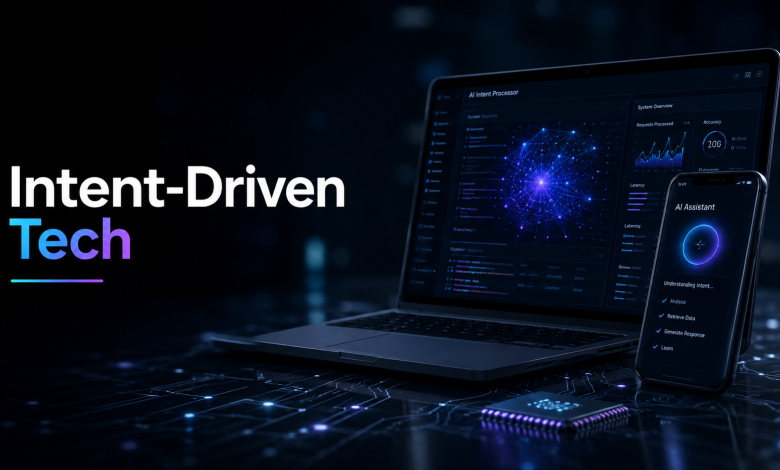
The biggest change in computing may be that users are starting to stop telling software exactly what to do. For decades, using technology meant learning the system’s sequence: open the right application, choose the right menu, enter the right command, check the result, and move to the next step. An intent-driven system starts somewhere else: what outcome is the person trying to achieve?
A request such as “find out why support costs rose last month and send the important findings to Maya” does not specify which files to open, what data to compare, or how to present the answer. The system has to interpret the goal, gather context, choose tools, plan the work, and know where human approval is still required.
The Command Era Is Fading
Traditional software is procedural. A person clicks a button, selects a filter, enters a value, or runs a known command, and the application performs a predefined operation. Graphical interfaces made those commands easier, but users still had to understand enough of the software’s structure to tell it what should happen next.
Consider booking a business trip. A conventional workflow may require someone to search flights, compare arrival times, check the company travel policy, find a hotel near the meeting, add the itinerary to a calendar, and notify colleagues. Intent-driven software shifts more of that coordination into the system.
| Command-based use | Intent-based use |
| Search flights and sort by time | Ask for a practical flight that fits the meeting schedule |
| Open the travel policy separately | Let the system check fare and hotel limits |
| Compare hotels manually | Ask for one that balances location, policy, and preference |
| Update the calendar yourself | Let the system prepare itinerary entries for review |
Natural-language input alone does not create this model. A chatbot that converts “show me June invoices” into a database query is still executing a fairly direct command. The deeper shift begins when software has to decide what information matters, which actions are needed, and how to handle details the user never specified.
Intent Depends on Context
“Book me a good hotel” is easy to understand grammatically and difficult to execute well. Good could mean inexpensive, close to a client office, quiet enough for work, near public transport, or within company policy. The correct interpretation depends on the user, the situation, and the constraints around the request.
This is why AI systems become more useful when they can retrieve relevant information from calendars, documents, CRM records, project tools, or internal knowledge bases. The model does not need to contain every fact itself if it can reach the right source at the right time.
The difficult part is deciding how much context is appropriate. Giving an assistant access to every email, financial record, and customer file simply because more context may improve an answer creates unnecessary exposure. A better design retrieves the minimum information needed for the current task and respects the permissions attached to it.
This question is becoming practical at scale. Stanford’s 2026 AI Index reports that 88% of surveyed organizations used AI in at least one business function in 2025, while 70% used generative AI in at least one function. As AI moves deeper into ordinary workflows, context management becomes an operational issue rather than a feature of a chat interface.
The System Has to Build a Plan
Understanding a goal is only the first part. The system must still decide how to reach it.
Take the request: “Find customers most likely to cancel this month and prepare retention offers for the accounts worth saving.” A useful system may need to inspect subscription history, recent support activity, product usage, contract value, existing discounts, and retention rules. It then has to decide which signals matter, identify the relevant accounts, prepare offers, and route unusual cases for review.
Traditional automation can perform many of those steps, but the sequence is usually designed in advance. Intent-driven software can be given the outcome without receiving the complete procedure. It may choose different intermediate actions depending on the available data, a policy constraint, or an unexpected result.
That flexibility creates a new monitoring problem. If an agent chooses the wrong data source or skips a validation step, every later action can still complete successfully. Systems therefore need more than a record of the final output. For important workflows, teams may also need to know which tools were used, what information influenced the plan, and where the system changed course.
Software Is Learning to Choose Tools
A language model can explain how to schedule a meeting, but scheduling it requires calendar access. It can describe how refunds work, but issuing one requires a commerce or payment system. It can discuss customer history, but answering a specific account question requires permission to retrieve that record.
This is why tool use matters so much in current AI systems. The model becomes less like a source containing every answer and more like an interpreter that can decide which capability to call. A support assistant might retrieve an order, check shipment status, inspect the refund policy, and prepare a response. A research assistant might search internal files, compare figures, calculate a result, and produce a summary.
Two products using similarly capable models can therefore behave very differently. One may have reliable data connections, strict permissions, and clear error handling. Another may use the same model but weak integrations and little visibility into what its actions changed. The quality of an intent-driven system depends heavily on the software surrounding the model.
Permission Becomes Part of Meaning
Understanding what a person wants does not mean software should automatically be allowed to do it. Suppose a support manager says, “Fix the issue with this customer’s order.” That could involve checking the shipment, changing an address, issuing store credit, refunding a payment, or replacing an item. An AI system might interpret the problem correctly while still needing firm limits on which actions it can perform.
A useful distinction is simple: intent describes the desired outcome, while permission defines the acceptable range of action. Organizations can build that range in several ways:
- The system can recommend an action without executing it, which works when a person wants the research and preparation automated but still needs to make the decision.
- The system can prepare an action and wait for approval, such as creating a refund or purchase request that a manager must confirm.
- The system can execute low-risk actions within fixed limits, while unusual, high-value, or irreversible cases are automatically escalated.
- The system can block certain capabilities completely, even when requested, because some permissions should remain outside an agent’s authority.
This is becoming an enterprise issue rather than a theoretical one. McKinsey’s 2025 global AI survey found that 62% of respondents said their organizations were at least experimenting with AI agents, while 23% reported scaling an agentic system somewhere in the enterprise. Yet in any individual business function, no more than 10% said agents were being scaled. The gap shows how much harder it is to give AI operational authority than to demonstrate that it can complete isolated tasks.
When Intent Reaches the Physical World
Intent-driven technology becomes more consequential when software interacts with events outside a screen. Modern vehicles, navigation apps, phones, cameras, connected services, and insurance platforms can create digital records around a road incident, including timestamps, location history, photographs, dashcam footage, or vehicle-generated data. For instance a Fayetteville Car Accident attorney dealing with a dispute may encounter some of those records alongside traditional evidence, which makes the accuracy and preservation of machine-generated information increasingly relevant.
The technology lesson extends well beyond traffic incidents. Once software can influence physical actions or record real-world events, systems need dependable histories of what they observed, what information was available, and what happened afterward. Without that traceability, an automated decision can become difficult to examine precisely when its behavior matters most.
Completing a Task Is Not Enough
Intent-driven systems need a way to determine whether the user’s actual goal was satisfied. That is different from checking whether a technical action completed successfully.
Imagine someone tells an assistant, “Make sure I do not miss anything urgent while I am away.” The system may successfully scan every email, classify each message, and send a daily summary. The workflow still fails if an urgent customer escalation is placed in the ordinary section.
Many digital systems measure execution rather than outcome. An API returned a success code, a record was updated, or a message was sent. None of those facts proves that the original intention was fulfilled.
Verification can take several forms. The system can compare its result against explicit constraints, confirm that an external transaction actually completed, cross-check a critical fact, ask for clarification when confidence is low, or monitor what happened after taking an action. The appropriate method should depend on the consequence of failure.
This is one of the main differences between an assistant that produces an answer and an agent that acts. The latter needs a definition of success that goes beyond whether a tool call completed.
Confidence Should Change Behavior
AI systems often operate under uncertainty, but uncertainty should not trigger the same response in every task. A moderately confident restaurant recommendation is low risk. A system that is only moderately confident about whether to approve a large payment should not have the same freedom.
| Situation | Sensible system behavior |
| Low-impact recommendation | Proceed and make correction easy |
| Request has several plausible meanings | Ask a focused clarification question |
| Sensitive information is required | Check authorization before retrieving it |
| High-value action is proposed | Require explicit human approval |
| Action is difficult to reverse | Apply stronger validation before execution |
The practical design question is not simply whether the model can be wrong. It is how costly a wrong result would be and how easily it could be corrected.
A good system should also recognize when it lacks enough information. Quietly filling missing details can make an interface feel smooth, but it is poor behavior in finance, security, healthcare administration, or other workflows where an incorrect assumption can trigger a real action.
Interfaces Will Change, Not Disappear
If users can describe outcomes, software may need fewer visible controls for some tasks. Applications have accumulated menus, filters, forms, and dashboards because users traditionally needed a direct control for each function.
Intent adds another layer above those controls. A project manager might ask, “Show me the work most likely to miss Friday’s deadline,” instead of manually building filters for due date, status, dependency, and ownership.
Conversation will not replace graphical interfaces. Visual controls remain better for comparing many items, inspecting details, and making precise adjustments. The more realistic design is hybrid: the user states the goal, the system prepares the relevant work, and conventional controls remain available for review.
In some cases, stronger automation will actually make visual confirmation more important. If an agent proposes changing 1,200 customer records, a table showing exactly what will change is more useful than a conversational assurance that the task is ready.
Personalization Needs Boundaries
A system becomes better at interpreting intent when it knows something about the person using it. Working hours, preferred formats, recurring collaborators, travel preferences, or accessibility requirements can reduce unnecessary clarification.
Persistent context, however, should not become unlimited memory. There is a meaningful difference between information needed for the current task, preferences a user deliberately asks the system to remember, and sensitive information that should only be retrieved for a specific workflow.
Users also need control over personalization. A well-designed system should make it possible to see what information is being remembered, where it came from, whether it can be corrected, and whether it can be removed.
Incorrect memory can be as disruptive as missing memory. If a work assistant continues using an outdated role, project, or preference, personalization starts producing worse decisions rather than better ones. The goal is not for software to know everything about a user, but to know what is relevant to the present task.
Businesses Will Have to Design for Intent
Companies have spent decades designing screens and workflows. Intent-driven computing adds another design problem: deciding which goals users should be able to express and how those goals map safely onto business systems.
A banking assistant receiving “sort out my finances” cannot treat that sentence as one executable instruction. The user may want a spending summary, a debt repayment suggestion, a transfer between accounts, or an explanation of unusual charges. Those outcomes require very different permissions. The same issue appears in enterprise software. “Clean up our customer database” sounds useful until the system has to decide whether cleaning means merging duplicates, correcting fields, deleting records, or changing ownership assignments.
Intent therefore has to be designed, not merely detected. Product teams need to define supported outcomes, required information, automatic actions, approval points, and behavior for ambiguous requests. A polished conversational interface is of limited value if the system cannot translate a broad request into a safe and understandable set of actions.
The New Skill Is Knowing What to Delegate
As systems become better at interpreting goals, users will spend less time learning every feature and more time deciding what level of control to hand over.
Low-risk work such as reformatting documents, organizing notes, or collecting background information can often be delegated with minimal supervision. Drafting external communications, analyzing business data, or preparing purchasing recommendations may benefit from automation but still deserve review.
Actions with direct consequences need clearer limits. A business might allow an AI system to issue refunds below a defined amount or schedule routine meetings while requiring approval for larger transactions or unusual account changes.
The useful skill is therefore not simply writing better prompts. It is stating the desired outcome clearly, providing relevant constraints, recognizing what information the system needs, and deciding which parts of the process should remain under human control. People who understand those boundaries will get more value from intent-driven tools than those who either micromanage every step or delegate everything without inspection.
Where This Model Leads
For most of computing history, humans adapted themselves to machines. They learned commands, menus, file structures, and application workflows because software required explicit instructions.
Intent-driven systems reverse part of that relationship. Software increasingly has to interpret what a person means, identify relevant context, choose useful tools, build a workable plan, and recognize when it needs approval.
The adoption numbers also show why this should not be confused with fully autonomous computing. AI use is widespread, while scaled agent deployment remains much more limited. The difficult part is no longer proving that a model can understand a request. It is building the permissions, verification, context controls, and recovery mechanisms required to let that understanding produce dependable action.