
Three of the most talked-about video models of the year all shipped inside the same week, and picking between them is now a real decision rather than a thought experiment. Seedance 2.5 from ByteDance, MiniMax H3 from MiniMax, and Wan 3.0 from Alibaba each promise longer clips, native sound, and tighter control. On a good day, all three can produce a clip that stops a scroll. The differences only surface once the work gets harder: sustained motion, prompt adherence, a character who has to look the same in the last second as the first, deliberate camera moves, believable physics, turnaround speed, and the unglamorous arithmetic of what a finished minute of video actually costs.
Here is the short version before the evidence.
For long single-take storytelling with the widest set of reference inputs, Seedance 2.5 looks like the most ambitious option.
For measured quality, the lowest cost per minute, and the only set of weights that can be pulled down and run locally, MiniMax H3 is the strongest all-round pick on today’s evidence.
Wan 3.0 earns a place in the Seedance 2.5 vs MiniMax H3 vs Wan 3 conversation mainly because it offers a live thirty-second endpoint right now, though it carries a caveat none of the others do: at the time of writing, no independent benchmark has measured it at all.
One line to keep in mind through everything below: a model can produce a beautiful five-second clip and still be frustrating to use every day. Selecting a video model is a workflow decision, not a demo-reel beauty contest.
The Verdict at a Glance
A compressed scorecard first, with the reasoning saved for later sections. Categories with no independent measurement are marked honestly rather than guessed.
| Category | Seedance 2.5 | MiniMax H3 | Wan 3.0 | Edge |
| Overall quality | Very strong | Very strong | Unmeasured | H3, narrowly |
| Realism | High | High | Unclear | Tie |
| Motion | Smooth, long | Smooth | Unclear | Tie |
| Prompt adherence | Improved | Category leader | Claimed | MiniMax H3 |
| Character consistency | Up to 50 refs | Up to 12 refs | Claimed strong | Seedance 2.5 |
| Camera movement | Advanced | Good | Unclear | Seedance 2.5 |
| Cinematic output | Built for it | Strong | Unclear | Seedance 2.5 |
| Image-to-video | Strong | Strong | Live | Tie |
| Text-to-video | Strong | Ranked No. 2 | Live | MiniMax H3 |
| Generation speed | Near real-time (claim) | Fast, short clips | Standard | MiniMax H3 |
| Creative control | Deepest toolset | Deep | Moderate | Seedance 2.5 |
| Accessibility | API opened Aug 7 | API plus weights | Live, staged | MiniMax H3 |
| Pricing and value | Token based | Cheapest per min | Priciest tier | MiniMax H3 |
| Developer access | API only | API plus open weights | API only | MiniMax H3 |
| Best suited for | Long narrative | All-round production | 30s single takes | Depends on job |
| Which is better: Seedance 2.5, MiniMax H3 or Wan 3?
On current evidence, MiniMax H3 is the best all-round choice: it ranks near the top of independent arena tests, costs the least per finished minute, and ships downloadable weights. Seedance 2.5 wins for long single-take storytelling and the richest reference control. Wan 3.0 suits creators who need a live thirty-second endpoint today, but no independent benchmark has measured its quality yet. |
The Differences That Matter Most
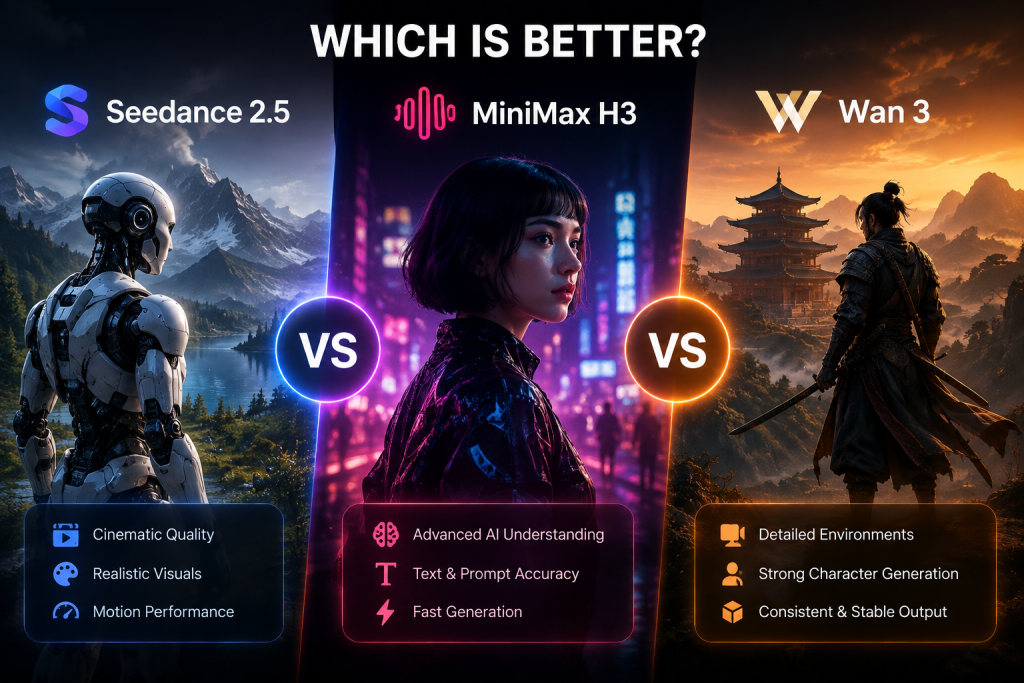
Visual Quality and Realism
MiniMax H3 has the clearest resolution advantage on paper, rendering natively at 2K with fine grain and accurate text and brand rendering, which matters for product and advertising work where a logo has to stay readable.
Seedance 2.5 leans into performance and scene realism: early hands-on reporting describes a meaningful step up over Seedance 2.0 in acting and staged action, though the same reports note that visual hallucinations feel similar to the previous version, with the occasional stray object appearing in a scene.
Wan 3.0’s realism is genuinely unmeasured, and its own vendor’s documentation quietly recommends a sibling model, HappyHorse, as the default for image and reference work, which is a signal worth respecting.
Motion Under Pressure
Seedance 2.5’s headline pitch is exactly this: smoother, more consistent motion held across a native thirty-second shot, which is the hardest window to keep stable.
MiniMax H3 renders shorter clips of 4 to 15 seconds, so it has less time in which motion can fall apart, and its motion transfer from a reference video is a documented strength. Wan 3.0 claims a thirty-second ceiling but offers no motion evidence beyond promotional footage.
Prompt Following
Instruction adherence is where MiniMax H3 has the strongest independent claim, holding the top position for instruction-driven video editing on the arena and second for text-to-video.
Its whole design premise is that reference and editing relationships are expressed in plain language, so a prompt like reference the camera move from clip one, have the character in image two sing, and match the vocals to audio three is meant to be parsed as a single instruction.
Seedance 2.5 advertises roughly twenty percent better prompt adherence than Seedance 2.0 and adds timestamp-level direction, letting a thirty-second idea be split into labeled intervals.
Longer, structured prompts tend to help both models rather than confuse them, provided each reference is given a clear role. Wan 3.0 claims omni-modal parsing but has no measured adherence score.
Character Consistency, the Section That Decides Most Projects
Seedance 2.5 has the widest safety net: up to fifty reference inputs, and hands-on reporting notes that as few as three images, two character portraits and one location shot, were enough to carry a two-minute short film with consistent characters and setting.
MiniMax H3 offers up to nine reference images plus video and audio, keeping subjects consistent while following referenced motion, and its shorter clip length means identity has less time to drift.
Wan 3.0 advertises production-grade character consistency, but with no independent test and no model card, available evidence is not yet strong enough to rank it against the other two.
Camera Control
Seedance 2.5 makes the boldest camera claims, offering professional camera movement, performance blocking, and white-model control that follows structured motion paths instead of relying on text alone.
MiniMax H3 reads camera language from a reference clip and reproduces framing and movement competently, which is often enough for product and social work.
Wan 3.0’s camera behavior is undocumented beyond marketing. The question to ask of any output is whether the camera is doing something on purpose or just wandering, and only Seedance 2.5 has built explicit tooling to answer it.
Cinematic Output
Seedance 2.5 is engineered squarely for this, with its long single-take window, cinematic language interpretation, and blocking controls.
MiniMax H3 produces genuinely cinematic short scenes and title sequences, and its 2K clarity helps on a large screen, but its 15-second ceiling limits longer narrative beats.
Wan 3.0’s thirty-second window is promising for a full broadcast spot in one take, yet without a quality signal it cannot be named a cinematic winner.
Image-to-Video
MiniMax H3 uses a supplied image as an opening frame or pairs first and last frames to control a transition, following the input’s aspect ratio, which keeps composition predictable.
Seedance 2.5 animates a reference image into a full-length clip while carrying the subject’s appearance through, and its larger reference set helps stabilize the result.
Wan 3.0 supports single or paired reference images and is live for the task, though Alibaba’s own docs steer image-to-video users toward HappyHorse.
Text-to-Video
MiniMax H3’s second-place text-to-video ranking is the clearest independent evidence in this whole comparison, and it renders from a prompt alone across seven aspect ratios.
Seedance 2.5 generates a complete thirty-second clip from a written scene in one native pass, which is a different value proposition: less about a single perfect shot and more about a coherent sequence with setup, motion, and an ending.
Wan 3.0 generates from text and is callable today. A model can behave differently across the two modes, and here H3 is the safer text-to-video pick while Seedance 2.5 is the stronger choice when the goal is a self-contained short.
Complex Scenes
Seedance 2.5’s structured motion paths and green-screen or white-model references are explicitly designed to make complex multi-character scenes more accurate and stable, which is the strongest theoretical answer to complexity among the three.
MiniMax H3’s shorter window reduces the surface area for chaos, and its instruction following helps coordinate several referenced elements.
Wan 3.0 is untested under load. None of the three should be assumed to handle a crowded action beat cleanly on the first try; each still rewards breaking a complex idea into controllable references.
Turnaround and Generation Speed
Seedance 2.5’s platform pages advertise near real-time generation, a notable jump from the several minutes standard generation used to take, but that is a vendor claim awaiting independent confirmation.
MiniMax H3 benefits structurally from shorter clips: rendering 4 to 15 seconds is simply less work than a native thirty-second pass, so H3 tends to feel fast in iteration even without a headline speed claim.
Wan 3.0 exposes concurrency of two and a fifty-task async queue, which tells more about throughput ceilings than about raw render speed.
Output Limits, Side by Side
Verified current limits, with honest gaps marked. Figures come from official listings and primary launch materials wherever they exist.
| Specification | Seedance 2.5 | MiniMax H3 | Wan 3.0 |
| Maximum resolution | Not publicly confirmed | 2K (2560 x 1440) | 1080p (per pricing) |
| Frame rate | Not publicly confirmed | 24 fps | Not publicly confirmed |
| Maximum clip duration | 30s single pass, extendable | 15s | 30s |
| Minimum duration | About 4s | 4s | Not publicly confirmed |
| Aspect ratios | Multiple | Seven ratios | 16:9, 9:16, 1:1 (reported) |
| Native audio | Yes | Yes, 32 kHz stereo | Yes |
| Reference inputs | Up to 50 (30 img, 10 vid, 10 aud) | Up to 12 (9 img, 3 vid, 3 aud) | Omni-modal, count unspecified |
| Local editing | Region-level | Sentence-level | Editing supported |
| Watermark | Platform dependent | Platform dependent | Watermark-free MP4 reported |
| Export format | MP4 | MP4 | MP4 |
What a Finished Minute Actually Costs
| Pricing dimension | Seedance 2.5 | MiniMax H3 | Wan 3.0 |
| Free availability | Trial credits on some platforms | Trial via Hailuo app and hosts | Free credits on signup (reported) |
| API billing model | Per token (official) | Per second | Per second |
| Approx. cost per minute | Varies by resolution and duration | About 7.80 USD at 2K | 12.00 USD at 1080p |
| Cheapest tier | About 0.089 USD per second (reported) | 0.09 USD per second (768p beta) | 0.05 USD per second (480p) |
Getting In: Access and Availability
MiniMax H3 is the most broadly reachable: a live global API, the Hailuo consumer app, a desktop app, and third-party hosts including fal and Krea, plus downloadable weights.
Seedance 2.5 reached consumers first through Jimeng and Doubao Pro, with its API opening through BytePlus ModelArk and Volcano Engine, though enterprise access can require business verification.
Wan 3.0 is live on Qwen Cloud but appears to be a staged rollout, with a live endpoint yet no formal launch, no model card, and modest concurrency limits.
Building on Them: The Developer View
For production integration, MiniMax H3 is the most build-ready. It exposes a documented global API with an asynchronous three-step flow of create a task, poll the task id, and download the result, plus optional self-hosting for teams outside the excluded regions and native ComfyUI support for pipeline experimentation.
Wan 3.0 is callable today on Qwen Cloud through the DashScope endpoint, with published rates and clear limits of two concurrent requests, a fifty-task queue, and 30 requests per minute, which is workable for modest workloads but constraining at scale.
Seedance 2.5’s API opened on August 7, 2026, and is async and reference-rich, though enterprise onboarding and business verification can slow the first integration, and international access has historically routed through resellers.
and Seedance 2.5’s deep controls both have a claim, while Wan 3.0 asks for a leap of faith.
Best Fit by Job
A category can end in a tie when the evidence is genuinely close, and several here do. Winners reflect current evidence, not permanent standings.
| Use case | Best fit | Reasoning |
| Cinematic videos | Seedance 2.5 | Long single take, blocking and camera controls, cinematic pedigree. |
| Social media clips | MiniMax H3 | Fast, cheap, 2K clarity, quick iteration on short formats. |
| Advertising | Seedance 2.5 | Fifty references hold product, logo, palette, and setting on brief. |
| Product videos | MiniMax H3 | Accurate text and brand rendering, sentence-level fixes, low per-minute cost. |
| Anime and stylized | Tie | Both handle stylized output well; no independent split yet. |
| Realistic human video | MiniMax H3 | Highest measured quality of the three on the arena. |
| Image-to-video | Tie | H3 ranks third measured; Seedance holds identity with more references. |
| Short films | Seedance 2.5 | Thirty-second beats plus reference-carried characters across a two-minute short. |
| Rapid content production | MiniMax H3 | Shorter clips render faster and cost less per pass. |
| Character-driven stories | Seedance 2.5 | Widest reference ceiling for identity across shots. |
| Developers | MiniMax H3 | Documented global API plus optional self-hosting. |
| Local and private generation | MiniMax H3 | Only one of the three with published weights, license permitting. |
| Beginners | MiniMax H3 | Approachable app, predictable results, plain-language editing. |
| Budget users | MiniMax H3 | Lowest cost per finished minute; free trials available. |
The Scorecard.
| Category | Weight | Seedance 2.5 | MiniMax H3 | Wan 3.0 |
| Visual quality | 15% | 8.5 | 9.0 | 7.0 |
| Motion | 15% | 8.5 | 8.5 | 7.0 |
| Prompt adherence | 12% | 8.5 | 9.0 | 7.0 |
| Character consistency | 10% | 9.0 | 8.5 | 7.0 |
| Camera control | 8% | 8.5 | 8.0 | 6.5 |
| Realism | 8% | 8.5 | 8.5 | 7.0 |
| Image-to-video | 7% | 8.5 | 8.5 | 6.5 |
| Text-to-video | 7% | 8.5 | 9.0 | 7.0 |
| Speed | 5% | 7.0 | 7.5 | 6.5 |
| Creative control | 5% | 9.5 | 9.0 | 7.0 |
| Accessibility | 3% | 7.0 | 8.0 | 6.5 |
| Value | 3% | 7.0 | 9.0 | 6.5 |
| Developer flexibility | 2% | 6.5 | 9.5 | 7.0 |
| Weighted overall | 100% | 8.4 | 8.6 | 6.9 |
Figure 4. Weighted overall scores. The gap between Seedance 2.5 and MiniMax H3 is small; the gap to Wan 3.0 reflects missing evidence as much as capability
Everything in One View
A comprehensive reference table for quick scanning.
| Attribute | Seedance 2.5 | MiniMax H3 | Wan 3.0 |
| Developer | ByteDance Seed | MiniMax (Hailuo) | Alibaba, Tongyi Lab |
| Release | July 31, 2026 | July 31, 2026 | 2026, undated |
| Text-to-video | Yes | Yes | Yes |
| Image-to-video | Yes | Yes | Yes |
| Maximum resolution | Not confirmed | 2K | 1080p |
| Maximum duration | 30s, extendable | 15s | 30s |
| Reference support | Up to 50 inputs | Up to 12 inputs | Omni-modal |
| Character consistency | Strong (refs) | Strong (measured) | Claimed |
| Motion quality | Strong (claim) | Strong (measured) | Unmeasured |
| Prompt adherence | Improved | Category leader | Claimed |
| Camera control | Advanced | Good | Unclear |
| Audio | Native | Native, 32 kHz stereo | Native |
| API | Opened Aug 7, 2026 | Live, global | Live (Qwen Cloud) |
| Open weights | No | Yes, with carve-outs | No |
| Local deployment | No | Yes, region-limited | No |
| Ease of use | Moderate | High | Moderate |
| Pricing | Token based | About 7.80/min at 2K | 12.00/min at 1080p |
| Best use case | Long narrative | All-round production | 30s single takes |
| Main weakness | Cost compounds | 15s ceiling, license | No independent benchmark |
| Overall rating | 8.4 / 10 | 8.6 / 10 | 6.9 / 10 (provisional) |
The Final Call on Seedance 2.5 vs MiniMax H3 vs Wan 3
Choose Seedance 2.5 for long single-take storytelling, ad and brand work that must hold many references on brief, and post-heavy pipelines where region-level editing and deep camera control justify a higher, iteration-driven bill.
Choose MiniMax H3 for measured quality at the lowest cost per finished minute, fast iteration on short and social formats, production integration through a documented global API, and any workflow that benefits from downloadable weights where the license permits.
Choose Wan 3.0 for a live thirty-second endpoint needed today, a workflow already anchored in the Alibaba and Qwen Cloud ecosystem, or a single-take spot with custom audio upload, accepting that its raw quality is not yet independently verified.
An overall winner, stated with the appropriate hedge: on today’s evidence, MiniMax H3 is the most sensible default for the widest set of users. It is the only one of the three with a top-tier independent score already on the board, the cheapest per minute, and the only one whose weights can be pulled down and run locally. That combination of measured quality, price, and flexibility is hard to argue against for general use.