A tool falls and almost hits a worker. A forklift stops just before a crash. A machine guard is left open, but no one gets hurt. These events are warnings that a serious accident could happen in the future.
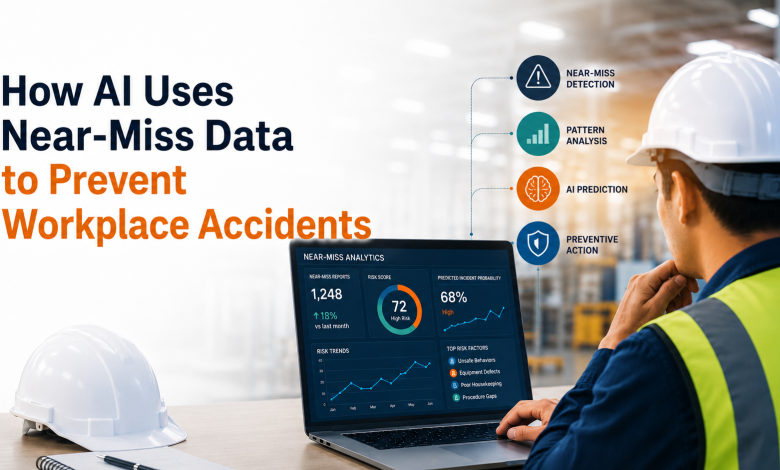
This is where AI in workplace safety can offer practical value. By analysing near-miss reports alongside inspection findings, equipment alerts and operational data, AI can help safety teams identify repeated warning signs before they lead to harm.
Near Misses Are Early Warnings, Not Minor Events
A near miss is an unplanned event that could have caused injury, illness or damage but did not, often because of timing, chance or a last-second intervention. OSHA encourages employers to investigate close calls because they can reveal hazards and weaknesses in safety systems before a more serious incident occurs.
The value of a near miss is not in the event alone. It lies in the conditions around it: the task being performed, the location, equipment involved, time of day, environmental conditions, work pressure and actions taken afterwards.
When these details are collected consistently, near-miss data becomes a record of where risk is building.
Why Traditional Safety Data Often Looks Backward
Many organisations still measure safety mainly through injuries, lost-time incidents and other lagging indicators. These metrics are important, but they describe harm that has already occurred.
Serious incidents are also relatively rare compared with the number of unsafe conditions, equipment irregularities and close calls that appear during everyday work. Relying only on injury records can therefore leave safety teams with too little information to recognise developing patterns.
Near-miss reports provide a wider view. They can show repeated exposure to risk even when the final outcome happens to be harmless.
How AI Finds Patterns in Near-Miss Reports
A large organisation may receive thousands of safety observations written in different styles. One worker may report “poor lighting near the loading bay,” while another writes “could not see reversing vehicle after sunset.” A human reviewer can connect these reports, but doing so across multiple sites and years is slow.
Natural language processing can classify free-text reports by hazard type, activity, location or potential severity. Machine-learning models can then look for clusters, unusual increases and combinations of factors that repeatedly appear before incidents.
Peer-reviewed research has shown that deep-learning methods can classify near-miss narratives and help identify work areas where accidents may be more likely. NIOSH has also noted that AI can use large datasets from reports and sensors to improve exposure estimates and potentially predict adverse workplace events.
The practical output should not be a dramatic claim that an accident will happen at a precise time. A more realistic result is a ranked signal: vehicle interaction risk is increasing at one location, dropped-object reports are clustering around a specific task, or corrective actions involving one machine are repeatedly overdue.
Better Predictions Begin With Better Reporting
AI cannot recover important facts that were never recorded. A report that simply says “unsafe situation observed” provides little value to either a safety professional or an algorithm.
Useful near-miss records should capture what happened, where and when it happened, the task underway, the hazard involved, potential consequences, immediate controls and supporting evidence. Consistent terminology also matters. For example, a shared understanding of unsafe acts and unsafe conditions can improve classification and reduce ambiguity across reports.
Data quality does not mean forcing workers to complete long forms. Reporting should remain quick and accessible, while the system guides users to provide the few details needed for meaningful analysis.
Human Judgment Still Decides What Matters
AI can identify correlation, but it does not automatically understand the full operational context. A rise in near-miss reports may indicate increasing risk, or it may reflect a successful reporting campaign that has made workers more willing to speak up.
Safety professionals must therefore validate patterns against site conditions, work schedules, maintenance history and changes in production. They also need to judge whether a frequently reported issue has low potential consequence or represents a credible path to serious injury.
Human oversight is equally important when models influence inspections, work stoppages or resource allocation. AI should support professional judgment, not replace it.
A Reporting Culture Is Part of the Technology
The strongest predictive model is of little use when workers do not report what they see. Fear of blame, complicated forms and a lack of feedback can quickly reduce participation.
OSHA recommends giving workers clear ways to report hazards and near misses, responding promptly and routinely explaining what action was taken. This feedback loop matters because workers are more likely to keep reporting when they see that their observations lead to visible improvement.
Organisations should also watch for reporting bias. Data may overrepresent teams that report actively while making quieter departments appear safer than they are.
Turning Prediction Into Prevention
Predictive insight only creates value when it leads to action. Each high-risk signal should have an owner, a response deadline and a method for verifying that the control worked.
That action might involve a targeted inspection, a maintenance check, a revised traffic route, additional supervision, a procedure review or focused training. The organisation should then track whether similar reports decline and whether the risk shifts elsewhere.
The International Labour Organization has highlighted the potential of smart monitoring and digital tools to improve working conditions, while also stressing the need for worker participation, risk assessment and preventive policies. That balance is essential: technology should make prevention more timely without turning safety into an automated numbers exercise.
The Goal Is Earlier, Better Decisions
AI will not eliminate uncertainty from workplace safety. What it can do is help organisations examine more information, find connections that are easy to miss and direct attention towards emerging risk.
Near-miss data is especially valuable because it captures the moments when a system almost failed. When organisations combine consistent reporting, responsible analytics and experienced human review, those moments can become early warnings rather than forgotten stories.
The real measure of AI in workplace safety is not how accurately it describes risk on a dashboard. It is whether people receive the information and support needed to prevent the next incident.