
Modern diesel trucks are increasingly defined by both mechanical engineering and data.
A current Ford Power Stroke, GM Duramax, or Ram Cummins relies on an interconnected network of sensors, electronic control modules, turbo controls, fuel-management systems, transmission electronics, and emissions equipment. These systems continuously generate information about how the truck is performing.
That creates an important opportunity for artificial intelligence and smarter diagnostic platforms.
Instead of treating a diagnostic trouble code as an isolated warning, intelligent systems can examine multiple data points together, identify abnormal patterns, and help technicians understand what is happening across the powertrain.
This is particularly valuable for trucks operating under demanding conditions such as heavy towing, agricultural work, construction, remote-area use, and dedicated off-road or competition applications.
The result is a different approach to diesel performance:
Establish a baseline → collect data → diagnose weaknesses → select appropriate hardware → calibrate correctly → continue monitoring.
In this model, AI does not replace mechanical upgrades. It helps owners and technicians make better-informed decisions about them.
From Mechanical Diagnosis to Data-Driven Maintenance
Modern diesel engines continuously generate information that previously required separate mechanical testing to obtain.
Depending on the platform and diagnostic equipment, technicians can monitor parameters such as:
- Engine coolant temperature
- Engine oil temperature
- Exhaust gas temperature
- Transmission temperature
- Boost pressure
- Intake-air temperature
- Fuel rail pressure
- Charging voltage
- Aftertreatment data
- Diagnostic trouble codes
The individual readings are useful, but their relationships can be even more valuable.
Suppose a truck begins losing power while towing.
A traditional diagnosis might initially focus on the turbocharger. Data could reveal a different story: commanded boost may be increasing while actual boost remains low, fuel pressure may be stable, and intake temperature may be rising unusually quickly.
That combination could direct attention toward the charge-air system rather than immediately replacing an expensive turbocharger.
AI-assisted diagnostic platforms can potentially make these relationships easier to identify by analyzing several data streams simultaneously.
Predictive Maintenance Could Change Diesel Reliability
Traditional vehicle maintenance is generally based on mileage, operating hours, time intervals, warning lights, or noticeable symptoms.
Predictive maintenance introduces another layer: identifying unusual patterns before they develop into larger problems.
Consider a diesel truck that regularly pulls the same trailer over similar terrain. Over time, its operating data establishes a baseline for coolant temperature, transmission temperature, boost pressure, and other measurements.
If transmission temperatures gradually begin increasing under comparable loads, that change may deserve investigation even if no warning light has appeared.
Similar patterns could occur with boost pressure, fuel delivery, charging voltage, exhaust temperature, or cooling-system performance.
AI-assisted platforms are particularly suited to this type of analysis because they can compare current behavior against historical operating information.
For owners who rely on their trucks for demanding work, finding a developing problem early can be considerably more valuable than diagnosing it after a breakdown.
AI Can Make Diagnostic Trouble Codes More Useful
A diagnostic trouble code identifies a condition detected by the vehicle. It does not always identify the exact component responsible.
That distinction is important on modern diesel platforms.
A sensor-related fault could originate from the sensor itself, but it could also involve wiring, connectors, unexpected operating conditions, or another system causing readings to move outside the expected range.
This is where AI-assisted diagnosis can add context.
Instead of asking only:
“What does this code mean?”
A data-driven diagnostic process can ask:
- What other measurements changed at the same time?
- Under what engine load did the fault occur?
- Has the same pattern happened previously?
- Which possible causes best match the complete data set?
AI does not eliminate the need for mechanical inspection or professional diagnosis. It can, however, narrow the investigation and reduce unnecessary parts replacement.
Heavy-Duty Reliability Requires Understanding Thermal Stress
Diesel performance cannot be judged entirely by peak horsepower.
A truck accelerating hard for several seconds experiences very different conditions from one towing a heavy trailer uphill, operating agricultural equipment, or spending extended periods under demanding off-road loads.
Sustained operation creates heat.
Engine coolant, oil, intake air, exhaust components, and transmission fluid all have to remain within suitable operating ranges.
Modern emissions equipment adds another thermal consideration. Systems such as exhaust gas recirculation and diesel particulate filtration are designed around emissions requirements, while DPF regeneration can involve elevated exhaust temperatures as accumulated particulate matter is managed.
For standard road vehicles, those systems should be maintained and repaired according to applicable requirements.
Dedicated off-road and competition applications can involve different engineering priorities. In those environments, owners may focus heavily on exhaust flow, intake cleanliness, thermal management, and reducing unnecessary mechanical stress during repeated high-load operation.
The key is that modifications should still be evaluated as part of the complete engine system rather than as isolated hardware changes.
Smart Monitoring Is Especially Valuable Under Heavy Loads
Real-time monitoring becomes more important as engine load increases.
A diesel truck may feel perfectly normal during everyday driving while developing excessive temperatures when towing uphill for several minutes.
Intelligent monitoring can provide context by examining engine load alongside coolant temperature, intake temperature, boost pressure, exhaust temperature, and transmission behavior.
This creates a much clearer picture of sustainable performance.
For example, a performance modification that produces stronger acceleration may initially appear successful. But if data shows significantly higher temperatures during prolonged operation, the complete result may be less positive.
AI-assisted monitoring provides a safeguard by making those secondary effects easier to identify.
How AI Fits Into the L5P Duramax Ecosystem
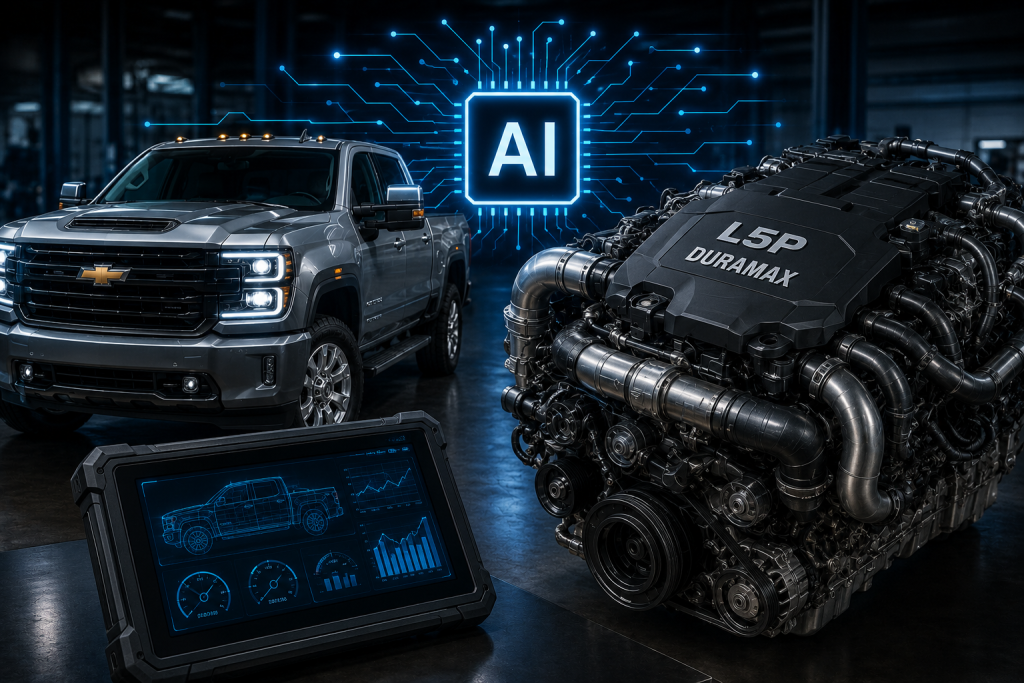
The GM 6.6L L5P Duramax demonstrates how closely modern diesel performance is connected to electronics.
Its high-pressure common-rail fuel system, variable-geometry turbocharger, electronic engine management, transmission integration, and emissions equipment depend on information from numerous sensors.
This makes the platform well suited to data-driven diagnostics.
Before changing hardware, technicians can compare commanded and actual boost, evaluate fuel rail pressure, examine temperature behavior, and determine whether sensor readings remain consistent under load.
For dedicated off-road, competition, and other applications where permitted, owners researching broader performance configurations may encounter an L5P delete kit from aftermarket suppliers such as Suncent.
The engineering discussion around these configurations extends beyond simply removing components. Hardware changes affect airflow, exhaust behavior, engine management, and operating conditions, which means compatible calibration and continued monitoring become important considerations.
This is where AI and intelligent diagnostics fit naturally into the performance ecosystem.
Rather than viewing diagnostics as something used only when factory equipment fails, owners can use data to understand overall engine health before and after an application-specific performance build.
For road-going vehicles, emissions systems remain subject to applicable laws and regulations. Dedicated competition or off-road configurations should therefore be considered separately from ordinary street-vehicle maintenance.
Modern Modifications Are Increasingly Data-Driven
The stereotype of diesel modification as simply removing hardware and adding more fuel does not accurately represent a properly engineered performance strategy.
Mechanical changes alter how the engine operates.
Changes affecting intake flow, exhaust flow, turbocharger operation, or other major systems need to be evaluated alongside the engine’s electronic management.
The objective is not simply maximum output.
A properly evaluated performance configuration needs predictable power delivery while maintaining acceptable temperatures and stable fuel and boost behavior.
Useful measurements can include:
- Boost pressure
- Fuel rail pressure
- Intake-air temperature
- Exhaust gas temperature
- Coolant temperature
- Transmission temperature
- Engine load
AI-assisted platforms can help compare those measurements across different operating conditions.
This turns performance tuning into a measurable engineering process rather than one based entirely on subjective throttle response.
Hardware modifications and intelligent diagnostics therefore serve different but complementary purposes.
The hardware changes the physical system. Calibration manages how compatible electronic systems respond. Monitoring then helps determine whether the complete configuration is operating as intended.
Measuring Fuel Economy and Throttle Response With Data
Performance improvements should ideally be measurable.
This is especially important when discussing fuel economy because MPG can change significantly according to vehicle weight, gearing, tire diameter, terrain, driving style, towing load, weather, and operating conditions.
Aftertreatment operation can also affect fuel consumption. Active DPF regeneration, for example, requires additional thermal management and can influence fuel use during the regeneration process.
Exhaust restriction and thermal behavior can likewise influence how a diesel engine responds under load.
In dedicated applications where exhaust or other hardware configurations differ from factory specifications, owners may notice changes in throttle response, turbo behavior, or fuel consumption.
Rather than assuming the size of those improvements, intelligent monitoring provides a better method: measure them.
An owner can record baseline information before changes and compare it with similar driving conditions afterward.
Useful comparisons might include:
- Fuel consumption before vs. after
- Boost response under comparable loads
- Exhaust temperature during sustained operation
- Transmission temperature while towing
- Throttle response and engine load
This before-and-after approach allows AI-assisted analytics to quantify whether a particular configuration has actually improved efficiency or performance instead of relying on generalized claims.
AI-Assisted DEF and Aftertreatment Diagnostics
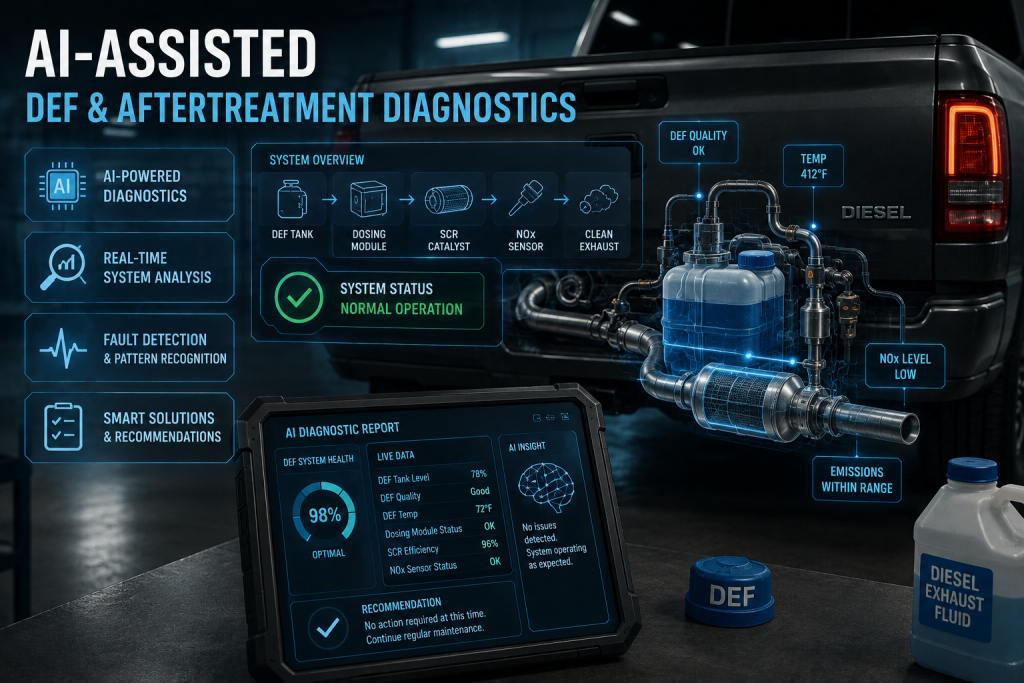 Modern DEF and aftertreatment systems contain considerably more than a fluid tank.
Depending on the vehicle, they may include pumps, heaters, dosing equipment, temperature sensors, NOx sensors, selective catalytic reduction components, particulate filtration, wiring, and electronic controls.
That complexity creates multiple potential failure points.
A DEF-related warning therefore does not automatically mean the fluid itself is responsible. Sensor faults, wiring problems, dosing issues, crystallization, heater failures, or other aftertreatment conditions may produce warnings or abnormal operation.
AI-assisted diagnostics can analyze the relationship between these readings and help technicians identify the most likely area requiring investigation.
Owners researching application-specific diesel performance hardware may also encounter products marketed as a DEF delete kit.
For dedicated off-road or competition builds where such configurations are lawful, these products may form part of a broader hardware and calibration strategy designed around different operating requirements from a standard road vehicle.
The important point from an AI perspective is that changing the hardware does not eliminate the value of diagnostics.
In fact, monitoring can become even more important after significant changes.
Temperature, boost, fuel pressure, and other engine parameters still need to remain within suitable operating ranges. Intelligent monitoring provides another layer of protection by identifying abnormal behavior before it develops into more serious mechanical damage.
For road-driven vehicles, factory emissions requirements and applicable regulations should continue to guide repairs and modifications.
Reducing Unexpected Downtime in Demanding Environments
Unexpected loss of power can be particularly disruptive when a diesel truck operates far from a workshop.
Some electronically controlled faults can result in reduced-power or derate strategies designed to protect the vehicle or address system problems.
On a normal road vehicle, the appropriate response is diagnosing and repairing the underlying fault.
However, dedicated agricultural, off-road, industrial, or competition vehicles may operate under different conditions where reliability and predictable performance are particularly important.
AI predictive diagnostics can help by identifying unusual sensor patterns before they progress to a warning or reduced-performance condition.
For application-specific builds, robust hardware and compatible calibration can then be combined with continuous monitoring.
The result is a two-layer reliability strategy:
Mechanical configuration designed for the application + intelligent monitoring designed to detect developing problems.
Neither should be treated as a substitute for the other.
Transmission Health Can Become Predictive Too
Engine performance receives most of the attention, but every additional pound-foot of torque ultimately reaches the transmission.
That makes transmission monitoring equally important.
Temperature, shift behavior, engine load, vehicle speed, and converter operation can provide useful information about drivetrain stress.
Larger tires provide a simple example.
Increasing tire diameter changes effective gearing and often adds rotating mass. A truck may consequently shift more frequently while towing even though the engine still produces adequate power.
Historical operating data could reveal that change.
Instead of immediately adding more horsepower, the owner might discover that gearing, transmission cooling, or another supporting modification deserves attention first.
AI Does Not Replace Preventive Maintenance
Advanced technology cannot compensate for neglected mechanical fundamentals.
Before increasing performance, inspect the truck’s:
- Engine oil and coolant
- Fuel and air filters
- Radiator and intercooler
- Charge-air boots and clamps
- Batteries and charging system
- Transmission fluid
- Belts and hoses
- Stored diagnostic codes
AI analysis is only as useful as the data and mechanical condition behind it.
Establishing a healthy baseline makes every later modification easier to evaluate.
The Future Diesel Build Will Be Data-Led
Performance hardware and artificial intelligence should not be viewed as competing approaches.
They solve different problems.
Hardware determines the physical capabilities and configuration of the vehicle. Calibration coordinates electronically controlled systems. AI-assisted diagnostics help owners understand what is happening before, during, and after those changes.
A modern performance-development process therefore looks more like:
Mechanical Baseline → Data Collection → Diagnosis → Application-Specific Hardware → Compatible Calibration → Performance Testing → Continuous Monitoring
This approach is particularly valuable for heavy-duty and dedicated off-road applications because sustainable performance matters more than a single peak horsepower number.
Conclusion: Smarter Data Can Build More Dependable Performance
AI is changing diesel diagnostics, but its greatest value may be in connecting digital information with mechanical decision-making.
Modern diesel engines already produce extensive information about temperatures, pressures, fueling, boost, transmission behavior, and system health. AI-assisted platforms can turn that information into more useful patterns and earlier warnings.
For stock road vehicles, that can mean faster fault diagnosis and better preventive maintenance.
For dedicated heavy-duty, off-road, agricultural, or competition applications, the same technology can help evaluate application-specific hardware and calibration using real operating data.
Performance modifications should not eliminate monitoring. They make accurate monitoring even more valuable.
The strongest diesel performance strategy is therefore not simply adding hardware or relying entirely on software. It is combining a mechanically sound platform, appropriate application-specific components, compatible calibration, and continuous data analysis.
That is where AI can have its biggest impact: helping diesel owners move away from guesswork and toward performance decisions based on what the engine is actually doing.