Why Japan’s AI Infrastructure Strategy Could Shape the Next Decade of Digital Innovation
Artificial intelligence has quickly become one of the defining technologies of this decade, but its success depends on more than sophisticated algorithms or increasingly powerful chips. Behind every large language model, industrial automation platform and AI-powered application lies a less visible yet equally critical foundation: digital infrastructure. As AI workloads become more computationally intensive, countries are beginning to compete not only on innovation but also on their ability to provide the power, connectivity and computing capacity required to support them.
Japan is emerging as one of the most compelling examples of this shift. Long recognised for its strengths in manufacturing, robotics and advanced engineering, the country is now investing in the infrastructure needed to support an AI-driven economy. The conversation has moved beyond expanding traditional data centers to building facilities specifically designed for high-performance AI computing.
This transition reflects a broader change taking place across the technology sector. For years, cloud computing shaped investment decisions in digital infrastructure. Today, artificial intelligence is introducing an entirely new set of technical requirements, forcing operators, policymakers and investors to rethink how future data centers should be designed, powered and located.
AI Is Changing the Rules of Digital Infrastructure
Conventional data centers were built to support enterprise applications, cloud services and digital storage. AI systems, particularly those powering generative AI and advanced analytics, operate very differently. Training and running these models requires significantly more processing power, higher rack densities, faster networking and far greater energy consumption than traditional computing environments.
This has transformed data centers from passive infrastructure into strategic assets. Facilities are no longer judged solely by the amount of space they provide, but by their ability to deliver reliable power, advanced cooling and low-latency connectivity at scale. Infrastructure that was considered sufficient only a few years ago is increasingly unable to meet the demands of modern AI workloads.
For Japan, this evolution presents both an opportunity and a challenge. The country already possesses one of Asia’s most mature digital economies, supported by extensive fibre networks, advanced telecommunications infrastructure and a highly connected enterprise sector. These strengths provide a solid foundation for AI infrastructure, but they also raise expectations around resilience, sustainability and long-term scalability.
Why Japan Is Well Positioned for the AI Era
Unlike many emerging digital markets, Japan is not starting from scratch. It combines a sophisticated industrial base with deep expertise in precision engineering, automation and semiconductor technologies. These capabilities have long supported sectors such as automotive manufacturing, electronics and industrial robotics, all of which are now integrating AI into their operations.
The demand for AI computing is therefore being driven not only by technology companies but also by manufacturers, financial institutions, healthcare providers and research organisations seeking to improve productivity and accelerate innovation. As AI adoption broadens across industries, demand for specialised computing infrastructure is becoming increasingly diversified.
Japan also benefits from a stable regulatory environment and a long-standing emphasis on digital resilience. Organisations operating critical systems often require high levels of reliability, redundancy and disaster preparedness, making infrastructure quality a strategic priority rather than simply a technical consideration.
From Capacity to Capability
One of the most significant changes taking place within the data center industry is the shift in how infrastructure is evaluated. For much of the past decade, discussions centred on the amount of available capacity or the number of facilities being built. AI is changing that conversation.
Today’s infrastructure must support graphics processing units (GPUs), specialised AI accelerators and increasingly dense computing environments. A facility capable of hosting conventional enterprise servers may require extensive upgrades before it can accommodate large-scale AI workloads. As a result, operators are investing in new cooling systems, enhanced electrical distribution and network architectures capable of handling unprecedented data volumes.
This shift suggests that the next generation of competitive advantage will depend less on how many data centers a country builds and more on how effectively those facilities support AI-specific requirements.
Infrastructure Has Become a Strategic Investment
The growing importance of AI infrastructure is also changing how investors view the sector. Data centers are no longer perceived solely as real estate or connectivity assets. They are increasingly recognised as essential components of national digital competitiveness.
Recent industry research reflects this momentum. According to Acumen Research And Consulting, Japan AI data center market is projected to expand at a strong pace over the coming decade, supported by accelerating enterprise AI adoption and sustained investment in digital infrastructure. While market forecasts naturally vary, the broader direction is clear: demand for AI-ready facilities is expected to outpace that of conventional data centers.
The implications extend well beyond infrastructure operators. Growth in AI computing is creating opportunities across power systems, cooling technologies, semiconductor manufacturing, networking equipment and engineering services. As the ecosystem expands, the value chain supporting AI infrastructure is becoming just as important as the facilities themselves.
Power, Location and Sustainability: The New Competitive Battleground
While computing power often dominates discussions about artificial intelligence, the real constraints on future AI growth may prove to be far less glamorous. Electricity, cooling capacity and land availability are rapidly becoming the defining factors influencing where AI infrastructure can be deployed and how quickly it can scale.
AI Is Redefining Infrastructure Requirements
Traditional enterprise data centers were designed to support business applications, websites and cloud services with relatively predictable computing demands. AI workloads are considerably more intensive.
Training advanced AI models requires thousands of processors working simultaneously, generating far greater heat and consuming substantially more electricity than conventional servers. Infrastructure that performed efficiently five years ago may struggle to support the power densities demanded by today’s AI applications.
As a result, designing an AI-ready facility increasingly requires a multidisciplinary approach that brings together electrical engineering, thermal management, networking and sustainability planning. The conversation is no longer about accommodating more servers but about creating environments capable of sustaining continuous high-performance computing.
Power Is Becoming a Strategic Resource
Across the global technology industry, power availability has emerged as one of the biggest obstacles to AI expansion. In several mature data center markets, new projects are facing delays because electricity networks are struggling to accommodate rapidly growing demand.
Japan is not immune to these pressures. Although the country benefits from a reliable electricity system, the growing concentration of AI infrastructure is expected to place additional demands on regional power grids. Future investment decisions are therefore likely to depend as much on energy availability as on market demand.
Cooling Has Become an Innovation Challenge
Heat has always been a by-product of computing, but AI has elevated cooling from an operational consideration to a strategic priority.
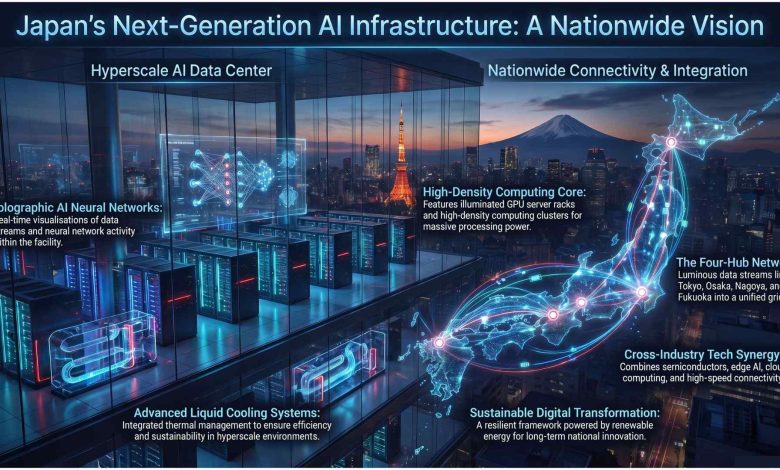
Conventional air-cooling systems remain effective for many enterprise environments, yet high-density AI deployments often require more advanced approaches. Liquid cooling technologies, once considered highly specialised, are becoming increasingly relevant as operators seek to improve efficiency while supporting more powerful computing environments.
The broader significance extends beyond technical performance. More efficient cooling reduces energy consumption, lowers operating costs and helps organisations meet increasingly ambitious sustainability targets. As environmental expectations continue to evolve, thermal management is becoming an important competitive differentiator rather than simply a facility design decision.
Sustainability Is No Longer Optional
Artificial intelligence presents an interesting paradox. It has the potential to improve energy efficiency across industries through optimisation and automation, yet the infrastructure supporting AI also requires significantly greater energy resources.
Balancing these realities will be one of the defining challenges of the next decade. Data center operators are increasingly exploring renewable electricity, intelligent energy management systems and more efficient cooling technologies to reduce the environmental impact of large-scale AI computing.
Why Geography Still Matters
One assumption often made about cloud computing is that physical location has become less important. In reality, AI is making geography relevant once again.
Large metropolitan areas continue to offer significant advantages, including extensive connectivity, established enterprise ecosystems and proximity to customers. These characteristics explain why Tokyo remains the country’s principal digital infrastructure hub.
However, concentration also creates challenges. Competition for land, increasing construction costs and pressure on electricity networks are encouraging operators to evaluate opportunities beyond traditional locations.
Cities such as Osaka are benefiting from this shift by offering additional capacity, geographic resilience and attractive connectivity. At the same time, emerging regional locations are beginning to receive greater attention as organisations seek to diversify infrastructure and reduce operational risk.
Rather than replacing Tokyo, these regional markets are likely to complement it, creating a more balanced and resilient national infrastructure landscape.
Japan’s Approach in an Asian Context
Across Asia, governments and private investors are racing to expand AI infrastructure, but each market is pursuing a different strategy.
Singapore has established itself as an international connectivity hub, although land and power limitations have encouraged more selective expansion. India is experiencing rapid growth driven by digital adoption and increasing cloud demand. China continues to invest heavily in domestic AI infrastructure while advancing its broader technology ambitions.
Japan occupies a distinctive position within this landscape. Its competitive advantage lies less in scale than in quality. A mature enterprise market, advanced telecommunications infrastructure and deep industrial expertise provide strong foundations for supporting sophisticated AI applications across manufacturing, healthcare, finance and research.
Rather than competing to build the greatest number of facilities, Japan appears well positioned to compete on resilience, operational reliability and the ability to support complex, mission-critical workloads. As AI becomes increasingly embedded within essential industries, these qualities may prove just as important as raw computing capacity.
Infrastructure as National Competitiveness
One of the most significant changes taking place is the way digital infrastructure is being viewed by governments and businesses alike. Data centers are no longer simply technology assets; they are becoming part of a country’s broader economic strategy.
The ability to provide secure, reliable and scalable AI infrastructure influences everything from research and innovation to industrial productivity and international investment. Countries capable of supporting advanced AI workloads are likely to strengthen their position within the global digital economy.
For Japan, this means infrastructure planning is becoming closely aligned with long-term economic resilience. Decisions made today about energy systems, connectivity and regional development will shape the country’s ability to compete in an increasingly AI-driven world.
What the Next Decade Means for Investors and Policymakers
The rapid expansion of AI infrastructure is creating opportunities that extend well beyond the data center industry itself. Every new AI facility stimulates demand for power systems, advanced cooling technologies, high-speed networking, engineering services and semiconductor supply chains. In many respects, AI data centers are becoming catalysts for broader digital economic development rather than isolated infrastructure projects.
For investors, this means looking beyond facility operators alone. Companies enabling the AI infrastructure ecosystem—from electrical equipment manufacturers to fibre network providers and energy technology firms—may become increasingly important beneficiaries of long-term market growth.
The investment landscape is also evolving in another important way. Capital is shifting from simply increasing capacity to improving capability. Facilities that can support higher power densities, greater energy efficiency and more flexible computing environments are likely to remain competitive for longer than those designed around conventional enterprise workloads.
The Infrastructure Race Is No Longer About Scale Alone
The global conversation around AI often focuses on the race to build larger models or deploy more powerful processors. While those developments remain important, they overlook a more fundamental reality: AI can only scale if the supporting infrastructure scales with it.
This has introduced a new measure of competitiveness. Countries are increasingly being assessed not only by their AI research capabilities but also by their ability to provide resilient energy supplies, modern transmission networks, high-capacity fibre connectivity and policies that encourage long-term infrastructure investment.
In this context, digital infrastructure is becoming a strategic national asset. Decisions about electricity generation, land use, environmental policy and telecommunications investment are now closely connected to a country’s future AI capabilities.
Why Collaboration Will Matter More Than Competition
The next phase of AI infrastructure development is unlikely to be driven by any single organisation or sector. Instead, progress will depend on collaboration across technology providers, utilities, telecommunications companies, policymakers and research institutions.
The complexity of AI infrastructure makes this increasingly necessary. Expanding computing capacity requires coordinated planning around electricity networks, fibre connectivity, land availability, workforce development and environmental objectives. Addressing these challenges in isolation is unlikely to deliver sustainable outcomes.
Japan has long demonstrated an ability to coordinate industrial strategy across government and private enterprise. That collaborative approach could prove to be one of its greatest strengths as AI infrastructure becomes more strategically important.
Looking Ahead
The evolution of AI infrastructure is still in its early stages. While attention often centres on breakthroughs in algorithms or semiconductor technologies, the physical foundations supporting those innovations deserve equal consideration.
Japan’s investments in digital infrastructure reflect a broader recognition that AI competitiveness depends on much more than software. Reliable electricity, advanced cooling systems, resilient communications networks and thoughtful long-term planning are becoming just as essential to innovation as computing power itself.
Recent research from Acumen Research And Consulting points to strong long-term growth in Japan’s AI data center industry, reflecting rising enterprise demand and sustained investment in AI-ready infrastructure. Yet the significance of this trend extends beyond market forecasts. It signals a structural transformation in how digital economies are being built.
As AI becomes embedded in every major industry, the countries best positioned for long-term success will be those that invest not only in intelligent technologies but also in the resilient infrastructure required to support them.
Japan enters this next chapter with significant advantages: a mature technology ecosystem, world-class engineering expertise and a long-standing commitment to operational reliability. If these strengths continue to be matched by strategic investment in energy, connectivity and sustainable infrastructure, the country is well placed to remain an influential player in the global AI landscape.
The future of artificial intelligence will not be determined solely by who develops the smartest models. It will also be shaped by who builds the strongest foundations beneath them—and that may prove to be the most important infrastructure story of the coming decade.