SHANGHAI and CHENGDU, China, Aug. 26, 2026 /PRNewswire/ — Gestala officially launched on January 1, 2026. Six months later, the company had completed two financing rounds totaling RMB 570 million, or approximately US$84 million.

The financing reflects growing investor interest in alternatives to implantable electrode-based BCIs—particularly approaches that aim to cover larger areas of the brain, reach deep neural circuits and reduce invasiveness.
Six Months at Startup Speed
Gestala was co-founded by Phoenix Peng and Tianqiao Chen, founder of Shanda Group and the Tianqiao and Chrissy Chen Institute.
Peng holds a doctorate from Fudan University’s Institute of Science and Technology for Brain-Inspired Intelligence and is a Principal Investigator (PI) at Tianfu Jincheng Laboratory. Gestala is his sixth startup.
The company has moved at an unusually fast pace since its launch. In March, Gestala completed a RMB 150 million angel round. Between April and May, a former Neuralink clinical lead and senior R&D and regulatory leaders from Nano Retina, a leading visual BCI company, joined the team.
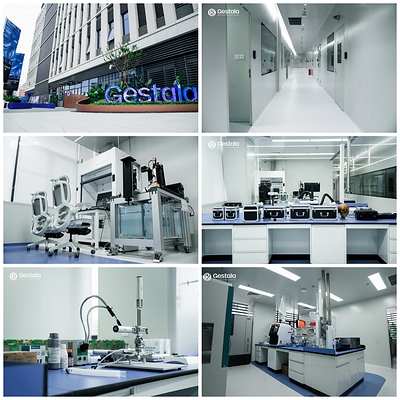
In June, Gestala’s global headquarters and the first phase of its ultrasound BCI superfactory began operations in Chengdu. In July, the company opened its Shanghai headquarters and completed a RMB 420 million Angel+ round.
The latest round included participation from HSG, Lens Technology, Sinovation Ventures and C Capital. Existing shareholders including Dalton Venture, Seas Capital, Tsing Song Capital and Gobi Partners made follow-on investments.
Gestala has done more than raise capital. Within six months, the company has simultaneously developed capabilities in fundamental research, ultrasound engineering, medical-device manufacturing, clinical trials and AI.
It has also assembled an interdisciplinary team of 29 scientists and engineers and plans to expand the team to approximately 45 by the end of the year.
That pace raises a question: Why does a company whose first product is still in development and clinical preparation need to build research, manufacturing, clinical and AI capabilities at such an early stage?
The answer lies in how Peng defines the company. In his view, Gestala is not simply developing a medical device. It aims to become a bridge between neuroscience and AI — and a “Neolab” for the life sciences.
From Electrical BCIs to Ultrasound
Peng previously co-founded NeuroXess, a BCI company pursuing an invasive approach. His move to ultrasound does not mean he dismisses the value of electrodes.
Invasive electrodes can record localized neural activity at high temporal resolution and have already demonstrated clinical potential in motor and speech decoding.
But if the goal expands from controlling a cursor or an external device to understanding higher-order functions such as memory, emotion, language and movement planning, is it enough to observe only a small number of neurons or isolated brain regions?
Higher-order brain functions generally emerge from interactions across multiple brain regions and neural circuits. Electrodes are well suited to capturing localized electrical signals. Functional magnetic resonance imaging can observe activity across broader areas of the brain, but the equipment is large and its temporal response is relatively slow.
Ultrasound offers another possibility. Functional ultrasound imaging can observe brain function through changes in cerebral blood flow associated with neural activity. Focused ultrasound, meanwhile, has the potential to act on specific brain regions, including deep neural circuits.
This also explains the name Gestala, which is derived from Gestalt psychology, a school of thought that originated in Germany and holds that the whole is greater than the sum of its parts.
The company’s long-term goal is to build a platform with the potential for whole-brain “read and write” capabilities: decoding activity across large areas of the brain while precisely modulating selected neural circuits.
That goal, however, remains some distance from clinical reality.
Ultrasound-based readout measures hemodynamic changes associated with neural activity rather than recording neuronal firing directly. Differences in skull thickness and anatomy can also attenuate, scatter and distort acoustic waves.
AI is therefore central to whether an ultrasound-based BCI can decode and modulate the brain. Gestala plans to develop a multimodal brain foundation model that identifies relationships among neural activity, cerebral blood flow, medical imaging and observable behavior.
As foundation models continue to evolve, a growing number of researchers are recognizing that the human brain remains the only known general-intelligence system validated through natural evolution.
Understanding the brain could not only lead to new treatments for neurological disorders, but also provide new theoretical foundations and technical paradigms for the next generation of artificial intelligence.
In Peng’s view, neuroscience and artificial intelligence are two sides of the same coin. One helps us understand intelligence; the other helps us create it. Gestala aims to connect the two.
“Brain-computer interfaces, ultrasound, artificial intelligence and life sciences are all different paths toward understanding human intelligence,” Peng said. “Our true subject of study is human intelligence itself.”
The Tests That Follow the Funding
A broad technological vision still needs to begin with specific clinical problems.
Gestala has selected chronic pain as its first target indication and plans to explore other neurological and psychiatric conditions, including depression, obsessive-compulsive disorder and stroke rehabilitation.
According to the company’s current plan, its first-generation ultrasound BCI product and brain foundation model will be unveiled by the end of 2026. The product will subsequently need to progress through clinical trials and medical-device registration.
Completing the financing therefore does not mean the technology has been proven. The real tests are only beginning.
The first is an engineering test: Can the system consistently target specific brain regions across individuals with different skull anatomies and produce reproducible readout and neuromodulation results?
The second is a clinical test: Can ultrasound neuromodulation deliver meaningful and durable benefits to patients while remaining safe over time?
The third is an AI test: Can Gestala’s brain foundation model bring electrical signals, cerebral blood flow, medical imaging and behavioral data into a unified representation? Can it establish verifiable relationships among neural activity, cognition, intention and behavior, while generalizing across individuals, tasks and diseases?
Gestala’s Chengdu headquarters is responsible for product development, engineering, manufacturing and industrial translation. Its Shanghai headquarters connects fundamental research, brain foundation model development, clinical resources and scientific collaboration.
Building on its existing dual-headquarters structure, Gestala also plans to establish an overseas headquarters in either Singapore or Hong Kong. The new location will connect the company with international research, talent and industry resources while supporting global collaboration and overseas development.
Through this structure, Gestala is building an integrated operation spanning technology development, engineering, manufacturing, clinical validation, AI models and international collaboration.
But regardless of how much capital it raises or how far its global footprint expands, Gestala’s ability to join the front ranks of the global BCI industry will depend on more than reproducible clinical data. It will also depend on whether the company can turn complex, multimodal brain data into a verifiable and generalizable brain foundation model.
The former will determine whether the technology can deliver meaningful benefits to patients. The latter will determine whether Gestala can establish a shared language through which neuroscience and artificial intelligence can explain one another.
About Gestala
Gestala is China’s first life sciences company dedicated to ultrasound-based brain-computer interface technology. Guided by the vision of “Better Brain for Better Humanity,” Gestala is committed to building an ultrasound-based BCI platform with whole-brain read and write capabilities. Beyond developing innovative therapies for a wide range of neurological disorders, the company is dedicated to decoding the brain and exploring a future in which neuroscience and artificial intelligence evolve in deep convergence. For more information, please visit www.gestala.com
 View original content to download multimedia:https://www.prnewswire.com/news-releases/chinas-bci-race-accelerates-gestala-raises-us84-million-in-six-months-302860300.html
SOURCE Gestala