Every week brings another announcement promising that AI will transform retail. AI will personalize promotions, improve forecasting, automate operations, optimize pricing, and unlock entirely new revenue opportunities. For independent grocers competing against national chains with far deeper resources, that’s a very compelling idea.
Yet despite growing investment in AI in the retail sector, many AI initiatives never progress beyond isolated pilots or deliver far less value than expected. According to McKinsey, 71% of retail merchants report that AI has had limited or no impact on their business, despite widespread adoption efforts. The issue is rarely the AI itself. More often, retailers are asking AI to solve problems created by years of disconnected technology decisions.
Looking at the retailers we work with, especially independent grocers, AI is not exposing a lack of innovation but a lack of integration.
AI has become the messenger
Historically retailers have successfully operated with fragmented technology because people compensated for the gaps.
Grocers have made this work because people knew the shortcuts. Someone in marketing knew which loyalty report to pull. Someone in e-commerce knew where online orders sat. Someone in finance knew which numbers needed checking before month-end. Store teams knew things the systems never captured at all.
That is fine when a business is relying on experienced people to connect the dots. It becomes a problem when AI is expected to do the same thing purely because it works differently.
Unlike people, AI cannot rely on tribal knowledge or experience. It can only work with the information it can access. When customer behavior is scattered across disconnected platforms, AI lacks a complete picture from which to generate meaningful insights. The result in this case is not inaccurate AI. It is incomplete AI.
Retail has spent decades buying technology instead of building intelligence
Most independent grocers did not deliberately create fragmented technology environments. They solved business problems as they emerged, and this led to a hodge podge of technologies being added to the mix.
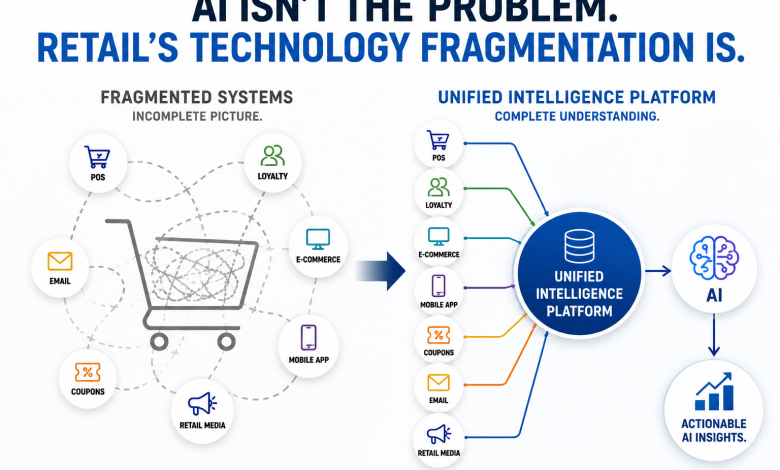
None of this happened overnight. A loyalty platform was added to keep shoppers coming back. E-commerce followed as customers began expecting online ordering. Then came digital coupons, retail media, mobile apps, email tools, analytics platforms, point-of-sale upgrades, and inventory systems. Most were bought to solve a real problem at the time, but they often came from different vendors and were built around different versions of the customer.
Each investment delivered value individually. Collectively, however, they created a technology environment where information is distributed across multiple systems that were never designed to work as a single intelligence platform.
It is the technology equivalent of a shopping cart after a dash through every aisle. It is full of valuable purchases, but unpacking everything into a coherent picture becomes increasingly difficult.
For those retailers we work with, we can see how each technology investment solved individual business challenges in the past, but AI requires those systems to work together.
Data alone is not enough
Many conversations about AI focus on the volume of data retailers possess. Everyone pins this as the holy grail that AI is sitting on. Similarly, independent grocers rarely suffer from a shortage of data as every transaction, loyalty interaction, promotion, online order, coupon redemption, and customer engagement generates valuable information. And they hold onto that information.
So no, the challenge isn’t data, it is context. Imagine a shopper who purchases groceries every Friday afternoon, regularly redeems digital coupons, recently began ordering online, has stopped opening promotional emails, and has gradually reduced the size of his or her weekly basket.
Those signs could indicate that the customer is changing shopping habits, becoming more price-sensitive or, in the worst-case scenario, are considering another retailer.
But if purchases reside in the point-of-sale system, coupon activity sits within the loyalty platform, e-commerce behavior lives elsewhere, and email engagement is managed through another application, AI never sees a single customer journey. It sees disconnected events with no relationship to one another.
Connected data creates understanding and tells the story that independent grocers can start to read.
Independent grocers have an opportunity many overlook
For the most part, when we consider retail tech and specifically AI, we immediately focus on the largest supermarket chains. These organizations have invested heavily in enterprise platforms and large technology teams capable of connecting complex systems. But independent grocers operate under very different conditions.
Many have accumulated technology over years of practical decision-making, selecting solutions that addressed immediate operational needs without always considering how they would integrate into a broader digital strategy. The result is often a patchwork of capable systems that perform well individually but provide limited visibility across the entire business.
This should not be mistaken for a lack of sophistication, as independent grocers possess some of the richest first-party customer data in retail. They know their communities, understand local buying behavior, and build relationships that national chains often struggle to replicate.
The competitive challenge is transforming that knowledge into connected intelligence that AI can use consistently across pricing, promotions, merchandising, retail media, and customer engagement.
AI is exposing years of fractured technology
Historically, fragmented systems created operational inefficiencies. Staff spent time exporting reports, reconciling information, and manually connecting data across departments. These were accepted as part of running the business.
But modern AI systems depend on connected, high-quality information to generate recommendations, automate decisions, and identify patterns that humans cannot easily detect. When the underlying data is fragmented, the value AI can deliver is constrained from the outset.
Gartner predicted that through 2026, 60% of AI projects that lack AI-ready data will be abandoned. That statistic highlights an important reality. AI success depends as much on information architecture as it does on the sophistication of the models themselves.
For independent grocers, competitive advantage will come from understanding customers better, responding faster to changing shopping behavior, optimizing promotions with greater precision, and creating new revenue opportunities through first-party data. None of these outcomes depends solely on deploying AI. They depend on giving AI access to a connected view of the business.
AI can only work with what the business makes visible
The next phase of retail AI belongs to grocers whose systems give AI a usable view of the business. For independent grocers, that starts with a practical question: can the business see the same shopper across the store, website, mobile devices, loyalty program, coupon activity, and marketing channels?
If the answer is no, AI will struggle. It may still generate reports, recommendations, or campaign ideas, but those outputs will be based on a partial version of reality. This is why the work beneath AI matters so much. Retailers need a unified intelligence platform that connects the systems already running the business, from point-of-sale and loyalty to e-commerce, retail media, shopper engagement, and marketing, into a single source of truth that AI can actually use.
AI will not fix years of fragmented decision-making on its own. It will show retailers where those fractures are. For independent grocers, that is not bad news. It is a chance to turn the data they already have into something more useful, more commercial, and more competitive.