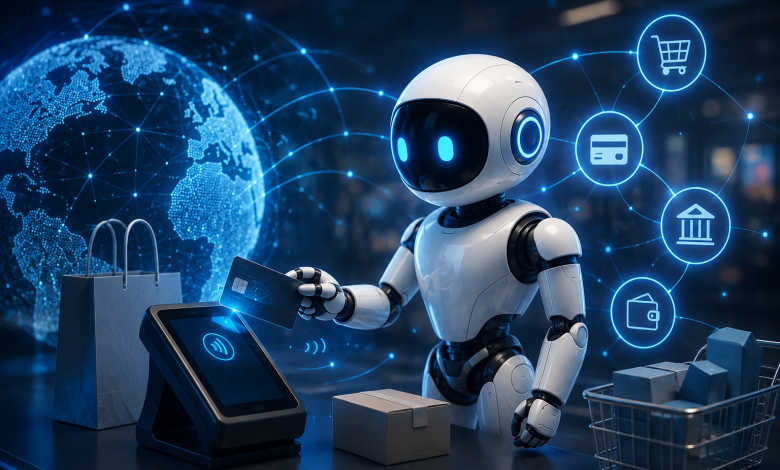
For decades, the payments industry has built technology around one basic assumption: a human being is making the purchase.
A person walks into a store and taps a card. A customer visits a website and clicks “Buy Now.” The accounts payable department receives an invoice, approves it, and sends an ACH payment.
Artificial intelligence is beginning to challenge that assumption.
AI agents are rapidly evolving from tools that simply answer questions into systems capable of performing tasks. They can research products, compare vendors, schedule meetings, analyze contracts, prepare purchase recommendations, and automate routine business processes.
The next logical step is obvious.
They are going to start spending money.
That raises a much bigger question than whether an AI agent can technically initiate a transaction.
Is our payment infrastructure ready for customers that are not human?
From AI Assistants to AI Buyers
Most people still think about AI as an assistant.
You ask a question. It provides an answer.
But the emerging generation of AI agents is designed to take action.
Imagine telling an AI agent:
“Find me the best flight to Chicago Tuesday morning, keep the cost under $600, book an aisle seat and add it to my calendar.”
Or a business owner telling an AI purchasing system:
“We’re running low on packaging supplies. Compare our three approved vendors and reorder from whichever supplier has the best combination of price and delivery time.”
The agent doesn’t simply provide information. It completes the task.
Once that happens, AI moves from being part of the research process to becoming part of the transaction itself.
And payments become critical infrastructure.
Who Actually Authorized the Purchase?
The payments industry has spent decades developing systems to determine whether a transaction is legitimate.
Was the card present?
Did the cardholder authorize the purchase?
Does the billing information match?
Is the transaction unusual?
Does the merchant appear trustworthy?
Agentic commerce introduces another layer.
Suppose an AI agent purchases $5,000 worth of equipment for a company.
Who authorized that transaction?
Was the agent allowed to spend $5,000?
Was it authorized to purchase from that particular vendor?
Could it have spent $10,000?
Could it purchase equipment but not software?
What happens if the agent makes a mistake?
These questions suggest that the future of payments may require much more sophisticated authorization rules.
Instead of simply asking whether a card is valid, payment systems may need to understand the boundaries within which an AI agent is permitted to operate.
Businesses could eventually establish rules such as:
An AI agent can spend up to $2,500 per transaction.
Purchases above $5,000 require human approval.
The agent can purchase from an approved vendor list.
Certain categories of transactions are prohibited.
Recurring expenses can be renewed automatically unless the price increases beyond a predetermined threshold.
The technology to create many of these controls already exists in different forms.
AI will make those controls much more important.
AI Could Transform B2B Payments First
Consumer AI shopping will receive a lot of attention, but I believe some of the biggest opportunities could emerge in B2B commerce.
Businesses already conduct enormous amounts of repetitive purchasing.
Companies pay invoices.
They renew software subscriptions.
They order inventory.
They pay contractors.
They purchase advertising.
They pay logistics providers.
They replenish supplies.
Many of these transactions follow predictable patterns.
That makes them ideal candidates for automation.
Consider accounts payable.
Today, an employee may receive an invoice, verify the amount, confirm that the product or service was delivered, obtain approval and initiate the payment.
An AI-powered system could eventually perform much of that process automatically.
It could read the invoice, compare it with the purchase order, identify discrepancies, determine whether the invoice qualifies for approval and select the appropriate payment method.
Then it could initiate an ACH payment, card payment, or virtual card transaction.
That could dramatically reduce the administrative friction associated with B2B payments.
But it also means payment technology needs to integrate much more deeply with AI-driven business systems.
The Checkout Page May Become Less Important
For years, payment technology has focused heavily on checkout experiences.
Reduce the number of clicks.
Make the form easier.
Add digital wallets.
Improve mobile checkout.
Those things will remain important for human customers.
But AI agents may not care about checkout pages at all.
They will care about APIs.
An AI agent doesn’t necessarily need a beautifully designed payment screen. It needs structured information and the ability to securely interact with a payment system.
This could shift payments further toward API-driven commerce.
Instead of a human visiting a website, an AI system might query a merchant’s inventory, compare pricing, submit an order, and initiate payment entirely through software.
The visible checkout experience may increase by a machine-to-machine transaction.
For merchants and software companies, that means payment infrastructure needs to become more programmable.
Fraud Will Become More Complicated
Of course, every major technology shift creates new opportunities for fraud.
Payments are no exception.
If legitimate AI agents can conduct transactions, criminals will attempt to create fraudulent agents that appear legitimate.
Identity will become extremely important.
Merchants may eventually need to determine not only who the customer is, but which AI system is acting on that customer’s behalf.
There may need to be mechanisms that answer questions such as:
Who owns the AI agent?
What authority has the agent been granted?
What account or payment credential is it allowed to use?
What transaction limits apply?
Has the agent’s behavior suddenly changed?
Payment fraud detection may increasingly involve understanding both human behavior and machine behavior.
That creates an entirely new category of risk management.
Disputes Could Become Interesting
Chargebacks are already one of the most complicated areas of payments.
Agentic commerce could make them even more complicated.
Imagine a customer telling an AI agent to purchase a product.
The agent selects the wrong model.
The customer receives the product and disputes the transaction.
The merchant says the order was properly authorized.
The customer says the AI made a mistake.
Who is responsible?
Or consider a business AI agent that automatically renews a software subscription because it determines that the company still needs the service.
A manager later disagrees.
Was the transaction authorized?
The industry will eventually need clearer standards around delegated purchasing authority.
Just as businesses create policies governing employee spending, they may need formal policies governing AI spending.
Payments Will Need More Intelligence
I’ve spent more than 25 years in the payments industry, and one thing has remained consistent: payment technology follows the way businesses operate.
When commerce moved online, payments moved online.
When mobile commerce grew, mobile payments followed.
When software companies began embedding financial services into their platforms, embedded payments expanded rapidly.
AI will likely create the next major shift.
The future payment stack will need more than transaction processing.
It will need intelligence.
Payment platforms will increasingly need APIs, real-time reporting, tokenization, transaction controls, fraud detection, automated reconciliation, and detailed data about why a transaction occurred.
At Nationwide Payment Systems, we already see businesses demanding more automation around invoicing, ACH, card payments, recurring billing, accounting integrations, and transaction data.
Those capabilities are becoming building blocks for a much more automated commercial environment.
The next evolution will be connecting those payment capabilities directly with intelligent software.
AI Founders Should Think About Payments Earlier
I regularly speak with entrepreneurs, technology executives, and AI founders through my work in payments and through conversations on the B2B Vault podcast.
One mistake I see technology companies make is treating payments as something they can figure out later.
The attitude is often:
“Let’s build the product first. We’ll just connect Stripe or another processor when we’re ready.”
That can work in the beginning.
But once a company scales, payments become much more strategic.
How will customers pay?
Will transactions be recurring?
Will customers use cards or ACH?
Are transactions B2B or consumer?
Are there large-ticket purchases?
Does the business model require additional underwriting?
Will the platform eventually facilitate transactions for other businesses?
How will payments reconcile with accounting systems?
How will fraud and disputes be managed?
AI companies building agentic commerce products should be asking these questions early.
Payment infrastructure shouldn’t be an afterthought.
It should be part of the architecture.
The Future Customer May Be Software
We are still early in the development of agentic commerce.
Humans are not going to disappear from purchasing decisions.
But the role humans play is likely to change.
Instead of personally completing every transaction, people may increasingly establish rules, budgets, and permissions while AI systems execute routine purchases within those boundaries.
The customer of the future might therefore look very different.
Behind every transaction there may still be a person or business.
But the entity actually researching the purchase, selecting the vendor, and initiating the payment could be software.
That creates enormous opportunities for merchants, payment companies, and AI developers.
It also creates new responsibilities around security, authorization, transparency, and trust.
For years, the payments industry has focused on making commerce faster and easier for people.
The next challenge may be very different.
We may need to build payment infrastructure for machines that are buying things on our behalf.
And that future may arrive sooner than many businesses expect.
About the Author
Allen Kopelman is the CEO and co-founder of Nationwide Payment Systems, a payment technology company founded in 2001 that provides merchant accounts, payment processing, B2B payment solutions, smart invoicing, ACH, payment gateways, and customized payment technology for businesses across the United States. He is also the host of B2B Vault: The Biz to Biz Podcast, where he interviews entrepreneurs, technology leaders and innovators about business, fintech, artificial intelligence, and the future of commerce.
Allen Kopelman – https://www.linkedin.com/in/allenkopelman/