
London, UK
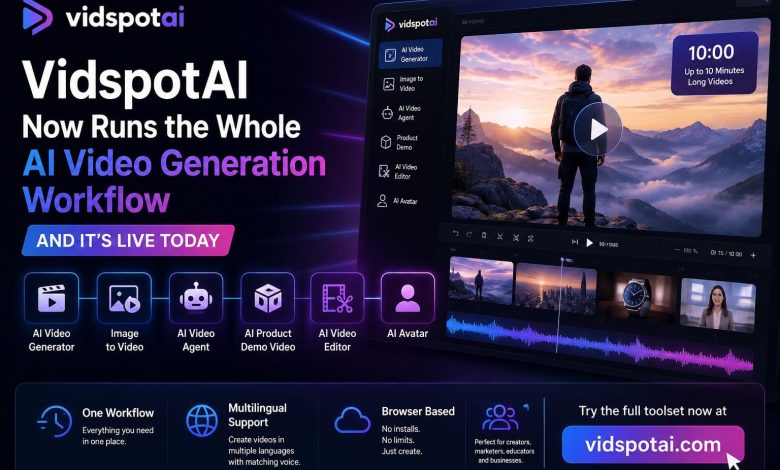
For the past couple of years, making a video with AI has meant hopping between apps. One tool writes the clip, another animates an image, a third handles the edit, a fourth adds a voice. VidspotAI is closing that gap. The platform now covers each stage of production in one place, so a video can go from a rough idea to a finished cut without ever leaving the browser.

The problem the platform is built around
The cost compounds with revisions. A change to one line of script can mean regenerating the clip, re-cutting the edit, and re-recording the voice — three separate applications, three separate waits, three separate chances for something to fall out of sync. Teams publishing video regularly end up spending more time on logistics than on the video itself.
VidspotAI’s answer is structural rather than incremental. Instead of making any single stage faster, the platform puts every stage in the same project.
Six tools that share one workflow
VidspotAI has grown into a connected set of tools, each built for a different part of making a video:
- AI video generator turns a script or a short text brief into a finished video. It is the entry point for anyone who already knows what they want to say — the script carries the structure, and the generator builds the video around it.
- Image to Video takes a still picture and animates it into a moving scene. It is the route in for people who already have the visual and need it to move.
- AI Video Agent takes a brief and works through the production steps on its own. Where the generator turns a script into a video, the agent handles the sequence of steps between brief and output, so the user is describing an outcome rather than driving each stage.
- AI product demo video maker builds walkthroughs and demos for a product, a format that has to be remade each time the product it documents moves on.
- AI Video Editor trims, reorders, and adjusts scenes after they are generated. It is the pass that turns a generated draft into something publishable: cutting a scene that runs long, moving a section earlier, tightening the middle.
- AI avatar puts a presenter on screen to deliver the script, for videos that need a face rather than a voice over visuals.
Because the tools sit inside the same platform, users move between them without exporting files or re-uploading anything. The generator or the agent can build a first version, the editor refines it, and the avatar or the image tool fills in whatever the video still needs.
That shared context is the part that is hard to replicate with a stack of separate products. In a fragmented workflow, each tool sees only its own slice: the editor does not know what the generator intended, and the voice tool does not know what the editor cut. Inside one platform, the project is continuous from first frame to last, and a change made late does not mean starting the chain over.
Long clips when the project calls for them
Length has been one of the harder limits in AI video. Most tools stop after a few seconds. VidspotAI produces videos up to ten minutes long, which is enough room for a full explainer, a course lesson, a product walkthrough, or an internal training module.
Ten minutes changes what the category is useful for. A few seconds of generated footage is a component — a b-roll insert, a social clip, something that still has to be assembled into a larger piece somewhere else. Ten minutes is a deliverable. It is the difference between a tool that contributes to a video and a tool that produces one.
The output arrives as one synchronized file, with text, images, and audio already lined up, so there is no stitching clips together afterward. Anyone who has manually aligned a voiceover against a sequence of short generated clips knows how much of the work sits in that step, and how quickly it has to be redone when the script changes.
From a script, an image, or a product to a finished video
Starting a project takes a few seconds. Paste in a script and the generator builds the video around it. Upload an image and the Image to Video tool sets it in motion. Voiceovers, scene timing, and transitions all live in the same interface, so the whole video stays in one project from the first frame to the last.
The three entry points matter because teams arrive with different raw material. Some have a finished script and nothing else. Some have visual assets and no copy. Some have a product and a need for a demo. Rather than forcing everyone through the same starting line, the platform meets each of those states and converges on the same place: a single project that can be edited, revoiced, and republished without leaving it.
It runs in the browser, in the language you need
There is nothing to install and no heavy hardware to buy. Users open a browser, sign in, add their inputs, and let VidspotAI sequence the scenes and render the final version. That removes two obstacles at once — the procurement of hardware and the IT overhead of installing and maintaining creative software on every machine that needs it.
Multilingual support is built in, so the same video can be produced in a range of languages with matching voice output. That makes it easier to publish for audiences in different regions without rebuilding the video from scratch. For a training module or a course lesson, localization has traditionally meant a second production cycle: a new recording session, a new edit, a new sync pass. Producing the language variants inside the same project collapses that into part of the original job. [verify: number and list of supported languages]
Who it is for
The point behind the launch is a practical one. As educators, marketers, and media teams publish more video at length, they need a way to make it without a pile of disconnected tools. VidspotAI is built to be that single workspace.
Educators get course lessons and training modules at a length that can actually carry a topic. Marketers get product demos and explainers, plus the ability to reissue them in other languages as the audience widens. Media teams get a workflow where the volume of output is not limited by how many applications each video has to pass through.
What the team says
“Creators were losing hours moving between separate apps just to finish one video,” a VidspotAI spokesperson said. “We wanted the whole job to live in one place, so you can go from an idea to a published video without leaving the browser.”
About VidspotAI
VidspotAI is a video technology company that builds AI tools for creators and businesses. Its browser-based platform turns text, images, and audio into finished videos in one workflow, with tools for video generation, image-to-video, an AI video agent, product demo videos, avatars, editing, and multilingual voiceovers.
Media Contact Details
Ammar Ibrahim
VidspotAI
Email: Send Email
Website: www.vidspotai.com