




Why one fulfilment model can create trade-offs
Shipping every order from China keeps inventory in one flexible place and avoids committing stock to any single market. The trade-off is longer transit time, which may conflict with delivery expectations in markets where faster fulfilment is available. Moving every SKU into local warehouses fixes the speed problem but creates another one. Stock gets bought, stored and handled before demand is proven, so slow sellers tie up cash and risk ending up discounted or written off.
A catalogue is rarely uniform. A bestseller with steady weekly sales, a seasonal item, and a product launched last month are three different bets, and no single model serves them all well. Treating the catalogue as one block forces a compromise on every product, when each SKU’s own numbers could make the call.
What data should drive inventory allocation?
Inventory allocation is the decision about which SKUs go to which warehouse and how much of each to hold. It happens before any order exists, so it must rest on evidence rather than a live customer.
Sales velocity shows how fast a SKU moves, and demand predictability shows how far to trust that pace. Margin sets how much delivery cost a product can absorb. Customer location suggests where stock should sit, and delivery expectations show how much speed the market actually demands. Storage and handling costs, inventory turnover and cash-flow pressure set the price of holding stock, while stockout and overstock risk pull in opposite directions. Methods such as ABC-XYZ analysis help by sorting SKUs by value and demand predictability. A SKU with regular, predictable demand is a safer candidate for local stock than one whose sales swing with seasons or promotions, even when their average volumes look similar. Splitting inventory equally across locations ignores all of it.
 How hybrid fulfilment balances speed, cost and risk
Hybrid fulfilment uses China fulfilment and local fulfilment together, chosen per SKU. Proven, fast-moving products can be positioned in US or European warehouses, where domestic delivery is faster. New, seasonal, long-tail, and uncertain-demand SKUs can stay in China, preserving flexibility and avoiding committing inventory to a market before demand supports it.
That makes it a SKU-level strategy, not simply having multiple warehouses. A brand that stocks every product in three locations has spread its risk thin without making a real choice. Building a hybrid fulfilment strategy for growing DTC brands means deciding, product by product, which model earns its place, then revisiting that decision as sales data changes.
Inventory allocation vs order routing
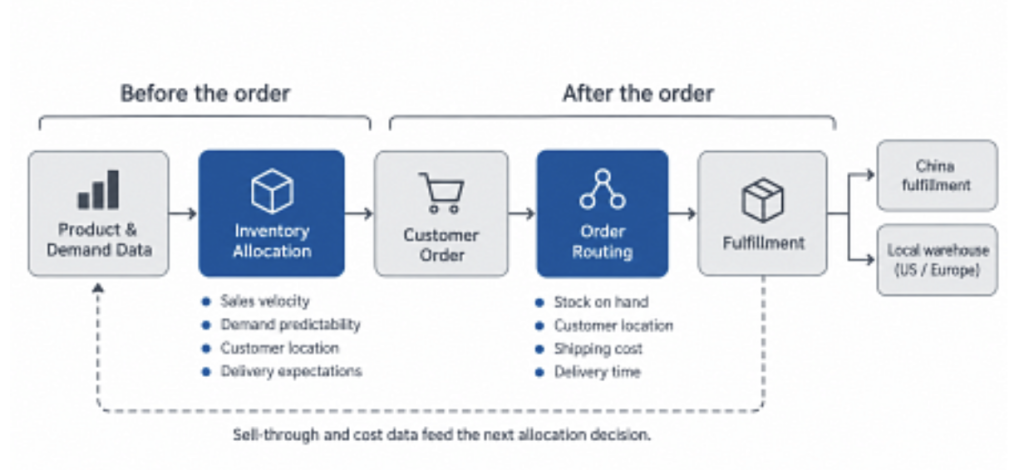
The two decisions are often blurred, but they happen at different times. Allocation happens before an order and decides where inventory is stored and how much. Routing happens after an order arrives and decides which available warehouse fulfils that specific order, based on factors such as stock on hand, customer location, shipping cost and delivery time.
The sequence runs from product and demand data to allocation, then a customer order, then routing, then fulfilment. Routing can only choose among locations that allocation has already stocked. A smart router can’t rescue a poor placement decision, and good placement is wasted if orders don’t reach the right warehouse.
Where warehouse connectivity and automation fit
Both decisions depend on current information. Order synchronisation pulls orders from stores and marketplaces into the fulfilment workflow without manual re-entry. Inventory visibility shows stock levels across every warehouse, so the same unit isn’t promised twice and low stock is caught before it becomes a stockout. Automated routing applies rules to each order, and analytics feeds sell-through and cost data back into the next allocation decision. When systems disagree, such as a store showing stock that a warehouse has already shipped, the result is oversold items and delayed orders, which is why synchronisation has to work before any routing logic can be trusted.
For a fulfilment partner such as NextSmartShip, which operates connected warehouses across regions, technology supports these functions: inventory visibility, order synchronisation, and routing. The strategy itself still comes from the brand’s own SKU data.
Example: one brand, two SKU profiles
Consider a hypothetical apparel brand selling mainly in the US. Its core hoodie has sold steadily every week for a year, so the data supports holding that SKU in a US warehouse and restocking it in line with recent sales. The same brand then launches a seasonal colourway with no sales history. It starts in China and ships direct. If orders build in one region and the trend holds over several weeks, that signal can trigger a first batch of local stock. If interest fades, the brand hasn’t tied up inventory in the wrong place. Nothing about the colourway’s starting position is permanent, because the data can change it. The scenario is illustrative only.

Metrics to watch
Sales velocity by SKU and region shows where local stock is justified. Stockout rates point to under-allocation, while inventory turnover and cash tied up in inventory point to over-allocation. Fulfilment cost per order belongs next to delivery performance, since cheaper shipping that slows delivery isn’t a real saving. Read together, these numbers show when a SKU should move, be replenished or stay where it is.
Conclusion
The goal isn’t more warehouses or fewer of them. It’s matching each SKU to the right fulfilment path before orders arrive, then matching each order to the right warehouse once they do. Data makes both decisions repeatable, and hybrid fulfilment is what results when they’re made well.