For the past few years, much of the enterprise conversation around artificial intelligence has focused on what large language models can generate. Businesses experimented with AI-generated text, summaries, code, customer responses, and internal knowledge tools.
The next phase looks different.
Companies are now asking whether AI can do more than answer questions. Can it complete a sequence of tasks, interact with business software, retrieve the right information, make decisions within defined limits, and involve a human when judgment is required?
This shift is driving interest in AI agents.
Unlike a conventional chatbot that waits for a prompt and produces a response, an AI agent can be designed to work toward a goal. It may retrieve information, call APIs, interact with software tools, evaluate results, and decide what action should happen next.
The technology is promising, but moving from an AI demonstration to a dependable enterprise system requires far more than connecting a large language model to a few applications.
The Difference Between AI Assistants and AI Agents
An AI assistant usually works within a relatively simple interaction model. A user asks a question, the system processes the request, and the model generates an answer.
AI agents introduce another layer of software behavior.
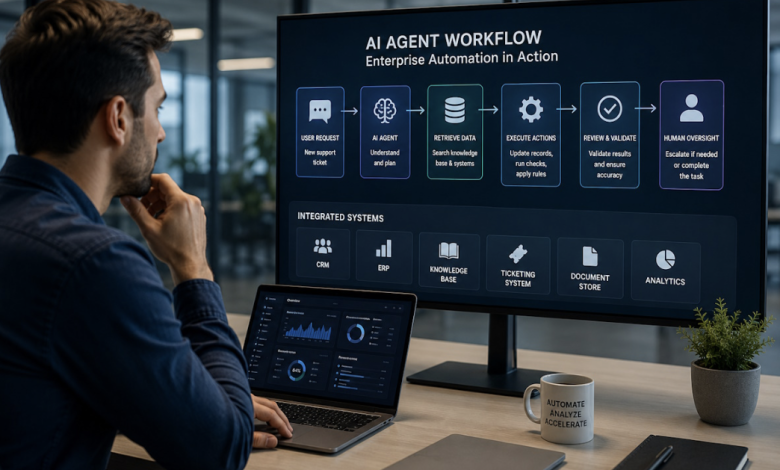
An agent may receive an objective, break it into smaller tasks, choose tools, retrieve data, execute actions, check results, and continue until the objective has been completed or human intervention is required.
Consider a customer service workflow.
An AI assistant might draft a response to a customer complaint. An AI agent could identify the customer, retrieve order information, check company policies, determine whether the issue qualifies for a refund, update the support system, prepare the response, and send the case to an employee if the situation falls outside its permitted actions.
This distinction helps explain why interest in AI agents and agentic AI has expanded beyond conversational interfaces.
The real opportunity lies in connecting AI reasoning with business processes.
Why Enterprises Are Interested in Agentic Systems
Most organizations already operate with dozens or hundreds of software systems.
Customer relationship management platforms, enterprise resource planning software, document repositories, analytics tools, ticketing systems, communication platforms, and internal applications all hold parts of the information employees need to complete their work.
The problem is rarely a complete absence of software. The problem is fragmentation.
Employees often spend significant time moving information between systems, checking records, requesting approvals, updating databases, and following repetitive procedures.
This is where enterprise AI agents may provide practical value.
Instead of replacing existing systems, agents can act as a reasoning and coordination layer between them. An agent could retrieve information from one application, analyze it with an AI model, apply business rules, and trigger an action in another system.
This model is pushing AI workflow automation beyond traditional rule-based scripts.
AI Journal has explored how agentic AI can affect business operations as organizations look for practical ways to move AI from experimentation into business processes.
The key question is no longer whether an AI model can produce an impressive response. It is whether an AI system can perform useful work reliably.
The Architecture Behind Enterprise AI Agents
Building enterprise AI agents requires several technical components working together.
The large language model is only one part of the system.
A typical architecture may include an LLM, business APIs, databases, retrieval systems, identity controls, workflow engines, monitoring tools, and human approval mechanisms.
The agent also needs a way to decide which tools it should use.
For example, an AI agent processing an insurance claim might need access to customer records, policy documents, image analysis tools, fraud detection systems, and claims management software.
Giving the model access to those tools is not enough.
The system must control what information the agent can access, which actions it can perform, how errors are handled, and when the process should stop and request human review.
These requirements are one reason custom AI agents are becoming a significant area of enterprise AI development.
Generic AI tools may work well for broad productivity tasks. Business processes often require systems designed around specific data, rules, security requirements, and existing software architecture.
Where Multi-Agent Systems Enter the Picture
Some business workflows are too complicated for a single agent.
A procurement process, for example, might involve supplier research, pricing analysis, contract review, compliance checks, approvals, and purchase order creation.
Instead of assigning every task to one large AI agent, developers can create multi-agent systems in which different agents handle specific responsibilities.
One agent might retrieve supplier information. Another could compare pricing data. A third could analyze contract terms. An orchestration layer would coordinate the process and decide when information should move between agents.
This approach can make complex workflows easier to manage, but it also creates new technical problems.
Agents need clear responsibilities. They need reliable ways to exchange information. Developers must prevent duplicated actions, endless processing loops, and conflicting decisions.
As the number of agents increases, observability becomes increasingly important.
Engineering teams need to understand why an agent selected a particular tool, what information it used, which actions it performed, and where a workflow failed.
Without that visibility, autonomous AI agents can become difficult to manage in production environments.
LLMs Need Access to the Right Business Context
One of the biggest limitations of general-purpose AI models is that they do not automatically understand an organization’s current information.
An enterprise may have product documentation, internal policies, customer records, technical manuals, and years of operational data that were never included in the model’s training.
Retrieval-augmented generation, commonly known as RAG, provides one way to address this problem.
A RAG system retrieves relevant information from approved data sources and provides that context to the model before it generates a response or makes a decision.
This can be especially useful for LLM-powered AI agents.
An agent reviewing a technical support request, for instance, could retrieve product documentation and previous support cases before recommending the next action.
Yet RAG development introduces its own engineering challenges.
Documents need to be processed correctly. Retrieval quality must be tested. Access permissions must be respected. The system also needs mechanisms for handling outdated, contradictory, or incomplete information.
For businesses exploring secure enterprise LLM architectures, decisions about data access and model deployment can become as important as model selection itself.
Reliability Matters More Than Impressive Demonstrations
AI agents are easy to demonstrate.
Production systems are much harder to build.
A controlled demonstration usually involves predictable data and a limited number of actions. Enterprise environments contain incomplete records, unavailable APIs, unusual user behavior, changing business rules, and security restrictions.
An AI agent must be prepared for these conditions.
Suppose an agent is responsible for processing supplier invoices.
What happens if the invoice contains missing information? What if two systems contain different supplier records? What if an API becomes temporarily unavailable? What if the agent attempts an action outside its permissions?
These are software engineering problems as much as AI problems.
Companies evaluating AI agent development services should pay close attention to testing, monitoring, access controls, failure recovery, and human oversight rather than focusing only on model capabilities.
The strongest AI product development strategy starts with a narrow business problem and gradually expands the agent’s responsibilities as reliability improves.
Human Oversight Is Still Part of the System
Autonomy does not have to mean removing people from every process.
In many enterprise workflows, the most practical design is a combination of automated actions and human decisions.
An AI agent might collect information, analyze documents, identify patterns, and prepare a recommendation. A human employee can then approve actions that involve financial, legal, safety, or reputational risk.
This approach is sometimes called human-in-the-loop AI.
It gives businesses the ability to automate repetitive work while maintaining control over decisions that require accountability.
The OECD AI Principles emphasize areas such as transparency, accountability, safety, and responsible stewardship. These considerations become especially relevant as AI systems gain greater access to business data and software tools.
The goal should not be maximum autonomy.
The better goal is appropriate autonomy.
AI Agents Will Change How Enterprise Software Is Designed
Traditional enterprise software is built primarily around user interfaces.
Employees open an application, navigate menus, enter information, and trigger actions.
AI agents introduce another interaction model.
Instead of manually navigating several applications, a user may describe an objective while an agent coordinates the required software tools in the background.
This does not mean user interfaces will disappear.
It means enterprise software may increasingly be designed for two types of users: people and AI agents.
APIs, structured data, permission systems, event logs, and machine-readable documentation will become more important because agents need dependable ways to interact with software.
This may also influence how AI software development companies approach enterprise projects.
The focus will shift from adding a chatbot to an existing product toward designing software architecture that allows AI systems to interact safely with business functions.
Why Starting Small Is Usually the Better Strategy
The idea of a fully autonomous enterprise is appealing, but it is not a practical starting point for most organizations.
A better approach is to identify a narrow workflow with measurable outcomes.
Good candidates often share several characteristics. The task happens frequently, requires employees to move between multiple systems, follows understandable business rules, and currently consumes significant manual effort.
An organization might begin with an agent that classifies support requests and retrieves relevant information.
Once the system performs reliably, it could be allowed to draft responses. Later, it might complete selected actions for low-risk cases while sending unusual situations to employees.
This gradual approach allows engineering teams to evaluate real-world performance before expanding the system’s authority.
It also helps businesses understand where AI automation solutions provide measurable value and where conventional software remains the better option.
The Next AI Advantage May Come From Better Systems, Not Bigger Models
Much of the AI industry has focused on competition between increasingly capable models.
For enterprises, model performance is only part of the equation.
The greater challenge is building dependable systems around those models.
AI agents need accurate data, controlled access to tools, clear business rules, monitoring, testing, and well-designed escalation paths. They also need software architecture that can handle failures without allowing a single incorrect model decision to damage an entire business process.
This is why enterprise AI solutions are becoming a broader engineering discipline.
The organizations that gain lasting value from AI may not be those that adopt the largest number of AI tools. They may be the ones that carefully identify where AI reasoning can improve existing workflows and then build the technical controls required to use it responsibly.
AI agents are moving the conversation from what artificial intelligence can generate to what AI systems can actually do.
That shift could prove far more significant for enterprise software than the chatbot boom that started it.