Why the next enterprise battle isn’t AI. It’s Orchestration.
Artificial intelligence has reached an important inflection point. After years dominated by discussions around increasingly capable language models, generative AI, and autonomous agents, the conversation is beginning to shift. The real challenge facing enterprises is no longer whether AI can generate text, summarize documents, or automate isolated tasks. Those capabilities are rapidly becoming standard. The harder question is what happens when artificial intelligence ceases to be an experimental tool and becomes part of the operating fabric of the organization.
Most companies are still focused on acquiring intelligence. They compare models, negotiate licenses with AI vendors, deploy copilots, and experiment with agentic systems. Yet very few are addressing what will ultimately determine whether AI creates sustainable competitive advantage: the ability to coordinate thousands of autonomous decisions across increasingly complex organizations.
The next generation of enterprise value will not come from building the most powerful AI models. It will come from building the operating systems capable of orchestrating them.
This distinction may appear subtle today, but history suggests it will become decisive. Every major technological revolution has eventually shifted value away from the underlying technology toward the infrastructure that enabled organizations to use that technology at scale. Computers created demand for enterprise resource planning systems. The internet created cloud computing, which in turn enabled Software-as-a-Service platforms that reorganized business processes. Artificial intelligence is following the same pattern. The models themselves are extraordinary technological achievements, but they are unlikely to remain the primary source of competitive differentiation. Like databases, cloud infrastructure, or operating systems before them, AI models are gradually becoming foundational utilities.
The real scarcity is no longer intelligence. It is organizational coordination.
For the past three years, enterprise AI has largely remained in what might be described as the pilot era. Organizations have experimented with customer service chatbots, productivity assistants, document analysis tools, coding copilots, and isolated predictive models. These deployments have demonstrated impressive productivity gains, but they have generally remained confined to specific business functions. The complexity of coordinating AI across the entire enterprise has yet to emerge.
That complexity is arriving much faster than most executives anticipate.
Consider the trajectory of a large international bank. Within the next five years it is entirely plausible that the organization will operate several thousand specialized AI agents supporting compliance, fraud detection, wealth management, customer service, risk analysis, cybersecurity, legal review, software development, treasury operations, and internal knowledge management. Each of these agents will interact with different data sources, enterprise applications, regulatory frameworks, and human supervisors. Together they may execute millions of decisions every day.
At that scale, the fundamental problem is no longer whether AI is sufficiently intelligent. The problem becomes organizational. Which agent should perform a particular task? Which model is authorized to access sensitive information? When should decisions be executed automatically, and when should human approval be required? How are conflicts between autonomous systems resolved? How are regulatory requirements enforced consistently across thousands of workflows? How can every decision remain explainable and auditable?
These questions cannot be answered simply by deploying a better language model. They require an entirely new architectural layer.
Every technological revolution eventually produces such a layer. During the 1990s, businesses did not gain competitive advantage merely by purchasing computers. Advantage came from integrating enterprise processes through platforms such as SAP, which coordinated finance, procurement, logistics, and manufacturing into a single operational architecture. During the internet era, organizations did not outperform competitors simply because they had websites. They built platforms capable of managing customers, sales, and operations across increasingly digital ecosystems. Salesforce did not invent customer relationships; it reorganized how enterprises managed them. Similarly, cloud computing became transformational not because remote servers were inherently valuable, but because cloud platforms coordinated infrastructure, applications, security, and identity management across distributed organizations.
Artificial intelligence is approaching the same transition.
Today, enterprises compete over access to models. Tomorrow, they will compete over their ability to orchestrate intelligence.
This shift is also driven by the economics of AI itself. Foundation models continue to improve rapidly while becoming increasingly accessible. Open-source alternatives narrow the performance gap with proprietary systems. Inference costs continue to decline as hardware improves and optimization techniques mature. Model quality is converging across providers far more quickly than many observers expected. While frontier models will remain strategically important, for most enterprise use cases the marginal difference between competing models will matter less than the quality of the systems surrounding them.
In other words, intelligence is becoming abundant.
Coordination remains scarce. This is precisely where enterprise value begins to migrate.
Rather than thinking about AI as a collection of individual models, organizations increasingly need to think in terms of interconnected systems. Modern enterprises will not rely on a single general-purpose assistant. They will operate ecosystems composed of specialized agents, each responsible for narrow domains but collaborating across workflows. Some agents will negotiate supplier contracts. Others will review legal documentation. Others will monitor financial transactions for fraud, optimize manufacturing schedules, generate software code, or continuously evaluate cyber threats. These agents will communicate not only with people but also with ERP platforms, CRM systems, databases, compliance engines, and one another.
As the number of intelligent actors multiplies, organizational complexity increases exponentially. Intelligence becomes distributed, decision-making becomes decentralized and coordination becomes the critical bottleneck.
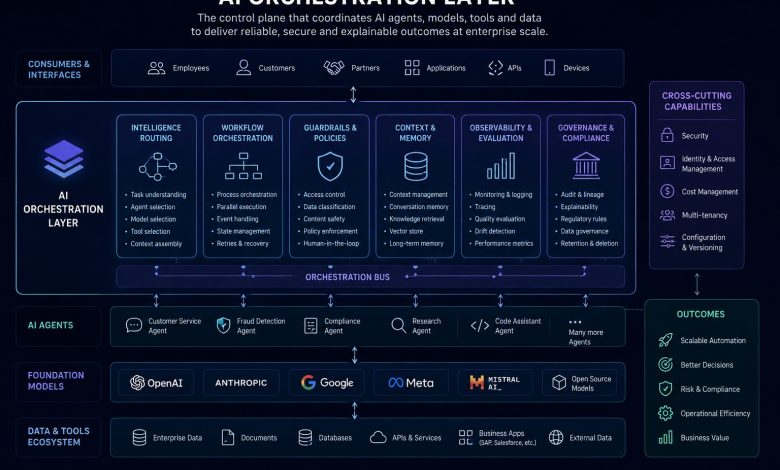
This emerging architectural challenge can be described as the AI Orchestration Layer
An architectural layer responsible for coordinating autonomous AI agents, governance policies, execution authorization and enterprise workflows across complex organizations.
the missing operating system for enterprise AI.
Unlike workflow automation platforms, which primarily connect predefined business processes, the orchestration layer dynamically coordinates autonomous intelligence. Its purpose is not simply to automate activities but to manage how intelligence itself flows throughout the organization. It determines which agents should execute specific tasks, allocatescomputational resources, enforces governance policies, manages permissions, validates regulatory constraints, resolves conflicts between competing recommendations, monitors performance, and maintains complete auditability across millions of decisions.
The orchestration layer effectively separates intelligence generation from organizational execution and this distinction is likely to become one of the defining architectural principles of enterprise AI.
Generating an answer and authorizing an action are fundamentally different activities. An AI model may propose approving a loan, executing a payment, modifying a contract, or updating a medical record. Whether that recommendation should actually be implemented depends on governance, organizational policy, legal constraints, risk management, and human oversight. As AI systems become increasingly autonomous, these execution decisions become more valuable than the underlying predictions themselves.
For this reason, governance should no longer be viewed merely as a compliance requirement. In AI-native organizations, governance becomes a source of competitive advantage.
Companies capable of governing autonomous systems efficiently will deploy AI more aggressively because they can trust its behavior. Organizations lacking this capability will be forced to limit automation, reducing both productivity gains and strategic flexibility. Governance therefore evolves from a defensive control function into operational infrastructure that enables speed, scale, and resilience simultaneously.
This suggests that enterprise AI is entering a third phase of development.
The first wave rewarded those capable of building increasingly capable foundation models.
The second wave rewarded application developers who embedded AI into individual business functions.
The third wave is likely to reward companies that build the infrastructure capable of coordinating intelligence across entire organizations.
History consistently demonstrates that value migrates upward in technology stacks as foundational capabilities mature. Databases created enterprise applications. Cloud infrastructure enabled SaaS. Mobile operating systems created application ecosystems. Artificial intelligence is unlikely to be different. As models become increasingly interchangeable, differentiation shifts toward orchestration, governance, integration, observability, security, and execution.
The companies already shaping this transition are not necessarily pursuing identical strategies, but they exhibit a common pattern. If their strategies may differ and their direction mayconverge, they are building infrastructure rather than isolated intelligence.
Although banking offers one of the clearest illustrations because of its regulatory complexity, this architectural transformation extends well beyond financial services. Healthcare organizations must coordinate AI across diagnostics, patient records, regulatory compliance, and clinical workflows. Manufacturers increasingly rely on intelligent systems connecting supply chains, robotics, predictive maintenance, and procurement. Insurance companies combine underwriting, fraud detection, claims processing, and customer engagement through autonomous workflows. Governments face similar challenges as public services integrate AI while maintaining transparency, accountability, and democratic oversight.
Across all these industries, organizational complexity—not model capability—becomes the primary constraint on AI adoption.
The implications for investors are equally significant.
Technology markets have historically rewarded visible innovation while underestimating enabling infrastructure. Models attract headlines because they are tangible demonstrations of technological progress. Infrastructure compounds value more quietly but often more durably. As AI capabilities become increasingly commoditized, enterprise spending is likely to migrate toward software platforms capable of governing complexity rather than generating intelligence. Companies providing orchestration infrastructure, agent lifecycle management, governance frameworks, observability platforms, enterprise integration layers, and decision management systems may ultimately capture a disproportionate share of long-term value creation.
Private equity investors may encounter similar opportunities. Many mature enterprise software companies already possess deep expertise in industry-specific workflows, regulatory processes, and operational execution. Embedding orchestration capabilities into these platforms may create considerably greater enterprise value than attempting to compete directly in foundation model development. In many sectors, owning organizational workflows will prove strategically more valuable than owning the intelligence itself.
The broader lesson extends beyond artificial intelligence.
Every major technology revolution eventually creates a new layer of infrastructure that reorganizes how institutions operate. The internet produced cloud computing. Cloud computing enabled SaaS. SaaS transformed workflow automation. Artificial intelligence is unlikely to culminate in another chatbot or another foundation model. Its most profound legacy may instead be the emergence of a new operating layer responsible for coordinating people, AI agents, enterprise systems, governance frameworks, and millions of distributed decisions across increasingly autonomous organizations.
The companies that dominate the AI era will not necessarily build the most intelligent models. They will build the most intelligent organizations. And the next trillion-dollar opportunity may not be artificial intelligence itself. It may be the infrastructure that allows enterprises to use intelligence safely, coherently and at scale.