
Retirement dollars deserve more than guesswork, yet choosing the right guide can feel risky. Robo-advisors already manage more than a trillion dollars at bargain fees, while nine in ten clients with a human planner say they’d never trade that relationship for an app, and nearly nine in ten robo users admit they may want human help later.
Over the next few minutes, we’ll unpack five decision factors that separate algorithmic efficiency from human insight so you can pick the mix that fits your retirement.
Keep one question in mind: How much personal financial planning do I truly need? If your list includes Social Security timing, tax-smart withdrawals, or estate goals, remember deeper, human-led planning is ready when you want it. As outlined on this personal financial planning page, a stage-by-stage pre-retirement checklist walks through Social Security timing, adjusting risk as life changes, and converting assets into reliable income streams, a useful gauge for whether a robo alone can cover your needs or a human adviser makes more sense.
Let’s weigh the evidence and ensure every dollar you saved keeps working just as hard for you.
1. Do you need comprehensive, personalized planning?
Picture two retirees.
Ann logs in, answers a risk quiz, and the platform slots her into a neat 60-40 portfolio. The algorithm keeps it balanced. Easy.
Ben walks into his planner’s office with a bigger puzzle: when to file for Social Security, how to stagger Roth conversions before required distributions begin at age 73, and whether gifting shares to his grandchildren will trim future estate tax.
Ann focuses on investing. Ben needs full-scope planning. That contrast is the first fork in our decision path.

Robo-advisors excel at mechanics: portfolio selection, automatic rebalancing, and sleek goal-tracking dashboards. Yet their mandate stops there. According to RiaFin, digital platforms typically charge 0.25 percent to 0.50 percent and focus on investment management only.
When retirement questions move beyond “Which ETF?” the limits appear. RiaFin also notes that most robos do not provide detailed retirement income strategies, Social Security optimization, estate planning, or personalized retirement advice.
That gap is where human advisors step in. A fiduciary planner can:
- map out a year-by-year withdrawal plan that keeps taxes low
- coordinate Social Security timing with spousal benefits
- review beneficiary designations, trusts, and long-term-care coverage
- adjust the plan when life brings surprises such as market drops, health changes, or inheritances
Each of these moves can shift six-figure sums over a multi-decade retirement. Algorithms are improving, but they still rely on the inputs you provide. Humans ask follow-ups you may not think of.
So start here: write down every money question that keeps you up at night. If many sit outside pure investing, taxes, legacy, Medicare, family goals, you already lean toward human advice or a hybrid model. If the list feels short and you like DIY learning, a robo can handle the heavy lifting while you keep costs low.
Knowing where you fit sets the tone for every other factor ahead.
2. What will it cost you, now and over decades?
Fees look tiny in percentage form, yet they hit hard when compounded over a long retirement.
Most robo-advisors charge about 0.25–0.50 percent of assets each year. That equals roughly $125 to $250 on a $50,000 account.
Traditional, full-service planners sit closer to 1 percent of assets. On the same $50,000 that is about $500, and the gap widens quickly on larger balances.
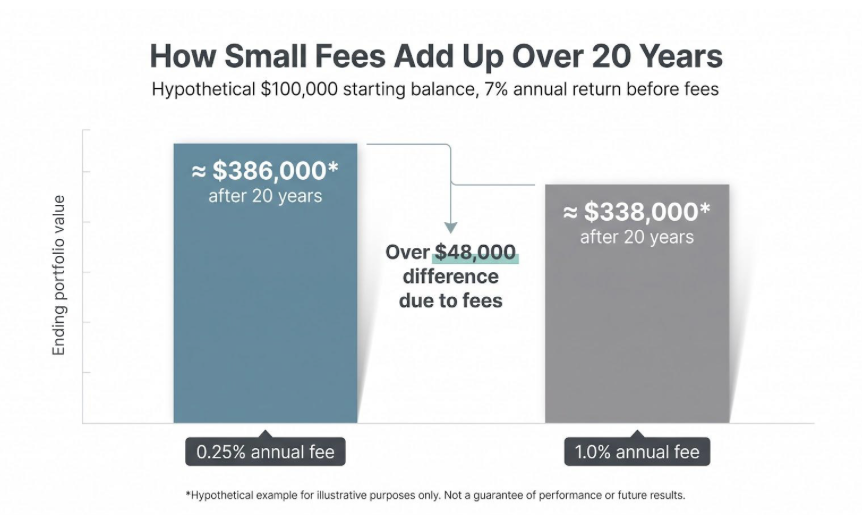
Industry math underlines the point. On a $100,000 portfolio growing at 7 percent a year, paying a 0.25 percent robo fee versus a 1 percent advisory fee leaves over $48,000 more in your pocket after 20 years.
But sticker price is only part of the story.
Robos welcome newcomers with low or no minimums. Some start at $0, while others require just $500. A human advisor often sets a bar ($100,000, $250,000, or more) before opening the door, making automation the default for smaller balances.
Human pricing is evolving. Many fiduciary planners now offer flat or hourly engagements: think $1,000 for a one-time retirement plan or $250 an hour for focused advice. If you want custom guidance but balk at 1 percent, these à-la-carte options bridge the gap.
Run two numbers:
- Annual check-write: the fee you will pay this year.
- Lifetime drag: what those fees siphon from future compounding.
If the dollars saved outweigh the value you expect from deeper planning and coaching, a robo earns its keep. If expert strategy or peace of mind is worth more than that fee gap, and you can clear any minimums, a human becomes the rational splurge.
Next we will look beyond the price tag to how each approach handles investing and taxes.
3. How each route handles investing and taxes
Good returns start with the right mix of assets and finish by keeping more of those gains after the IRS takes its cut. Here is where algorithms and advisers follow different playbooks.
Robos rely on disciplined, index-fund portfolios. After you fill out a risk questionnaire, the software builds a low-cost blend of stock and bond ETFs and keeps that mix on target day after day, with no ego or hunches.
That automation shines at tasks humans find tedious. Tax-loss harvesting is the headline example. The software scans every holding, sells losers, and swaps into similar funds so you book a write-off without changing risk. Industry research pegs the after-tax lift from constant harvesting at roughly 0.5 to 1.2 percent per year.
Human planners can also harvest losses, rebalance, and pick index funds. Their edge appears in places algorithms cannot yet reach, such as mapping which accounts you tap first so Social Security is not taxed away, or timing a partial Roth conversion in a low-income year. A skilled adviser can incorporate individual bonds for steady income, keep a legacy stock position intact for sentimental reasons, or avoid sectors that clash with your values.
What about performance? Study after study finds that, once fees and risk are matched, neither side reliably beats the other on raw returns. The real difference comes from behavior (we will cover that next) and taxes. If most of your nest egg sits in IRAs, robo tax features matter less. If you hold large taxable accounts, that automated harvesting can add real dollars.
Quick check:
- If you want a rules-based, always-on system that maximizes efficiency and you feel comfortable letting code handle the details, consider a robo.
- If your questions start with “should I” rather than “how do I,” and if life events often demand nuanced moves, a human adviser, or at least a hybrid, earns its fee.
Either way, insist on a clear, evidence-backed investment process and a plan to trim taxes over the decades you will spend the money, not just the years you save it.
4. Staying calm when markets panic: the human edge
Great plans fail for simple reasons: nerves, headlines, and the reflex to sell right when prices hit the floor.

Robo-advisors show strength and weakness in the same breath. The algorithm never feels fear; it keeps rebalancing while you pace the kitchen. Yet that calm code will not pick up the phone when you are about to sell everything.
An industry survey found that over 90 percent of clients with a human planner said they would not switch to digital advice, while 88 percent of robo users were open to hiring a person later, mainly for reassurance during volatility.
Behavior research echoes the point. Studies show that coaching from a human advisor, keeping clients invested during swings, can add roughly 1.5 to 2 percent in net returns each year by preventing emotion-driven trades.
Why the gap? A planner handles three jobs a bot has not mastered:
- Pre-commitment coaching. Before trouble hits, you and the adviser set rules (how much loss triggers a rebalance, when to tap cash buckets) so emotion never drives the decision.
- Real-time guidance. When markets dive, you get context: “Your plan already assumes a 20 percent drop every few years. Here is why you are still on track.”
- Accountability. Knowing someone will ask, “Did we follow the strategy?” makes you likelier to stay disciplined.
Disciplined investors who sleep through bear markets may skip that support. If you feel a skipped heartbeat every time the S&P dips, a human co-pilot is less a luxury and more affordable insurance on a lifetime of returns.
Next we will look at the final factor: trust and fiduciary duty, because calm only matters when you know advice is aligned with your best interests.
5. Fiduciary duty and trust: who is in your corner?
All the algorithms, credentials, and glossy dashboards boil down to one question: Do I trust this advice with my life savings?
Human planners can wear two hats. A fiduciary advisor must put your interests first, disclose conflicts, and document every recommendation. A commission-based salesperson only has to stay within a broad “suitability” zone. Always ask: “Are you a fiduciary one hundred percent of the time?” RiaFin’s primer flags this as the single best litmus test for avoiding hidden incentives.
Robo-advisors register as investment advisers too, which technically grants fiduciary status. Their edge is transparency: the fee is spelled out, no steak-dinner fund pitches, no load charges. Yet trust also means understanding. A J.D. Power survey found that only 22 percent of robo users fully grasp how their money is managed, leaving the rest to wonder what the black box is doing.
Humans win on empathy and perceived alignment. Research published by Wealth Professional shows investors overwhelmingly believe a human advisor works in their best interest and understands their goals, ranking those traits far above digital tools.
Your takeaway:
- Verify fiduciary status: human or robo, the label matters.
- Demand clarity: if the algorithm feels opaque, ask for the methodology or walk away.
- Match comfort level: choose the channel that lets you sleep soundly, because a plan you do not trust is a plan you will not follow.
With the five factors in view, you can now weigh costs, planning depth, tax smarts, emotional support, and trust to craft an advice model tailored to your retirement vision.
Hybrid advice: blending algorithmic precision with human insight
If choosing between pure robo and full-service human advice still feels like picking a flip phone versus a spaceship, you are not alone. Many investors refuse to surrender either low-cost automation or reassuring conversation, and the industry has responded.

Hybrid services attach a robo engine to a human steering wheel. Leading platforms deliver daily rebalancing and tax-loss harvesting while giving you scheduled or on-demand access to a Certified Financial Planner. Typical price tag: 0.30 to 0.50 percent of assets, midway between pure robo and traditional one-percent advice.
Why hybrids resonate:
- You keep the algorithm’s fee edge and discipline.
- You gain a professional sounding board for Social Security timing, Roth conversions, or a market panic at 2 a.m.
- Minimums drop: many hybrid models start at $50,000, a fraction of brick-and-mortar firms.
Industry reports note that several large banks have closed stand-alone robos, steering clients into blended models because demand moved there. Investors want the best of both worlds without doubling costs.
Is hybrid right for you? Scan your own needs:
- Crave strategic check-ins but do not need year-round hand-holding?
- Value automation yet still want a real person to confirm big moves?
- Willing to pay a bit more than robo fees for that comfort?
If the answers tilt yes, a hybrid platform offers a comfortable middle lane, letting you add human insight as life grows more complex without replacing your entire investment system.
Conclusion
The choice between robo, human, or blended advice comes down to your need for personalized planning, your sensitivity to fees, the complexity of your tax picture, your behavioral discipline, and the trust you place in the advice model. Evaluate each factor against your retirement goals, and you will land on the approach that keeps your money, and your peace of mind, on track for decades to come.