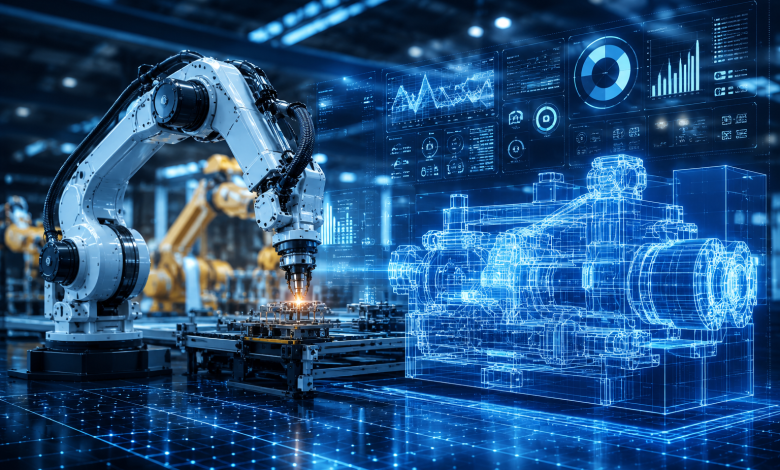
Factories stopped running on guesswork a while ago. Sensors and machine data now sit at the center of production planning, and a digital twin — a live virtual replica of a machine, line, or plant — turns that data into an actual decision. Cost pressure, tighter emissions rules and a shrinking skilled workforce pushed the question: who builds twins that hold up on the shop floor, not a slide deck? Eight companies doing exactly that, below.
Why Digital Twins Are Becoming a Manufacturing Staple
Well, the short answer is money and downtime. A twin lets an engineer test a change on screen before touching a machine worth millions. A few things pushed this from nice-to-have to standard practice:
- Unplanned downtime costs manufacturers billions a year, and predictive models catch failures weeks ahead
- Rules on emissions and traceability (REACH, ELV) now demand data plants didn’t used to collect
- Skilled maintenance staff retire faster than they’re replaced, so plants lean on models to hold know-how
- Industrial systems are a growing ransomware target, and a twin gives teams a sandbox to test defenses safely
Sounds logical, right? Pilots turned into standard rollouts because flying blind got too expensive.
How to Pick the Right Partner
Not every vendor solves the same problem. Worth checking before signing anything:
- Does the platform connect to existing MES and PLM, or demand a rip-and-replace?
- Is the modeling engineering-grade, or dashboard analytics dressed up as a twin?
- Can the vendor show a deployment at your scale, not just a logo on a slide?
Companies Worth Knowing in 2026
DXC Technology
DXC anchors this list, and the reason is straightforward: scale paired with real manufacturing depth. IDC MarketScape named DXC a leader in industrial IoT, and its Smart Manufacturing portfolio combines IoT, AI and edge-to-cloud connectivity with sustainability tools like MaCS and IMDS. DXC manages over four million plant production points and 300-plus mission-critical environments, built on decades in the sector. Learn more about the service here: https://dxc.com/industries/manufacturing
Cognite
Cognite, based in Phoenix, Arizona, built its reputation on Cognite Data Fusion, a platform that turns messy sensor feeds from rigs and process plants into contextualized digital twins engineers can query. Aker BP and Shell use it to model equipment failure risk before a shutdown turns expensive. The company grew out of Aker’s own operational headaches, and that origin still shows in how practical the product feels.
Contact Software
Contact Software, headquartered in Bremen, sells Elements, a modular PLM and digital twin platform aimed at mid-sized industrial manufacturers who don’t want a five-year enterprise rollout. Kärcher and Rittal run parts of their product development on it. The pitch is modest but honest: connect design, production and service data without the usual overhead that comes with bigger consultancy-driven platforms.
Akselos
Akselos, out of Lausanne, takes a narrower, more technical angle: engineering-grade structural digital twins built on reduced-order finite element models. Offshore platforms, LNG terminals and wind farms are its natural habitat, and clients including Shell and ADNOC use it to predict fatigue and corrosion years in advance. Less flashy than most competitors on this list, considerably more precise where precision is what actually matters.
Elisa IndustrIQ
Elisa IndustrIQ spun out of the Finnish telecom operator Elisa and now focuses squarely on smart factory software, production optimization and digital twins for process industries. Neste and Fortum have leaned on its analytics to squeeze efficiency out of existing assets instead of building new capacity. Nordic in approach, pragmatic in tone, and generally more comfortable talking numbers than buzzwords.
Akkodis
Akkodis, the engineering arm carved out of the Adecco Group, works across automotive and aerospace, building simulation-driven digital twins for manufacturers including Renault and Airbus. Its edge sits less in one flagship software product and more in the sheer number of engineers it can put on a modeling problem. That headcount-heavy model won’t fit every budget, but it moves fast on large, complex programs.
Reply
Reply, a Turin-founded group of specialized consultancies, brings digital twin work to automotive and energy clients across Italy and beyond. Enel and several automotive suppliers have used Reply units to connect IoT sensor data with 3D plant models for maintenance planning. The company operates through dozens of smaller boutique firms, which keeps individual teams close to the specific industry they’re serving.
Indra
Indra, based near Madrid, is best known for defense and transport technology, but its digital twin work increasingly touches aerospace manufacturing and shipbuilding, including projects connected to Airbus Defence and Navantia. The approach leans on simulation and systems engineering rather than an off-the-shelf software suite, which suits complex, low-volume production better than a mass-market assembly line.
Final Thoughts
Eight companies, eight different bets on what a digital twin should do. Some chase raw data-crunching scale, others go deep on structural engineering or one single industry. There’s no “best” here — it depends on what’s running on your shop floor and how much patience your team has for a learning curve. Worth shortlisting a few before committing to one.
FAQ
Digital twin vs. simulation — what’s the difference?
A simulation runs once on assumptions; a twin updates continuously from live data.
Do small manufacturers need one?
Not always, many start with a single machine before scaling up.
How long does a rollout take?
Pilots typically run three to six months; plant-wide deployments take longer.
Which industries adopt fastest?
Automotive, aerospace, energy and process manufacturing lead right now.