Industry 4.0 isn’t a futuristic idea anymore.
It’s an active change in the way manufacturers are overseeing production, quality, maintenance, and cost efficiencies in real-time conditions today. The lynchpin of this evolution is the smart factory, where interconnectivity of machines, tools, and shop floor systems drives faster decisions and greater consistency in performance. But automation isn’t the only deliverable. Empowering production data connections, enhanced process controls, minimized downtime and more nimble responsiveness to changing buyer exigencies are where the real payback occurs. Discovering the dynamics of this change is becoming essential for any business trying to stay competitive in a more intelligent industrial environment.
Why Industry 4.0 Needs Connected Production Data
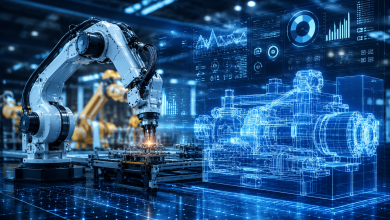
Factories do not become genuinely intelligent if data stays trapped inside isolated machines, on spreadsheets, or in manual reports. Rather, it’s data culled and acted on by smart tools and sensors that offer real-time visibility into production performance, which allows plant managers to detect and correct problems, identify bottlenecks, and make process improvements while production is still ongoing. Atlas Copco’s smart factory material makes the same case in concrete terms, noting how smart manufacturing connects data to digitize and automate manufacturing, drives productivity, and saves energy and material.
The Role of Factory Automation in Smarter Operations
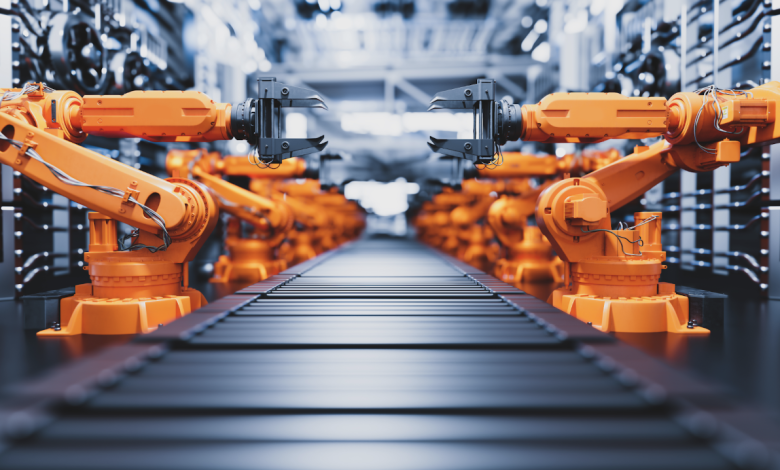
That is why factory automation now means more than replacing manual tasks. In a mature Industry 4.0 setting, automation standardises processes, improves repeatability, reduces operational waste, and supports safer, more consistent production environments. It also improves coordination between people, machines, and software, which matters because modern production systems are becoming more complex and increasingly dependent on networked operations. Atlas Copco’s page highlights exactly those pressures, including system complexity, the need for user-friendly control, and the importance of intelligent data processing that gives operators clear, actionable insight.
How Smart Factory Automation Solutions Create Business Value
The strongest business case emerges when connected systems do more than automate tasks and start improving decisions. That is where smart factory automation solutions become commercially important. In practice, connected automation ecosystems can support predictive maintenance, tighter quality control, process optimisation, equipment lifecycle management, and lower downtime. Atlas Copco’s smart factory material describes this as a unified, scalable approach that combines tools, automation, software, and services, while AI Journal’s manufacturing coverage similarly frames smart operations around AI, IoT, and data-driven optimisation. The value is not just technical. It is financial, because better visibility usually means lower scrap, faster fault response, and more stable throughput.
Why AI and Automation Must Work Together
AI works with and adds value to plants that already have automation capabilities, providing a firm foundation of process data. It can recognise patterns, identify imminent process issues, predict maintenance requirements, and enable better production scheduling. All of this could be possible in theory, but without reliable data there is no means of execution. With that data, plants move closer to the smart operations ideal, where quality, uptime, and scheduling are each a little better because the underlying combined operation is better informed and more predictive. Automation does produce signals, and AI enables these signals to drive decisions.
Conclusion
The smart factory of the future is not simply a more automated factory but a more automated, connected, intelligent, and measurable factory. Those manufacturers aligning industry 4.0 with data and factory automation will be more ideally placed to deliver higher quality, lower costs, and the flexibility to deal with different production requirements. In that sense, the real promise of smart manufacturing is not isolated technology but operational systems that can see more, respond faster, and improve continuously.