Introduction
The 2026 FIFA World Cup served as a high-stakes proving ground for a comparative analysis between machine learning and collective human intuition. At the center of this study was Goal26’s AI model, a custom-built machine learning pipeline and a partnership with the bracket-hosting platform wcpredictor.app. The research compared the Goal26 model with more than 50,000 human-submitted tournament brackets. This large-scale experiment aimed to determine whether data-driven algorithms could effectively out-predict the “wisdom of the crowd” in one of the world’s most complex and unpredictable sporting events.
Methodology
To predict the outcomes of the 2026 FIFA World Cup, an end-to-end machine learning pipeline was developed to transform historical match data into predictive probabilities. This process was divided into three technical phases.
Data Acquisition and Filtering
A comprehensive dataset of international football match results from Kaggle was utilized to extract historical match features for the model. The dataset was then filtered to only include results from the past 28 years (1998-present) and matches where both participating teams qualified for the 2026 World Cup, ensuring model relevance.
Feature Engineering
To construct the feature set, a rolling “Points Per Game” (PPG) metric utilizing a five-match window was engineered to quantify immediate team form. The pipeline also incorporated an is_host binary feature to account for the well-documented structural advantages associated with hosting—specifically for the USA, Mexico, and Canada—including localized crowd support and the mitigation of international travel fatigue. Additionally, January 2026 FIFA Rankings were integrated to provide a static numerical strength index for each squad, enabling the calculation of the relative “rank gap” between opponents to help the model predict match outcomes. The combination of these features allows the model to incorporate historical performance, host status, and FIFA rankings into its predictions.
Model Architecture and Training
TThe model employs a Random Forest Classifier, chosen for its ability to handle non-linear relationships and noisy sports data more effectively than linear alternatives. The model was trained using an 80/20 train-test split to rigorously validate performance against unseen data, with tree depth restricted to 10 to prevent overfitting and ensure the identification of generalized patterns.
Human Baseline and Consensus Metrics
To establish comparative benchmarks for performance, human prediction data was integrated from the partner platform (wcpredictor.app). Absolute accuracy metrics (total points) by Goal26 were evaluated against the mean absolute points calculated across the individual human participant pool. For the probabilistic calibration metrics, the collective human consensus was derived using an aggregate “People’s Bracket” that tracks the round-by-round advancement percentage for each team across the 50,000 participants.
The Scoring Factors
Factor: Fan support (AI win)
Humans gave Portugal a 45% chance of reaching the semi finals while Portugal got eliminated in the Round of 16. Goal26 AI predicted Portugal will get eliminated before the semi final (ie in the quarter final). As Ronaldo and Messi have a huge fan base, the two teams Argentina and Portugal were favored by humans. Goal26 depends on recent historical data and Fifa ranking which were more objective and eliminated the bias. AI won this comparison.
Factor: Knockout predictions (AI win)
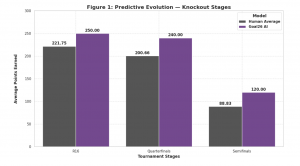
The results revealed a distinct performance gap, with Goal26 consistently outperforming the aggregate human consensus across the knockout stages. In terms of absolute accuracy, the AI model secured higher cumulative point totals from the Round of 16 through the Semifinals. Beyond simple “picks,” the study utilized Brier Score analysis to evaluate probabilistic calibration. Goal26 achieved a tightly calibrated Brier Score of 0.052, superior to the human consensus score of 0.056. This indicates that the AI possessed a more mathematically reliable understanding of risk and uncertainty than the collective human participants. AI won this comparison.
Factor: Strong teams (Humans tie with AI)
Both human and AI predictions correctly picked strong teams, such as Spain, France, and Argentina, to reach the semifinals. These predictions may have been influenced by the teams’ reputations and past success. Like AI, which looks at past performance data, humans may also rely on a team’s history and popularity when making their picks. As a result, both groups predicted that the more established teams would qualify for the semifinals, making this category a draw between humans and AI.
Factor: Finalists (Humans tie with AI)
Humans predicted Spain and France as the top 2 teams with Spain having a 46% chance and France a 37% chance of reaching the final. Goal26 AI predicted a France v/s Argentina final. In both cases, the predictions were half correct. AI and Humans end up in draw in this comparison.
Conclusion
With Goal26 outperforming human consensus 4–2 in the prediction comparison, the results highlight the growing role of AI in modern sports analytics. By relying on data-driven factors such as FIFA rankings, recent team performance, and historical trends, Goal26 was able to avoid some of the biases that can influence human predictions, including team reputation, fan loyalty, and media narratives. While AI models are not perfect and cannot account for every unexpected moment in sports, this analysis shows how algorithmic approaches can provide a valuable perspective alongside traditional human analysis. Sports results depend on a lot of other variables like weather, team fatigue, injuries and fan support which cannot all be factored in an AI model. And more important, human passion and gut feeling brings in the fun and excitement which humans are surely better at. The research paper link: Research Paper For more details on the research, reach out to https://www.goal26.app
References
-
Breiman, L. (2001). Random forests. Machine Learning, 45(1), 5-32. https://doi.org/10.1023/A:1010933404324
-
Brier, G. W. (1950). Verification of forecasts expressed in terms of probability. Monthly Weather Review, 78(1), 1-3.
-
Deb, R. (2026). FIFA World Cup 2026 – Prediction. Goal26. https://www.goal26.app/
-
FIFA. (n.d.). FIFA/Coca-Cola Men’s World Ranking. Inside FIFA. https://inside.fifa.com/fifa-world-ranking/men
-
Jürisoo, M. (n.d.). International football results from 1872 to 2026. Kaggle. https://www.kaggle.com/datasets/martj42/international-football-results-from-1872-to-2017
-
Kleos Labs. (2026). World Cup Predictor 2026 — Free Bracket Game. WCpredictor. https://wcpredictor.app/
Riya Deb is an independent AI researcher at Moreau Catholic, San Francisco Bay Area and founder of Goal26, a sports analytics platform.