Artificial intelligence has become synonymous with semiconductor demand. From large language models to edge AI in smart sensors, chips are at the heart of today’s AI revolution. But while the semiconductor industry continues to enable AI, it has been much slower to adopt AI for its own internal benefit. This needs to change.
We are entering a new phase, in which AI not only drives innovation in downstream technologies but also transforms the upstream manufacturing systems that make AI possible. To stay competitive, reduce complexity, and scale sustainably, AI must become a foundational capability across the entire semiconductor supply chain.
A Patchwork of AI Efforts
There’s no question that AI has already shown promise in chip design, process optimization, and manufacturing workflows. Some companies use machine learning to accelerate R&D by refining process recipes through closed-loop feedback. Others apply AI to improve yield uniformity, streamline wafer scheduling, or enable predictive maintenance on complex tools. In design, AI algorithms have significantly reduced the time and resources required to produce new chip architectures.
But these efforts are often fragmented and siloed. Although AI is capable of shortening development cycles, reducing operational costs, and uncovering insights from large datasets, only a limited number of companies are implementing AI at a meaningful scale. And even fewer are doing so across multiple levels of the supply chain. So, what’sholding us back?
Two Words: Trust and Interoperability
Semiconductor manufacturing is one of the most IP-sensitive industries in the world. Equipment makers, device manufacturers, materials suppliers, government and academia are all wary of sharing process data due to competitive concerns (although coordinated efforts to address this challenge are under way). Without shared data, AI algorithms can’t be trained effectively across the full spectrum of manufacturing environments.
Without a trusted framework for data sharing, this sensitive and highly dynamic environment makes it difficult to build the cross-enterprise datasets and models needed to maximize AI’s impact. While some companies have internal AI frameworks, deploying them externally—across fabs, geographies, and suppliers—remains a significant challenge. The answer: development and adoption of semiconductor industry standards for AI implementation.
The Power of Standards—and the Importance of Timing
Standards play a critical role in unlocking collaboration without compromising competitive integrity. Rather than stifling innovation, standards enable it. Being able to implement best known methods frees companies to pursue new developments in their core areas of competency.
With that said, in high-tech industries, timing is everything. Too early, and you risk stifling innovation. Too late, and the market fractures into incompatible approaches.
The SEMI Standards development process is both cautious and coordinated, involving pre-competitive engineering, stakeholder alignment, and deep evaluation of a standard’s value-add. The standards define how tools talk to each other, how semiconductor wafers are monitored in real time, and how performance data can be compared across systems objectively. Think of them as the “yardsticks” that create a level playing field for measuring and improving manufacturing performance.
Digital Twins: From Model to Mirror
Digital twins are a foundational element of the AI transformation. Unlike static models, digital twins are dynamic representations of real-world systems that update continuously based on sensor inputs and environmental changes. The Smart Manufacturing roadmap contextualizes the role of AI in digital twins, and the role of agentic AI that may control multiple digital twins in the manufacturing environment.
In semiconductor manufacturing, digital twins of equipment and wafers can interface directly with AI models to optimize processes in real time. SEMI’s multi-phase proof-of-concept project has already demonstrated this potential, combining digital twins with AI to produce accurate predictive outcomes across complex process flows.
With that said, practical deployment requires consensus on what to monitor, how frequently, and how digital twins from different vendors should interact. Like AI, digital twins require standardization before they can scale effectively; joint industry-government development efforts are under way here, as well.
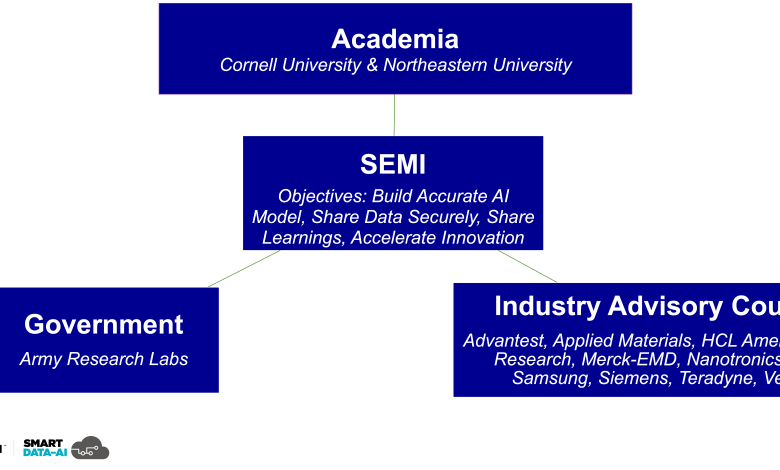
In 2018, SEMI launched the Smart Data-AI initiative backed by public-private partnerships and guided by an industry advisory council (see Figure 1). After the initial setup period, the initiative focused on identifying critical roadblocks and developing the foundation for future secure standards for AI and digital twin integration, by leveragingproof-of-concept projects executed by Cornell University and Northeastern University.
The current Smart Data-AI initiative work has developed a robust virtual framework, the Virtual Semiconductor Processing Exchange Record (ViSPER), that enables plug-and-play digital twins. It includes specifications for equipment interfaces, data requirements, and secure exchange protocols. SEMI has formed a working group to evolve the initialViSPER guidelines into an industry-vetted standard in 2026. The standard(s) will start addressing the critical trust and interoperability issues mentioned above, helping the industry to utilize the full potential of AI.
Figure 1: The SEMI Smart Data-AI Initiative brings together key stakeholders from industry, academia and government to collaborate on accelerating AI innovation.
The Case for a Coordinated Industry Approach
AI stands to benefit semiconductor manufacturing in several key areas:
- Process development: AI can dramatically reduce experimental cycles by predicting ideal process parameters and outcomes with fewer test wafers.
- Yield and quality control: By learning from production variability, AI can highlight anomalies early and suggest corrective action, reducing scrap and rework.
- Predictive maintenance: AI models trained on tool behavior and performance drift can forecast failures before they occur, minimizing downtime.
- Supply chain optimization: AI can improve forecasting, inventory control, and scheduling across fabs and geographies, enabling just-in-time manufacturing.
- Sustainability: Optimized processes use fewer chemicals, generate less waste, and consume less energy—goals that align with broader ESG commitments and are cited in the SEMI Smart Manufacturing Initiative taskforce roadmap on improving sustainability outcomes in fabs.
For AI to become a foundational layer in semiconductor operations, coordination is essential. Every stakeholder—device makers, tool vendors and materials suppliers—faces similar challenges. Without shared frameworks, each must solve the same problem in isolation. This is neither efficient nor scalable.
SEMI’s role is to bridge these divides through standards, collaboration, and platform-building. By providing a neutral forum for companies to work together, SEMI enables pre-competitive progress while protecting proprietary knowledge. The association’s Smart Data-AI efforts, including the development of secure multi-level data exchange formats and interoperability protocols, are designed to turn AI adoption into a rising tide that lifts all boats.
Looking Ahead
In the next five years, the semiconductor industry will face even greater complexity—from advanced packaging and heterogeneous integration to the mounting energy demands of AI data centers. We cannot address these challenges with yesterday’s tools. The future will require new ways of thinking, new methods of collaboration, and new technologies embedded within our own operations.
AI is not just the engine driving chip demand. It is the key to building chips better, faster, and more sustainably. To realize that potential, we must move from fragmented experimentation to coordinated execution. The path is clear—and SEMI is ready to help the industry pave the way.