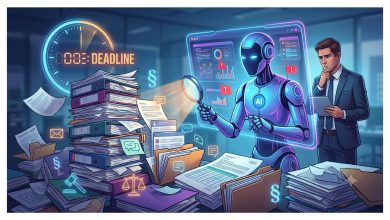
Much of the conversation around agentic AI focuses on autonomy. What actions will agents take? How much responsibility should they have? What happens when systems begin operating with less human involvement?
Those are important questions, but they distract from a more immediate challenge that organizations are already facing today.
The accountability issues many companies will encounter with agentic AI are not waiting somewhere in the future. They already exist in the systems, data, and workflows businesses rely on every day. Data is fragmented across platforms. Teams use different definitions for the same business concepts. Decision logic often lives in documentation, dashboards, or institutional knowledge rather than in a form that can be applied consistently. Agentic AI doesn’t create those problems. It simply makes them more visible.
As organizations race to deploy AI agents across workflows, the conversation often centers on efficiency. Can we automate investigations? Can we reduce manual effort? Can we move faster? Those are worthwhile goals. But speed has a way of exposing weaknesses that were previously hidden. When organizations introduce agentic capabilities into environments where context is incomplete or inconsistent, they often discover that the underlying challenge was never a lack of automation. It was a lack of shared understanding.
AI doesn’t fix understanding problems
One of the most common assumptions in enterprise AI is that better interfaces will solve existing operational challenges. If employees can ask questions in natural language instead of navigating dashboards, productivity improves. If workflows can be automated, teams move faster. If agents can take on repetitive tasks, organizations gain efficiency.
The problem is that AI does not automatically improve understanding.
Consider a simple business question: Why did conversion decline? Most organizations assume there is a single answer. In reality, different teams often approach the question from entirely different perspectives. Marketing may focus on campaign performance. Product teams may look at customer journeys. Engineering may investigate technical issues. Finance may examine changes in customer behavior or revenue mix.
Human teams work through these differences every day. They challenge assumptions, debate conclusions, and bring context from their part of the business. Agentic systems don’t have the benefit of those conversations. They operate using the definitions, business rules, and context they are given. If those foundations are inconsistent, AI does not resolve the ambiguity. It simply reaches conclusions faster.
Organizations often believe they are accelerating decision-making. In reality, they may be accelerating the application of logic that was never fully aligned in the first place.
The hidden accountability gap
Most accountability discussions focus on ownership after something goes wrong. Who approved the workflow? Who configured the model? Who deployed the agent?
Those questions matter, but they are difficult to answer if organizations cannot first explain how an outcome was reached.
This is where accountability becomes challenging in agentic environments. Not because there is a single autonomous system making decisions independently, but because outcomes increasingly depend on multiple systems working together. Data comes from one source. Business rules come from another. An agent performs a task. A workflow triggers an action. A human reviews the result. Each individual step may be reasonable, yet understanding how those pieces contributed to the final outcome can become surprisingly difficult.
Organizations often discover that they can see what happened but struggle to explain why it happened. Accountability depends on the ability to challenge decisions, validate assumptions, and understand the factors that influenced an outcome. Once those connections become difficult to trace, ownership becomes difficult as well.
Accountability starts with context
The organizations that navigate this challenge most successfully focus less on autonomy and more on context. They recognize that AI systems can only operate within the boundaries of the information they are given. If the business itself lacks consistency around definitions, ownership, and decision-making logic, AI will inevitably inherit those same weaknesses.
That means accountability starts long before deployment. Shared definitions. Consistent business rules. Clear ownership of metrics and outcomes. Visibility into how decisions are formed and validated. None of these requirements are new. The difference is that AI makes the consequences of ambiguity much harder to ignore.
A human analyst can often compensate for missing context. Automated systems tend to be less forgiving. They apply the logic available to them consistently, whether that logic is complete or not.
Building accountability before scale
Many organizations approach accountability as something that can be addressed after deployment through governance processes, audits, and review procedures. Those controls matter, but accountability becomes much easier when it is considered before systems are scaled.
The most successful organizations tend to start with narrow, well-understood problems where success can be clearly defined and validated. They make business definitions explicit instead of relying on institutional knowledge. They preserve visibility into what information influenced an outcome and why. Most importantly, they expand capabilities only after trust has been established.
The goal is not to automate everything as quickly as possible. The goal is to create confidence that systems behave consistently before increasing their scope and responsibility.
The accountability challenge is already here
Organizations do not need fully autonomous agents running the enterprise to experience accountability problems. Many are encountering them today as they introduce AI into existing workflows, customer experiences, and decision-making processes.
The challenge is not that AI systems are making too many decisions on their own. It is that they are being introduced into environments where definitions, context, and ownership were never fully aligned to begin with. Agentic AI did not create those conditions. It simply makes them more visible.
The organizations that succeed will not necessarily be the ones that automate the fastest. They will be the ones that create enough shared understanding to explain, validate, and improve outcomes as AI becomes a larger part of how work gets done.
Because when something unexpected happens, accountability ultimately begins with a simple question:
Can anyone clearly explain why?