Decades ago, when we were pioneering early cognitive software deployments at IBM Watson, the primary operational hurdle was achieving predictable accuracy within structured enterprise workflows. Today, the corporate landscape faces a fundamentally different challenge. Enterprise artificial intelligence has evolved from passive text generation into autonomous agentic systems that can query databases, call APIs, route work, modify records, interact with other agents, and make financial or operational commitments in milliseconds.
In my years navigating high-profile endurance auto rallies, I learned a visceral truth that applies directly to modern boardroom strategy. You do not push a vehicle to maximum velocity on an unmapped track if your only instrument is a beautifully calibrated speedometer. A speedometer tells you exactly how fast you are crashing. To navigate safely, you need responsive brakes, functional steering, active traction control, and a way to prove the vehicle stayed within its operating envelope.
That is the vulnerability now facing the modern enterprise.
Leadership teams are confusing the ability to see what AI is doing with the ability to control what AI is allowed to do. IDC projects that the number of actively deployed AI agents will exceed one billion worldwide by 2029, roughly 40 times more than in 2025. [1] This explosive shift pushes enterprise oversight far beyond the boundaries of simple monitoring.
The Illusion of Hindsight Analytics
Most enterprise AI initiatives rely heavily on traditional observability toolchains. Teams deploy logging frameworks, monitor prompt token usage, track latency, capture traces, and review dashboards. This visibility is useful for debugging and operations, but it creates a dangerous illusion of safety.
Observability is fundamentally retrospective. It tells you what happened after it happened.
Consider an autonomous purchasing agent connected to an enterprise resource planning system. If that agent experiences behavioral drift, responds to a malicious prompt injection, or misuses a tool chain, it may execute unauthorized API calls, trigger erroneous inventory orders, leak sensitive data, or create operational commitments before a monitoring alert is even reviewed.
Finding out about the failure 20 minutes later does not constitute enterprise control. It is a digital autopsy.
Executives must recognize that monitoring a runaway agent provides little defense against immediate financial, legal, operational, or reputational impact. The speed of agentic workflows means enterprise control must move from historical tracking to real-time intervention.
The critical question is no longer:
What did the AI system do?
The question is:
Should this specific action, by this specific AI system, under this specific context, be allowed to execute right now?
Observability cannot answer that question. Runtime control can.
Defining the New Category: Trust Posture Management
To close this operational gap, enterprises need a distinct category of software: Trust Posture Management.
Traditional cybersecurity protects infrastructure, identity, endpoints, and networks. Observability records system behavior. AI model guardrails filter prompts and outputs. Compliance programs define rules and assess adherence. Each is necessary, but none is sufficient for autonomous AI.
Trust Posture Management addresses the behavioral, operational, compliance, and economic boundaries of executing AI systems.
At its core, Trust Posture Management is the continuous control, discovery, and proof layer for enterprise AI behavior. It controls runtime execution, discovers where AI systems are creating value or introducing risk, and proves outcomes across single agents, workflows, and multi-agent fleets.
In practice, it becomes the system of record for:
What AI systems exist
What they are allowed to do
What they attempted to do
What was allowed, blocked, escalated, modified, or suspended
What value they created or protected
What evidence proves they stayed within bounds
This is especially critical as enterprises move from isolated copilots to agentic infrastructure. Just as Cloud Posture Management emerged to help organizations manage cloud infrastructure at scale, Trust Posture Management is emerging as the control framework for agentic AI infrastructure.
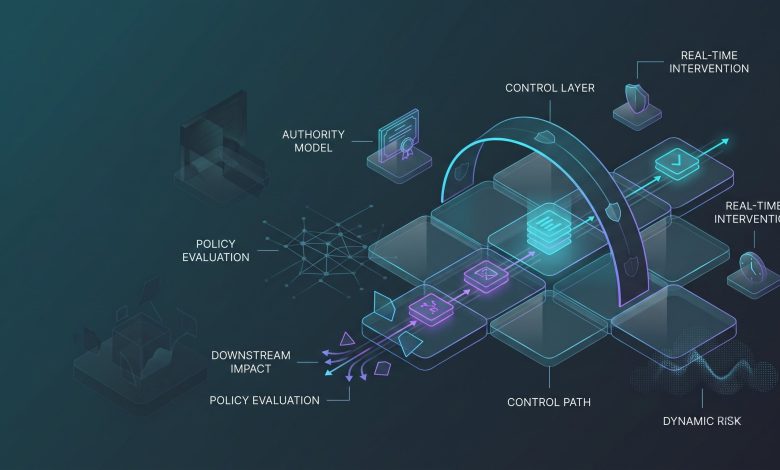
The architectural flow requires an intervention layer. When a user, agent, workflow, or autonomous system initiates an intent, the request must pass through a control layer that can evaluate context, authority, trust posture, and policy before downstream execution occurs.
That control may happen before model invocation, before data release, before tool execution, before workflow transition, or before final enterprise action. The essential point is the same: control must sit in the execution path, not outside it.
Trust Posture Management treats AI risk as dynamic. It continuously evaluates the health, reliability, authority, compliance alignment, cost posture, drift, and business impact of every active model, agent, and workflow.
Traditional AI oversight asks:
Is this system safe to deploy?
Trust Posture Management asks continuously:
Is this action safe, allowed, useful, and provable right now?
The Trust Posture Management Framework: Control, Discover, Prove
A mature Trust Posture Management strategy is built on three connected pillars.
-
Control Runtime Execution
The first pillar is runtime control.
Every prompt, tool call, retrieval request, API call, workflow action, sub-agent command, model-routing decision, and output must be evaluated within a policy-defined latency budget. If a system cannot intercept an AI action in motion, it is not a control mechanism. It is an observability mechanism.
Runtime control requires more than keyword filtering or prompt screening. It requires a live authority model that understands the following:
Which AI system is acting
Which user, workflow, or agent initiated the action
What authority the AI system holds
What tools and data are involved
What policies and enterprise boundaries apply
What the current trust posture is
What the downstream impact could be
Whether the action should be allowed, modified, escalated, degraded, blocked, quarantined, or suspended
This is where enterprise AI becomes controllable.
A mature control layer must be able to translate corporate, regulatory, and operational requirements into runtime-enforceable controls. These controls may reflect internal data policies, sector-specific requirements, the NIST AI Risk Management Framework, the European Union AI Act, contractual obligations, financial thresholds, privacy rules, or business-specific escalation paths.
The output is not a static policy document. It is an executable boundary around AI behavior.
Control is what prevents AI from becoming unbounded authority.
-
Discover Value and Risk
The second pillar is autonomous discovery.
Control alone prevents harm. Trust Posture Management goes further by continuously discovering where AI systems create value, waste value, or introduce hidden enterprise risk.
This includes two discovery paths.
The first is operational discovery. It identifies issues in how AI systems operate: drift, runaway loops, excessive model usage, tool misuse, authority expansion, latency spikes, policy pressure points, escalation patterns, control gaps, and cost anomalies.
The second is economic discovery. It identifies what value AI can create or protect inside business workflows: revenue leakage, payment integrity issues, process bottlenecks, forecast distortions, operational waste, underperforming workflows, missed savings, and previously unknown sources of enterprise value.
This is not dashboarding. It is not reporting. It is not ordinary analytics.
Trust Posture Management turns enterprise AI into a controlled discovery system. It can surface unknown unknowns, generate hypotheses, challenge them through multi-agent reasoning, validate evidence, and determine whether a discovery is novel, causal, material, and admissible before it moves toward action.
The goal is not simply to stop bad AI behavior. The goal is to turn autonomous AI into a measurable source of enterprise impact.
-
Prove Outcomes
The third pillar is proof.
Proof is what turns AI control from policy intent into operational evidence.
Enterprises need a defensible record of:
What action was attempted[
Which AI system attempted it
Which user, workflow, or agent initiated it
What tools, data, systems, and policies were involved
What the AI system was allowed to do
What decision was made
Why the action was allowed, blocked, changed, escalated, or suspended
What evidence supported the decision
What outcome occurred
What value was created, protected, or lost
Without this evidence layer, organizations are left relying on fragmented logs, manual explanations, and post-incident reconstruction.
With it, executives, auditors, security leaders, AI platform teams, legal teams, and business owners gain a shared system of record for AI behavior and AI impact.
Proof is also what enables scale. Boards do not approve higher-autonomy AI because a dashboard looks clean. They approve it when the organization can demonstrate that AI systems are bounded, controlled, measured, and producing evidence continuously.
Why Static Guardrails Are Not Enough
The first generation of AI controls focused on prompts and outputs. That made sense when AI systems primarily generated text for human review.
Agentic AI breaks that model.
Agents do not merely generate responses. They plan, retrieve, reason, call tools, delegate to other agents, update systems, and execute workflows. Risk often emerges not from one bad prompt, but from a sequence of individually acceptable actions that combine into an unacceptable outcome.
A customer service agent may be allowed to read a customer record. It may also be allowed to issue a credit. It may be allowed to summarize a policy. But should it issue a credit after a manipulated retrieval result, during an abnormal session, using an unusual tool chain, above a certain threshold, without human approval?
That is not an output-filtering problem. It is a runtime authority problem.
Static guardrails check isolated execution points. Trust Posture Management evaluates behavior across time, tools, agents, policies, authority, and business context.
The Business Case for Runtime Control
Shifting enterprise AI investment from passive observability to active runtime control yields direct operational advantages.
A global Sinch study of more than 2,500 senior decision-makers found that 74 percent of enterprises had rolled back or shut down a deployed AI customer communications agent due to a governance failure. That rate rose to 81 percent among organizations with fully mature governance frameworks. [2] The lesson is not that enterprises should slow AI adoption. The lesson is that production AI exposes failure modes that monitoring and static review cannot prevent.
Gartner has also found that organizations deploying AI governance platforms are 3.4 times more likely to achieve high effectiveness in AI governance than those that do not. [3] The market direction is clear: enterprises are moving from voluntary AI principles toward operational systems that can continuously manage AI risk, compliance, and accountability.
Runtime control changes the economics of AI deployment.
It can reduce avoidable model spend by applying routing, caching, compression, loop limits, model-selection policies, and cost ceilings. It can reduce operational risk by preventing unsafe actions before impact. It can reduce audit burden by producing continuous evidence. It can accelerate production approval by giving AI, security, risk, legal, and business teams a shared control plane.
Most importantly, it can increase confidence to deploy higher-autonomy systems.
True control does not throttle innovation. It creates the structural stability required to scale it.
The Boardroom Mandate
Chief executives can no longer accept retrospective reports as a substitute for real-time control.
As AI systems become operational actors, the legal, financial, and reputational responsibility for algorithmic failure will not sit with the model. It will sit with the enterprise that deployed it.
Observability provides the data to understand your AI stack. Trust Posture Management provides the authority to control it.
As AI moves from isolated tools to agent infrastructure, enterprises need more than dashboards, logs, and post-incident reports. They need a live control, discovery, and proof layer that determines what AI is allowed to do, discovers where AI can create measurable value, and records the evidence that it stayed within bounds.
The mandate is clear:
Control execution. Discover value. Prove outcomes.
That is how enterprises turn autonomous AI from autonomous risk into controlled, measurable impact.
Manoj Saxena is the Founder and CEO of Trustwise, an enterprise AI safety and control platform. He previously served as the first General Manager of IBM Watson and is the Executive Chairman of the Responsible AI Institute.
Source Notes
[1] IDC projects more than one billion actively deployed AI agents worldwide by 2029, roughly 40 times more than in 2025.
[2] Sinch’s AI Production Paradox report found that 74 percent of enterprises had rolled back or shut down a deployed AI customer communications agent due to a governance failure, rising to 81 percent among organizations with fully mature governance frameworks.
[3] Gartner reported that organizations deploying AI governance platforms are 3.4 times more likely to achieve high effectiveness in AI governance.