The enterprise AI boom has created a massive new line item for corporate finance teams: token spend. But as companies route billions of prompts through models built by OpenAI, Anthropic, and Google, a costly problem is emerging behind the scenes. No one is entirely sure if the bills are accurate.
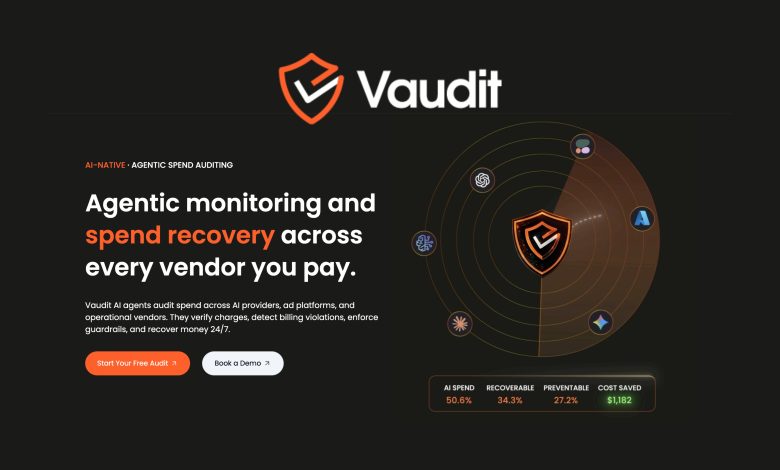
Enter Vaudit, a San Francisco-based startup that wants to bring standard financial auditing to the murky world of artificial intelligence infrastructure. This week, the company is launching TokenAudit, a new tool designed to independently verify AI usage against provider invoices, and automatically help enterprises recover cash when they are overcharged.
The scope of the problem is surprisingly large. Vaudit says that since quietly rolling out the service in March, it has analyzed $34 million in AI spending across 60 enterprise customers. In just that small sample, the platform identified nearly $1.7 million in mistaken overcharges. More importantly for CFOs, Vaudit was able to get roughly 80% of that money credited back by cloud platforms and model providers.
Worldwide AI spending is projected to reach $2.59 trillion in 2026, up 47% year over year, with AI infrastructure expected to account for more than 45% of total spend, according to Gartner.
“What we are observing is that enterprise AI billing has become increasingly opaque,” Michael Hahn, founder and CEO of Vaudit, said. “Customers often don’t have independent visibility into which model actually handled a request, how it was routed, or whether it was cached, retried, or deduplicated before it showed up on their bill.”
The issue stems from how AI usage is currently tracked. Unlike traditional SaaS seats or simple cloud storage, generative AI is billed dynamically based on compute and token volume. Each vendor calculates this usage internally, effectively grading its own homework.
As enterprises scale up their AI adoption, engineering architectures are becoming vastly more complex. Companies are using multiple model providers, experimenting with different model weights, and routing requests through cloud hyperscalers like AWS Bedrock, Google Vertex, and Microsoft Azure (which Vaudit notes handle roughly half of the billing decisions it currently reviews).
This complexity has given rise to a phenomenon Vaudit calls “tokenmaxxing”, where agentic loops, prompt bloat, and poor routing quietly drive up costs without triggering internal alarms.
Through its early pilot programs, Vaudit’s software pinpointed five recurring billing errors draining enterprise budgets:
-
Model bait-and-switch: Customers being billed at premium rates (e.g., GPT-4 class) for cheaper or older model usage.
-
Ghost prompts: Requests that returned no output but were billed anyway.
-
“Retry storms”: Scenarios where autonomous AI agents repeat failed requests in a loop, racking up massive duplicate charges.
-
Outage billing: Charges that continued to accrue even when a provider’s API was down.
-
Orchestration errors: Cloud platforms accidentally sending the exact same request to two models simultaneously and billing for both.
To catch these discrepancies, Vaudit requires customers to install a lightweight SDK directly inside their AI environment. This allows the startup to capture raw, ground-truth usage data, reconcile it against incoming invoices, and automatically flag mismatches.
When clear-cut errors are presented to providers like Azure, AWS, or OpenAI, Vaudit notes that credits are typically issued within 48 to 96 hours.
“We had no idea how much of our AI spend was going unchecked until we ran our first audit,” an engineering executive at a Fortune 500 Vaudit customer said in a statement. “TokenAudit gave us visibility into our billing that we didn’t have before, and it paid for itself within the first audit cycle.”
For Hahn, who founded Vaudit in 2023, the pivot to AI tokens is a natural evolution. He previously built and scaled companies in ad-tech and revenue operations, industries infamous for their complex, hard-to-verify vendor costs. Vaudit originally launched to audit enterprise ad-spend and general SaaS sprawl. To date, the company claims its platform has audited more than $1.2 billion in total vendor spend and recovered over $50 million for a client roster that includes Panasonic, HP, and Honda.
As AI agents become more autonomous and token usage scales exponentially, the days of finance teams simply trusting a vendor’s dashboard may be over. TokenAudit is currently available for enterprises looking to put guardrails around their AI budgets, with free initial audits available through the company’s website.
Try today at https://www.vaudit.com/.