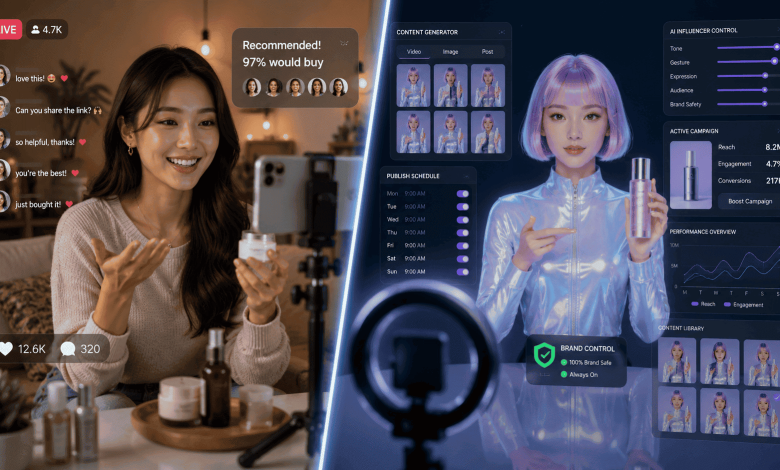
A growing number of brands are launching their own AI influencers. The pitch is appealing. Full creative control, no scheduling conflicts, infinite content capacity, a fixed cost structure, and a launch announcement that doubles as its own press event. From the outside, it looks like the same channel as creator marketing, just with the messy human part removed.
It isn’t. And the longer the industry treats AI influencers as a substitute for human creators, the more budget will be misallocated against the wrong problem.
After six years working in influencer marketing across regions including LATAM, MENA, and APAC, I’ve watched the channel evolve through plenty of identity crises. This one is different because the confusion is structural rather than tactical. Brands aren’t choosing between two versions of the same tool. They’re choosing between two different tools that happen to share an aesthetic, and pricing them against each other on metrics built for only one of them.
What influencer marketing actually is
Influencer marketing works for one reason. An audience has built a relationship with a person over time, and a portion of that relationship transfers to whatever that person endorses. The mechanism is trust, not visibility. The creator’s taste, consistency, opinions, off-camera life, controversies, and even their imperfections are all part of the asset. Audiences are not buying the content. They are buying the implicit recommendation of someone they have decided is worth listening to.
This is why a follower count alone never predicted campaign success. It’s why micro-creators can outperform mega-creators in conversion. It’s why the same celebrity can boost one brand and barely move the needle for another. The trust transfer only fires when the endorsement feels consistent with who the audience believes the creator to be.
Now strip the human out of that equation. What remains?
What AI influencers actually are
What remains is a branded content asset with a face. It can generate awareness, novelty press, and a wave of “did you see what that brand did” conversation. Those are real outcomes. They are just outcomes from a different channel.
AI influencers behave like brand-owned social media marketing executions. The brand controls the message end to end, the visual identity is consistent across every post, and the output scales with whatever production capacity the brand wants to put behind it. The metrics that come back, impressions, mentions, sentiment of news coverage, are the metrics of brand-owned social, not creator-driven influence. AI avatars belong in the social media marketing column. They do not belong in the influencer marketing column.
The audience knows this, often before the marketers do. Even users who enjoy AI influencer content rarely describe themselves as fans of the avatar in the way they describe themselves as fans of a human creator. They follow the novelty. They engage with the spectacle. They don’t build the kind of parasocial relationship that powers trust transfer. And without that relationship, the campaign produces reach without endorsement weight.
The measurement trap
This category mistake has a concrete cost. When brands evaluate an AI influencer activation against a human creator campaign using the same metrics, they’re comparing two assets that were built and priced in fundamentally different ways. The CPM of an AI avatar is artificially low because it doesn’t price in what human creators are actually paid for: accumulated audience trust, off-camera reputation, and the implicit endorsement weight that takes years to build.
A brand can match a human creator’s CPM with an AI avatar. It cannot match the trustworthiness, because trustworthiness isn’t a line item AI campaigns can buy. The moment AI avatars and human creators land on the same campaign report side by side, the AI numbers look stronger and the human numbers look expensive, when in reality they are measuring different things. Brands making this comparison and adjusting budgets accordingly are quietly weakening the channel they think they’re optimizing.
This gap is even wider in markets where creator trust is built on tight community ties. In LATAM, MENA, and parts of APAC, audiences treat creators less as media personalities and more as community-embedded voices. An AI avatar shipping branded content into that environment is read as exactly what it is, an ad with a face. The category gap between AI content and creator influence is largest precisely in the markets where the channel is growing fastest.
Where AI is genuinely useful in this work
The category confusion around AI influencers tends to obscure what AI is actually doing well inside influencer marketing right now. The honest answer is that it has quietly become essential at the workflow layer.
Creator discovery has gone from a guessing game to a structured search. Tools surface candidates by audience overlap, brand fit, and historical performance in seconds rather than weeks. First-pass vetting of vanity metrics, fake followers, bot engagement, and suspicious growth patterns is now AI’s job, not a junior analyst’s. Brief drafting, content scripting, and post-campaign reporting have all been compressed in time.
What’s coming next, and what I think will matter most over the next year, is sentiment analysis at the content level. Not just measuring how many people watched a creator’s video, but understanding what the video was actually about, what tone it struck, and how the audience emotionally responded in the comments. The brands that figure this out first will be able to evaluate creator content with a depth that simply wasn’t operationally possible before.
The fix is a category fix
What the industry needs is not a verdict on AI influencers. It is a category fix. Treating AI avatars as creator partnerships will keep producing reporting decks that look defensible and outcomes that quietly underperform. Treating them as what they are, brand-owned social media marketing assets with a face, gives them a fair test on metrics they can actually win on.
The CPM comparisons stop. The trustworthiness expectations stop. And the channel goes back to being about what it has always been about: who gets to make the recommendation, and whether the audience believes them.