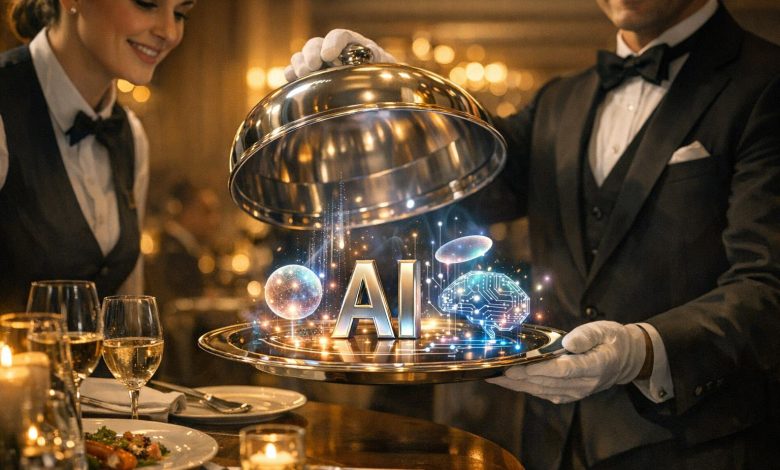
The culinary world is currently undergoing a silent revolution. For decades, the restaurant industry has been built on a simple premise that people return not just for food and atmosphere, but also for the human experience. Hospitality has depended on the personality and creativity of seasoned chefs, bartenders and operators, rather than algorithms. That may be changing.
Artificial intelligence has slipped on an apron and is now disrupting the industry. From drafting menus, generating images, functioning as the social media team, handling reservations, and modifying orders, to machine learning algorithms optimizing supply chains, GenAI is no longer a futuristic concept but rather a functional ingredient in modern restaurant operations.
However, this secret sauce comes with both compliance requirements and liability risks that operators must be cognizant of. Operators must look at how they can adopt GenAI for efficiency while navigating emerging legal, regulatory, reputational and ethical risks.
Intellectual Property: Who Owns the Recipe and the Authenticity?
One of the first questions GenAI raises in this creative industry is also one of the most unsettling: if a machine helps write the menu, who owns the menu? Under current U.S. Copyright Office guidance, the answer may be “nobody.” Current U.S. Copyright Office guidance maintains that copyright protection requires human authorship. The court has also been consistent on this point. In Thaler v. Perlmutter, a federal court held that the Copyright Act requires works to be authored by a human being and the Supreme Court declined to revisit that conclusion in March 2026.
Furthermore, there is the “input risk” associated with using GenAI for creative endeavors. If a restaurant’s GenAI tool was trained on proprietary recipes from competitors without authorization, then using that output could expose the brand to claims of trade secret misappropriation or infringement. There has been a significant increase in trademark lawsuits, where sophisticated detection systems are used by lawyers and their staff to find GenAI uses of copyrighted or trademarked materials, often unknowingly used. Because of the heavy statutory fines and legal fees that can be associated with such violations, these lawsuits can often rearrange a restaurant’s balance sheet overnight.
Authenticity Does Not Scale and Guests Know it
There is a subtler risk that does not appear in any legal code but may prove just as consequential. Restaurants often trade on authenticity and craftsmanship as defining characteristics. Customers are increasingly able to identify GenAI in the marketplace. Where a cocktail menu appears to come from an experienced veteran bartender or the restaurant’s social media team, expressing the voice of the operator, customers feel the authenticity and connect with the brand. When messaging becomes overly curated and automated through GenAI, consumers notice and feel removed from the personal experience that is typically offered.
This does not mean GenAI has no place in guest-facing communications. It means the guardrails matter as much as the tools. Using GenAI to assist a brand identity is different than replacing it entirely. The former amplifies what makes a restaurant distinctive. The latter produces content that feels like it was written by a well-read robot.
Hiring by Algorithm: Efficient, Yes. Bulletproof, No.
High-volume hiring is one of the more compelling GenAI use cases in hospitality, capable of screening hundreds of applicants, optimizing shift scheduling, flagging coverage gaps before they become problems. The efficiency gains are real. So are the legal risks.
While efficient, these tools can inadvertently mirror historical biases present in their training data. Under Title VII of the Civil Rights Act, if a GenAI tool disproportionately filters out candidates based on protected characteristics, the restaurant, not the software vendor, is often the primary target for a disparate impact claim. Regulators are paying attention. There has been an increase in jurisdictions that require bias auditing, such as California, New York, Colorado, Illinois and Europe. It is anticipated that many other jurisdictions will join in adding these stringent requirements.
Guests’ Data has Legal Opinions About Itself
Modern Point of Sale (POS) systems integrated with GenAI can predict a customer’s “usual” and suggest upsells. However, the collection of this biometric or behavioral data triggers stringent requirements under the Federal and State laws. Restaurants must ensure their privacy policies explicitly disclose GenAI data processing and comply with both federal and state laws in what data they are collecting, storing and perhaps sharing with third-party vendors.
The Contract is the Operator’s Mise en Place
Successful restaurants having “everything in place” before service begins is known as “mise en place”. It is the difference between a smooth evening and chaos. The same can be true for adoption of GenAI.
Before integrating GenAI, the most critical step is the vendor contract. Most standard “Terms of Service” favor the developer. Restaurants must negotiate for robust indemnification clauses, ensuring the vendor takes responsibility if the GenAI produces infringing content or violates privacy laws. Without these protections, a restaurant stands alone in a high-stakes litigation environment. In an industry with such thin margins, restauranteurs must protect themselves at all costs.
The Final Course
GenAI can streamline restaurant operations, elevate guest experiences, and improve margins, but only with disciplined oversight. Start small, choose reputable vendors, build human checks around high-risk use cases, and paper those relationships with clear contracts. A thoughtful governance program will let restaurants capture the upside while keeping legal and operational risks in check.
Despite the operational sophistication GenAI offers, the restaurant industry remains fundamentally relationship driven. Customers return to restaurants because they trust and enjoy the experience being offered to them. That trust may become increasingly important as GenAI quietly reshapes hospitality behind the scenes. Consumers may tolerate GenAI-assisted inventory systems, reservation management, or operational forecasting. They may be less comfortable if they perceive hospitality itself becoming overly automated, synthetic, or impersonal.
The legal risks surrounding GenAI in restaurants will continue evolving. But many of the most immediate challenges may not arise from statutes or regulations alone. They may instead stem from reputational expectations surrounding authenticity, transparency, and consumer confidence. For restaurant operators, the long-term competitive advantage may not belong to businesses that use the most GenAI. It may belong to those that integrate GenAI thoughtfully while preserving the distinctly human experience that hospitality has always promised.